
Local service guide
Fremont gardening: Hiring and Project Planning
Arrange gardening in Fremont by separating routine upkeep, a one-time cleanup, and planting or irrigation changes in your quote request. Ask the gardener to price each part and identify who buys materials and removes debris. If you want ACWD’s lawn-conversion rebate, obtain its Notice to Proceed before anyone removes the lawn. [1]
Define the work before comparing gardeners
Walk through the garden and describe the result you want in each area: weed the planting beds, trim named shrubs, remove fallen leaves, replace selected plants, or inspect irrigation. Mark plants you want to keep. Tell the gardener whether you want hand weeding and whether any treatment needs your approval before use.
For recurring care, agree on the tasks included in each visit and how the gardener will handle unfinished work. Ask for a separate cleanup quote if you want accumulated weeds, cuttings or overgrowth removed before maintenance begins. Include gate access, parking, pets, available water and the destination for garden waste in the written scope.
Ask candidates for proof of liability insurance and examples of similar planting or irrigation work. If the proposal expands into construction, major tree work or chemical treatment, ask who will perform that work and what authorization they hold. Avoid treating a general maintenance quote as approval for additional work.
Compare quotes with the same scope
Request separate amounts for labor, plants, mulch, irrigation equipment, delivery and debris removal. For hourly work, agree on a spending limit and a point when the gardener must check with you before continuing. For a fixed quote, list exclusions and require your approval for substitutions or added tasks.
For planting, ask for plant names, quantities, container sizes and proposed locations. Agree on who will water new plants between visits and who will adjust the irrigation schedule. For mulch, ask the gardener to state the coverage area, depth and material rather than quoting an unspecified delivery.
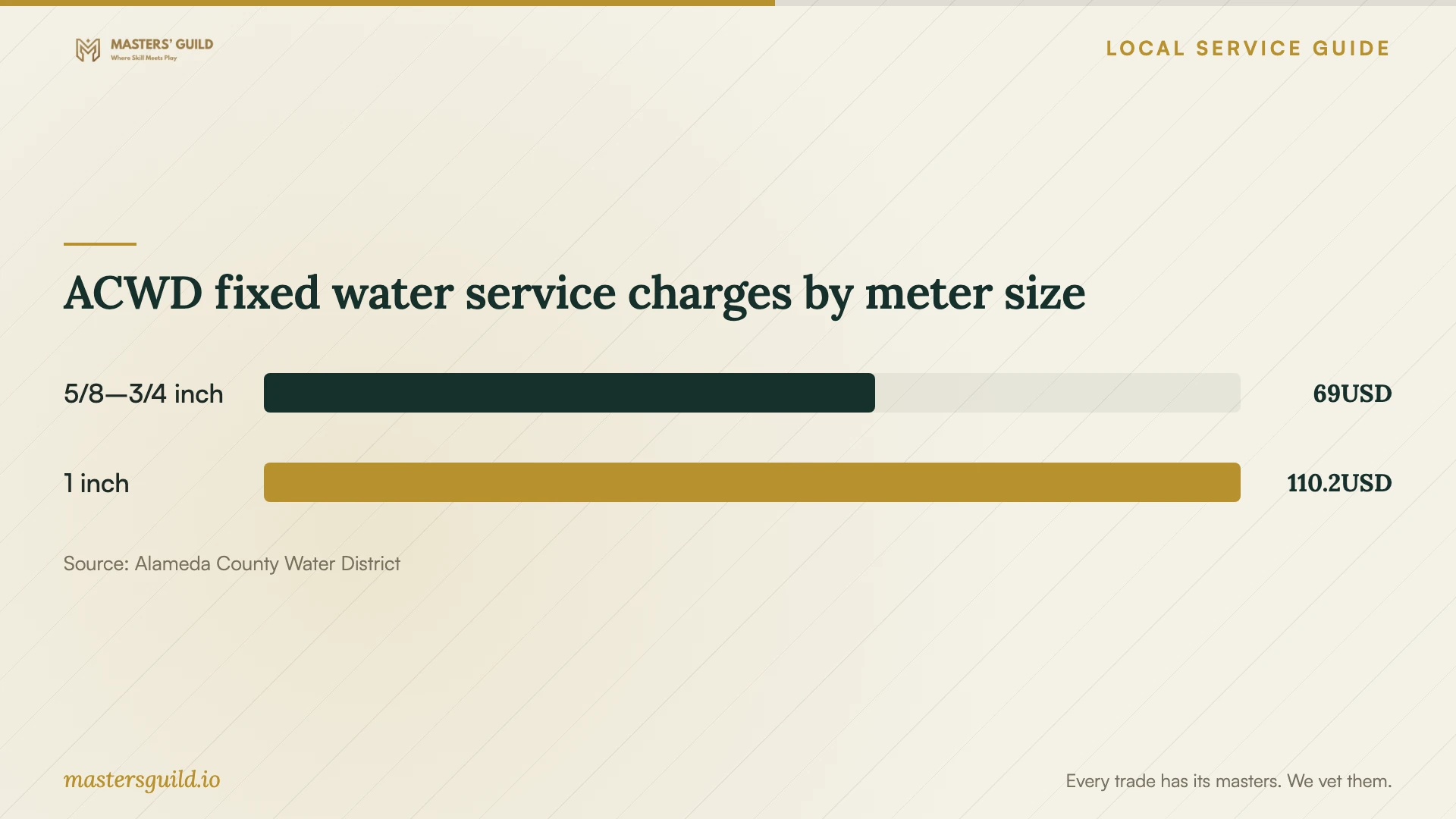
The utility figures below describe water service costs, not gardener prices. ACWD’s rates effective March 1, 2026 include a $68.95 charge every two months for a 5/8- or 3/4-inch meter, plus $5.38 per consumption unit inside the district. Each unit equals 748 gallons. Reducing irrigation use affects the consumption portion; the fixed service charge does not vary with consumption. [3]
Sequence a lawn conversion around ACWD approval
If you plan to seek the single-family lawn-conversion rebate, arrange planning before lawn removal. ACWD requires a Water Conservation Q&A session, an application and a pre-conversion inspection before issuing a Notice to Proceed. The application asks for lawn measurements, six existing-area photos, a proposed plant list and a project plan with labeled components. [1]
Ask the gardener to design against the rebate requirements before ordering materials. ACWD requires low-water plants that provide at least 50% coverage at maturity and at least three inches of mulch in planting areas. It excludes artificial turf, impermeable surfaces and traditional plastic or polypropylene weed cloth from the converted area. [1]
Include irrigation changes in the same proposal. ACWD does not require an irrigation system in the converted area, but it excludes overhead sprinklers there. An existing sprinkler system must be removed, capped or converted to low-volume drip. If you retain part of the lawn, ACWD requires a separate valve for the converted area and sprinkler adjustments that keep spray off it. [1]
Specify irrigation repairs and a usable handover
Before buying a weather-based controller, ask the installer to inspect the existing system and identify repairs. ACWD’s controller rebate requires compatibility with a WaterSense-labeled weather-based controller and a well-maintained system without line breaks, pressure problems or broken spray heads. [2]
Ask the installer to label zones, demonstrate manual operation and explain the settings for each planted area. Decide who will monitor watering after installation and who will handle later adjustments. Request the model information, receipt and photographs before closing out the job.
ACWD offers eligible single-family customers up to $100 plus tax toward the qualifying controller. Submit the application within 90 days of installation, with the receipt and installed-controller photos showing the WaterSense label. ACWD excludes installation, programming, delivery, shipping and ongoing service costs, and it does not guarantee lower water use or bills. [2]
ACWD fixed water service charges by meter size
Local details that affect your job
Keep the existing lawn until ACWD authorizes removal
ACWD requires the lawn to remain present for pre-inspection, even if it is unhealthy or no longer irrigated. The usual minimum conversion area is 200 square feet; ACWD will consider smaller projects that eliminate all front or publicly visible lawn. After the Notice to Proceed, you have 120 days to finish. Put that approval dependency and completion deadline in the gardener’s schedule. [1]
Use separate application schedules for the two rebates
The lawn-conversion program requires approval before work starts, while the controller program requires an application within 90 days after installation. For either project, check funding before committing your budget: ACWD describes both programs as first-come, first-served with funding limits. Its Water Conservation team lists 510-668-4218 for program questions. [1] [2]
Choose the scope to request
| Your goal | Request in the quote | Planning step |
|---|---|---|
| Routine upkeep | Named beds, shrubs and cleanup tasks, plus visit frequency | Agree on how to approve extra work |
| One-time garden reset | Initial cleanup, plant protection and debris removal | Review the result before arranging recurring visits |
| Rebate-supported lawn conversion | Planting plan, mulch, irrigation changes and itemized materials | Obtain ACWD’s Notice to Proceed before lawn removal |
| Weather-based controller upgrade | System inspection, repairs, eligible controller and programming | Submit the ACWD rebate application within 90 days of installation |
Your hiring checklist
- Photograph the work areas and mark plants to keep or remove.
- List recurring tasks separately from the initial cleanup and new planting.
- Request itemized labor, materials, delivery and debris-removal charges.
- Agree on access, waste handling and approval for extra work.
- Assign responsibility for watering new plants and adjusting irrigation.
- For a rebate project, confirm ACWD requirements before setting the start date.
- Keep receipts, plant lists, equipment details and completion photos.
Frequently Asked Questions
How should I compare gardening prices?
Give each gardener the same task list and ask whether the quote covers the initial cleanup, materials and waste removal. Compare the total for that scope. For hourly work, agree on a spending limit and require approval before the gardener exceeds it.
Will ACWD reimburse the gardener’s labor for lawn conversion?
No. ACWD excludes labor and delivery fees and limits payment to eligible material spending, up to the approved rebate amount. Ask for itemized invoices and retain receipts for plants, irrigation equipment and other eligible materials. [1]
Can I replace lawn with artificial turf and claim the rebate?
ACWD excludes artificial turf from its lawn-conversion rebate. Its program requires low-water planting with at least 50% plant coverage at maturity. Have the gardener prepare a qualifying plant list and plan before submitting the application. [1]
Does a smart controller guarantee a lower water bill?
ACWD states that a WaterSense-certified weather-based controller does not guarantee reduced water use or bills. Its rebate requires a compatible, well-maintained irrigation system. Ask the installer to check repairs and explain how you should monitor the controller. [2]
Sources and scope
This guide combines the sources below with practical planning guidance. Figures apply to the stated geography and period; request a written quote for your property.