
Local service guide
Duct cleaning in Fort Worth, TX: Hiring and Planning
Arrange duct cleaning in Fort Worth after a provider shows you contamination that warrants the work, then compare written estimates for the same system components. EPA recommends cleaning as needed. If the proposal includes HVAC installation, repair or maintenance, verify the contractor’s Texas license and ask which licensed contractor the company employs at its permanent location. [1] [2]
Decide whether cleaning addresses your problem
Start with an inspection rather than a recurring cleaning package. EPA identifies substantial visible mold on hard surfaces, pest infestation and excessive dust or debris as reasons to consider cleaning. Dust on a return grille alone does not establish heavy contamination inside the ducts. You can vacuum or remove and clean an accessible grille. [1]
Ask the provider to show you the affected area and explain the likely cause. An expert may need laboratory analysis to confirm suspected mold. If insulation has become wet or moldy, EPA recommends removal and replacement because cleaning cannot address it. Correct the moisture source before paying for cleaning that could leave the underlying problem unresolved. [1]
Keep expectations specific. EPA reports no demonstrated prevention of health problems from duct cleaning and little evidence that cleaning ducts alone improves HVAC efficiency. Ask a contractor to explain any promised result in terms of the condition found at your home. [1]
Compare the complete scope and price
Request estimates from at least three providers. EPA advises a written agreement covering total cost and scope before work begins. Ask each bidder to identify supply ducts, return ducts, registers and the equipment components they intend to clean. EPA warns that leaving a contaminated component untreated can recontaminate the system. [1]
Give bidders the same description of your concern and ask them to list exclusions. Request separate lines for cleaning, equipment maintenance, duct replacement and chemical treatments. Ask whether the price covers each heating and cooling system at the property, and require your approval before anyone adds work.
EPA’s guidance describes a broad national reference of $450 to $1,000 per heating and cooling system, with variation by scope, size, access and contamination. The guidance carries an October 1997 publication identifier. Treat that figure as background, rather than a current Fort Worth price; use property-specific written estimates to set your budget. [1]
Choose methods suited to your ducts
Ask the cleaner to identify sheet metal, flexible duct and fiberglass sections before selecting tools. EPA recommends controlled brushing with vacuum collection and soft-bristled brushes for fiberglass materials. For indoor vacuum exhaust, EPA specifies HEPA equipment; the alternative is equipment that exhausts particles outside the home. [1]
Request an explanation before approving sanitizers or interior coatings. EPA advises homeowners to understand the benefits and risks of chemical treatments and does not recommend routine encapsulating sealants. Ask for the product label, intended application and reason physical cleaning plus moisture control would not address the condition. [1]
Prepare the appointment and inspect completion
Clear a route to the equipment and registers, move fragile belongings and arrange a place for pets away from the work area. Tell the provider about restricted attic access or rooms that need to remain available. Ask for an estimated work duration and agree on how long the crew expects to interrupt heating or cooling.
Before work starts, agree on photos or a walkthrough of the included components. EPA identifies visual inspection as the best way to verify cleanliness and recommends asking the provider to show each component after cleaning. Check that the crew reattaches registers, closes access openings and demonstrates system operation before you accept completion. [1]
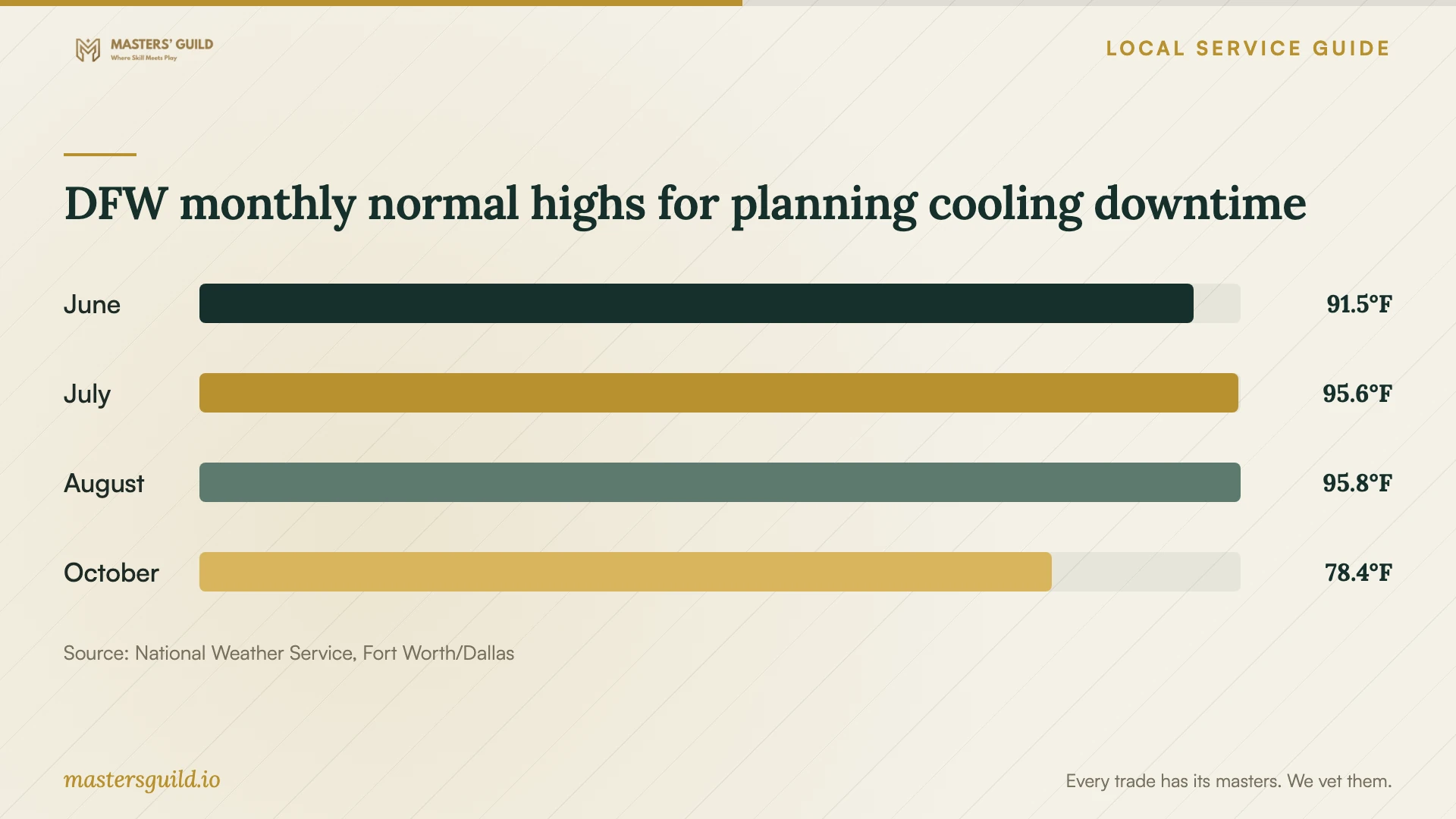
DFW monthly normal highs for planning cooling downtime
Local details that affect your job
Texas contractor check for expanded HVAC work
TDLR requires a license for contractors who install, repair or maintain air-conditioning, refrigeration or heating systems. If your cleaning estimate includes those tasks, ask for the contractor’s name and license number and use TDLR’s Search Licenses option. The supplied regulator overview does not establish the precise licensing boundary for cleaning alone, so do not infer an exemption from it. [2]
Check the company’s permanent location
Texas also requires an air-conditioning and refrigeration company to employ an ACR contractor at each permanent location. For proposed HVAC maintenance or repairs, ask which permanent location will handle your job and which licensed contractor it employs there. This checks the company’s staffing obligation alongside the individual credential. [2]
Choose the next step from the condition found
| Condition | Next step |
|---|---|
| Dust on a return grille alone | Clean the accessible grille; ask for evidence before approving whole-system cleaning. |
| Excessive duct debris or particles leaving supply registers | Request an inspection and comparable written cleaning estimates. |
| Suspected mold or wet insulation | Confirm the condition, correct moisture and discuss replacement of wet or moldy insulation. |
| Quote includes HVAC repair or maintenance | Verify Texas contractor credentials and the company’s staffing at its permanent location. |
Your hiring checklist
- Describe the visible problem and request inspection photos.
- Give each bidder the same system and access information.
- Compare written totals, included components and exclusions.
- For HVAC maintenance or repairs, check the contractor’s Texas license and the company’s permanent-location staffing.
- Approve any chemical treatment as a separate decision.
- Clear access and agree on heating or cooling downtime.
- Review completion photos and system operation with the provider.
Frequently Asked Questions
Should I schedule cleaning every year?
EPA recommends duct cleaning as needed rather than as routine maintenance. Ask for evidence of contamination before accepting a recurring package. Continue filter changes and the equipment maintenance recommended for your system. [1]
Does EPA certify duct cleaners?
No. EPA says it does not certify, endorse or approve duct-cleaning companies. Ask providers about their training, references, procedures and relevant state credentials. [1]
Does duct cleaning include the dryer vent?
Ask the bidder to specify this in writing. Describe dryer-exhaust cleaning as a separate requested task so you can compare its scope and price without assuming the HVAC quote includes it.
How should I plan cooling downtime?
Ask the crew how long it expects to keep your system off and whether it can restore cooling between stages. DFW regional normal highs reach 95.6°F in July and 95.8°F in August. Use the actual forecast and your household’s needs when choosing an appointment. [3]
Sources and scope
This guide combines the sources below with practical planning guidance. Figures apply to the stated geography and period; request a written quote for your property.