
Local service guide
Art instruction in Fort Worth: choosing lessons
Art instruction in Fort Worth should start with your learning goal: ask a private instructor for a lesson plan matched to your medium and experience, or investigate Tarrant County College for structured drawing study. Before committing, compare the full cost, schedule, supplies, and feedback you will receive. TCC lists Drawing I as a three-credit foundation studio course; check current section availability before treating it as a booking option. [2]
Choose a learning goal before choosing a teacher
Write a short description of the result you want: draw objects with convincing proportions, understand color mixing, finish a painting, or receive feedback on an existing portfolio. Include your experience and preferred medium. For a child, add their age and ask the instructor to explain how they would adapt the lesson.
Ask prospective instructors to describe a first lesson for that goal. Request examples of how they explain a technique, watch you practice, and help you correct a mistake. Review their artwork, but also ask about their teaching approach. Decide whether you want demonstrations, guided exercises, critique, or help completing a particular project.
Compare private lessons with TCC drawing study
Use TCC's Drawing I curriculum as a concrete reference when comparing lesson plans. The college describes a foundation studio course that explores descriptive, expressive, and conceptual drawing approaches. The course includes critical analysis and develops students' understanding of drawing as a discipline. Its catalog lists three semester credit hours, two lecture hours, and four lab hours. Check the section timetable for the actual meeting pattern. [2]
Consider that course if you want the described foundation and can accommodate the section schedule. Ask a private instructor for a proposal if you want to focus on a narrower project or arrange lessons around household commitments. Confirm that the instructor can provide the location, format, and timing you need before paying. [2]
TCC's regional arts-and-crafts page lists interests including drawing, oil painting, watercolor, ceramics, and pottery. It directs readers to current schedules and course descriptions and notes that art classes run through academic credit programs. Use that list to investigate offerings, then confirm whether a particular medium has an available class. [3]
Compare the total commitment and cost
Ask a private instructor for a written quote stating lesson length, number of learners, location, and supplies. Request separate amounts for instruction, travel, materials, and any other charges. Ask whether you can book an initial lesson before purchasing a package, and get cancellation and rescheduling terms in writing.
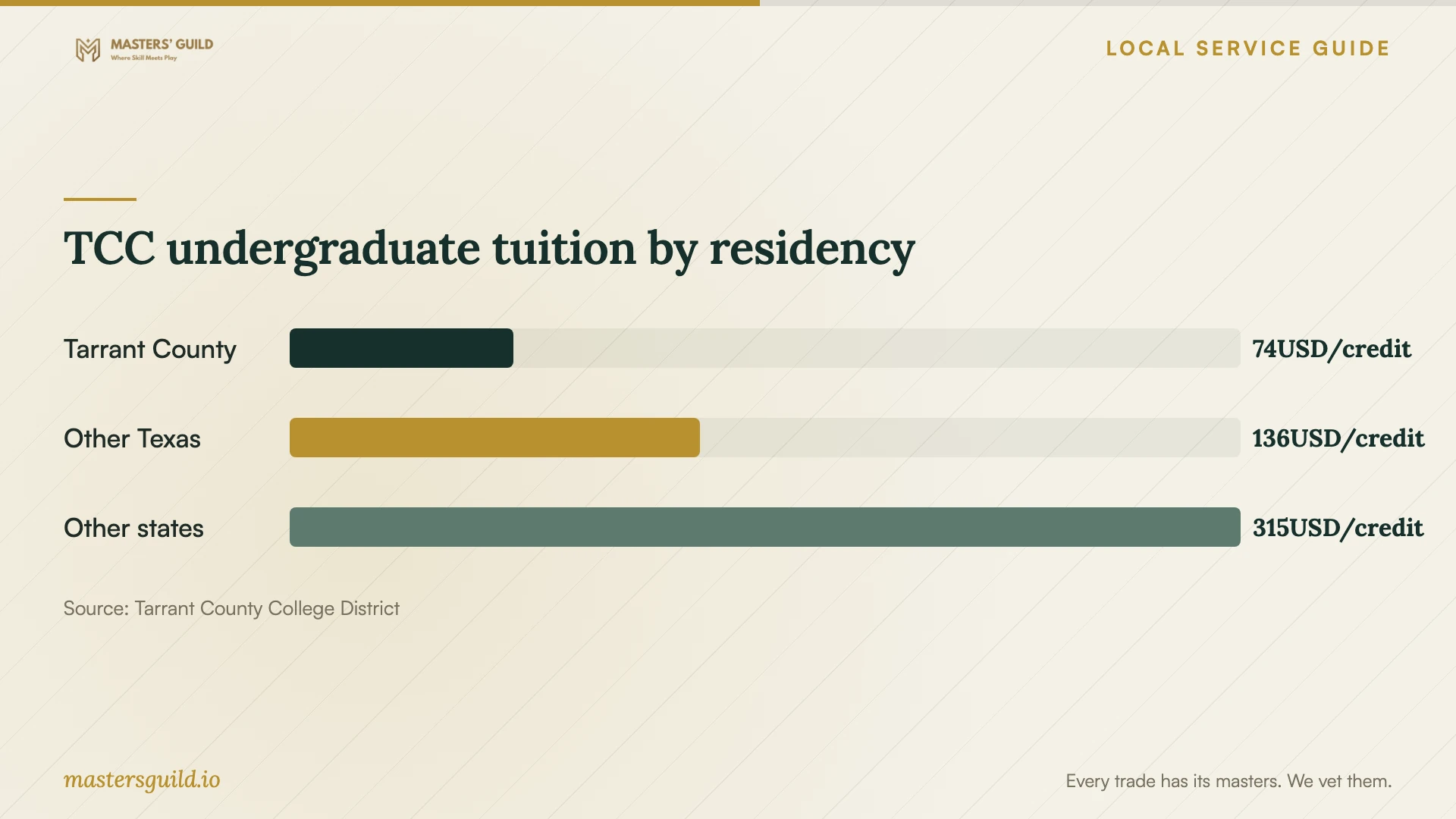
TCC's published Fall 2026 undergraduate rates depend on residency: $74 per semester credit hour for legal Tarrant County residents, $136 for legal residents of other Texas counties, and $315 for legal residents of another state. The college excludes books, supplies, and other materials from those rates and directs students to departments for additional costs. [1]
Use the tuition chart to budget for college credit study. TCC states that continuing-education fees vary by course, so confirm the fee for your chosen class before making a comparison. Add required materials to each quote or course budget and check the scheduled instruction time. The college's tuition rates do not establish private-lesson prices. [1]
Agree on the lesson setup and feedback
For lessons at home, describe the available table, lighting, cleanup area, and storage space. Ask the instructor to approve the setup for the planned medium and explain any material-handling needs before you buy supplies. Agree on who protects surfaces and handles cleanup.
For a child's lesson, confirm supervision, parent attendance, pickup arrangements, and how the instructor will share progress. For your own study, agree on how you will review practice work between lessons. Ask what you should bring to the next session and how the teacher will decide whether to repeat a skill or move forward.
After an initial lesson, assess whether you understood the explanation and received feedback you could use. Discuss any mismatch before booking more sessions. Keep examples of your work so you and the instructor can compare progress against the goal you agreed on.
TCC undergraduate tuition by residency
Local details that affect your job
Confirm Tarrant County tuition residency
For the regional public-college option, TCC asks students to declare their proper residency status through its Admissions and Registrar Office. Its Fall 2026 table distinguishes Tarrant County residents from residents of other Texas counties. Confirm your classification with that office before budgeting for a credit course. [1]
Check the right TCC registration route
TCC's Drawing I catalog entry directs students to MyTCCTrack for course availability. Its arts-and-crafts page directs personal-enrichment readers to Instant Enrollment and course-specific descriptions, while noting that art classes run through academic credit programs and seats are limited. Check which route applies to your chosen class, along with campus, dates, and available seats, before arranging transport or buying materials. [2] [3]
Choose a route to investigate
| Your goal | Route to investigate | Confirm before committing |
|---|---|---|
| Foundation drawing study | TCC Drawing I, a three-credit studio course | Current section availability, meeting schedule, and supplies |
| Help with a specific artwork | Ask a private instructor for a project-focused proposal | Relevant teaching examples, feedback method, and total quote |
| Explore a different medium | Check TCC's arts-and-crafts listings and current schedule | Whether the medium has an available class and which registration route applies |
| Arrange lessons at home | Ask instructors whether they offer home visits | Travel charge, workspace needs, cleanup, and cancellation terms |
Your hiring checklist
- State the learner's medium, experience, and desired result.
- Ask the instructor to outline a first lesson and explain their feedback approach.
- Confirm learner age suitability, supervision, and parent attendance when relevant.
- Request a written total covering instruction, supplies, travel, and other charges.
- Agree on location, workspace preparation, cleanup, and material storage.
- Read cancellation, rescheduling, and package terms before paying.
- For college study, confirm residency, section availability, timetable, and required materials.
Frequently Asked Questions
How much should I budget for private art lessons?
Request quotes for the same medium, lesson length, learner count, and location. Ask each instructor to include supplies, travel, package commitments, and cancellation charges. Compare the complete amounts and the instruction each teacher proposes before choosing.
Can I use TCC's per-credit rate for a watercolor workshop?
Check the actual course listing first. TCC states that continuing-education fees vary by course, while its arts-and-crafts page lists watercolor among its interests and directs readers to schedules and course descriptions. Confirm the class type and fee before budgeting. [1] [3]
Does Drawing I focus on one drawing technique?
TCC describes Drawing I as a foundation course using diverse materials and techniques, with descriptive, expressive, and conceptual approaches. If you want instruction in a specific technique, ask whether the course covers it or request a focused plan from a private instructor. [2]
Should I buy supplies before booking?
Ask for the instructor's or course's required supply list first. Confirm which materials the teacher provides, which you must buy, and whether you can use what you own. For TCC undergraduate study, budget beyond tuition because the published rates exclude books, supplies, and other materials. [1]
Sources and scope
This guide combines the sources below with practical planning guidance. Figures apply to the stated geography and period; request a written quote for your property.