
Local service guide
Arrange pest control in Fargo, ND
Arrange pest control in Fargo by requesting an inspection, the proposed applicator’s certification details, and a written treatment and follow-up plan. NDSU advertises an applicator search, but its page showed an application error when retrieved; do not treat an unsuccessful search as verification. For suspected bed bugs, seek professional help and entomologist confirmation because NDSU identifies regional bat bug and swallow bug lookalikes. [1] [3]
Check the proposed applicator’s credentials
Ask who will apply pesticides and request that person’s certification information before scheduling. Request proof of liability insurance as a separate document. Keep the company’s contact details and identify who will answer questions after the visit.
NDSU’s applicator database advertises searches by name or ID and lists filtered by commercial or private status, county, certification category and expiration date range. However, the page retrieved on October 14, 2026, also displayed an application error. These advertised options do not establish that searches currently work. [1]
If the search fails, request the provider’s certification documentation and ask NDSU Extension how to confirm its status and suitability for the proposed work. The North Dakota Department of Agriculture identifies NDSU Extension as the state’s pesticide certification and training administrator. Ask whether the program can help resolve a discrepancy; do not assume it offers a documented credential-dispute service. [2]
Identify the insect before choosing treatment
Send photographs, affected-room details and a timeline of sightings. Ask how to preserve a specimen for identification. Include observations around the attic or roof, and describe any treatment you have already attempted.
NDSU recommends entomologist confirmation of bed bug identifications because bat bugs and swallow bugs look similar. Its regional guidance links bat bugs with bats roosting in homes, probably in attics, and explains that swallow bugs can enter after birds leave their nests. Discuss those possible host areas before approving treatment limited to a bedroom. [3]
For suspected bed bugs, NDSU describes mattress seams, box springs, bed frames and cracks as inspection areas. Its guidance identifies rusty fecal spots, eggs and shed skins as signs to examine. Show the inspector your findings and request identification before selecting a treatment. [3]
Get a quote for the complete treatment plan
Get an inspection-based quote for your Fargo home. Request the target pest, included rooms, treatment method, preparation duties and total price in writing. Ask the provider to separate optional work and explain charges for monitoring, return visits, sealing or repairs.
For bed bugs, NDSU recommends combining nonchemical and chemical strategies. It identifies insecticide resistance, missed hiding places, inadequate preparation and migration from nearby apartments as possible reasons for unsuccessful control. Ask the provider how the proposed plan addresses the conditions found during your inspection. [3]
Clarify follow-up before accepting the quote. NDSU explains that many insecticides do not kill bed bug eggs and that another treatment after egg hatch may be necessary. Have the provider specify planned return visits, additional charges and the findings that would trigger further work. [3]
Prepare around the chosen treatment
Obtain preparation instructions before setting the appointment. Discuss what to move, what to leave for inspection, and how to handle belongings. Request written instructions about time away for household members and pets, and flag aquariums or access limitations.
NDSU’s bed bug guidance includes reducing clutter, laundering clothing and bedding, vacuuming, repairing cracks and using bed bug mattress encasements. Coordinate those measures with your provider’s plan. NDSU cautions that vacuuming after insecticide treatment can remove residue, so establish when and where to resume cleaning. [3]
For a condominium or apartment, involve the property manager in inspection planning. NDSU recommends inspecting adjacent apartment units and identifies movement from nearby units as a possible cause of reinfestation. Agree on who will arrange access and communicate findings before approving work confined to your rooms. [3]
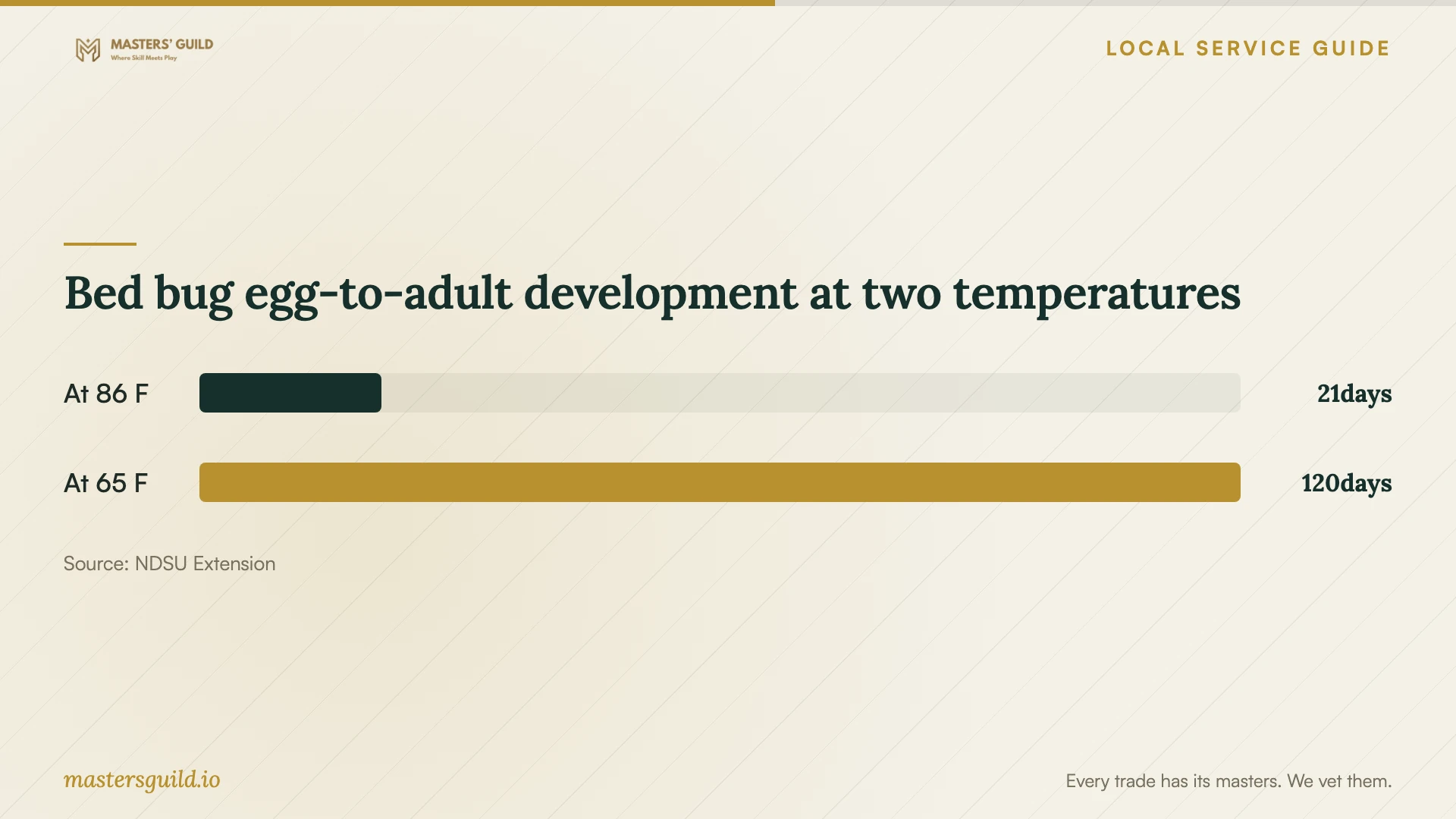
Bed bug egg-to-adult development at two temperatures
Local details that affect your job
North Dakota credential records need a fallback
NDSU advertises state applicator searches and certification-category filters, but the retrieved page reported an application error. Try the official search without assuming it will work. If it fails, obtain documentation from the provider and request verification guidance from NDSU Extension, the state’s certification and training administrator. Keep unresolved status questions open before approving the work. [1] [2]
Regional lookalikes can widen the inspection
NDSU identifies bat bugs and swallow bugs as bed bug lookalikes found in homes in this region. Its guidance connects them with bat roosts and swallow nests. For a suspected infestation here, request entomologist confirmation and discuss inspection of possible host areas. This regional guidance does not establish how common either insect is in Fargo. [3]
Match the inspection to your situation
| Situation | Next step | Question for the provider |
|---|---|---|
| Unidentified insect | Request identification before choosing treatment. | How should I preserve a specimen? |
| Suspected bed bugs with attic or nesting activity | Discuss regional bat bug and swallow bug lookalikes. | Who can confirm identification, and should you inspect host areas? |
| Bed bugs in an apartment | Coordinate adjacent-unit inspection with the property manager. | Who will arrange access and communicate findings? |
| Proposed insecticide treatment for bed bugs | Clarify possible treatment after egg hatch. | Which return visits and monitoring does the price include? |
Your hiring checklist
- Send photographs, affected-room details and a timeline of sightings.
- Request the proposed applicator’s name, certification ID, category and expiration date.
- Resolve credential questions if the official search fails or records do not match.
- Request proof of liability insurance.
- Get a written scope, total price, preparation duties and exclusions.
- Confirm included monitoring, return visits and charges for additional work.
- Discuss pets, aquariums, access and time away before scheduling.
- Coordinate shared-building inspection access with the property manager.
Frequently Asked Questions
How can I check the applicator if the database fails?
Request certification documentation from the provider and ask NDSU Extension how to verify it. NDSU advertises name and ID searches, but the retrieved page displayed an application error. The agriculture department identifies Extension as the state’s certification and training administrator; ask what assistance it can provide with your specific question. [1] [2]
Will bed bug treatment need another visit?
Ask the provider to explain the planned follow-up. NDSU says many insecticides do not kill eggs and another treatment may be necessary after egg hatch. It also recommends monitoring for at least two weeks after treatment. Your provider should define the schedule for the chosen method. [3]
Should neighboring apartments be inspected?
NDSU recommends inspecting adjacent apartment units when bed bugs occur. Ask the property manager and provider to coordinate access, inspection findings and any proposed treatment responsibilities. [3]
How much should I budget?
Get an inspection-based written quote for your home. Compare the complete plan, including preparation support, treatment, monitoring and return visits. Request prices for excluded work and ask what you could owe if the provider recommends additional treatment.
Sources and scope
This guide combines the sources below with practical planning guidance. Figures apply to the stated geography and period; request a written quote for your property.