
Local service guide
Pest control in El Paso: Hiring and Planning
For Pest control in El Paso, hire a provider whose Texas structural pest control credentials cover your proposed treatment, and ask for a written scope with inspection charges, follow-up visits and tax. For mosquitoes around stagnant water or public canals, contact city Vector Control through 311 before arranging private work; the city monitors and treats bodies of water and fogs public rights-of-way. [1] [3] [4]
Choose the inspection before the treatment
Describe what you have seen before requesting a treatment price: the affected rooms, dates of sightings, visible damage and any products you have used. Send clear photographs if you can take them without disturbing a nest or entering a confined space. Ask the provider to identify the pest and explain the proposed work before you approve it.
Ask whether the inspection carries a charge and whether the company credits that charge toward treatment. Texas includes identifying infestations, inspection reports, recommendations and bids among compensated structural pest control activities. The Comptroller also lists inspections of possible infestations among taxable services. [3] [4]
For a suspected wood-destroying pest, request an inspection that addresses the damaged area and ask what the treatment covers. Do not assume a general household pest proposal includes termite work: Texas defines termite control as a separate category covering termites, beetles and other wood-destroying organisms through methods other than fumigation. [3]
Check credentials for the proposed work
Request the company's legal name, business license information and the credentials of the person assigned to your home. Use the Texas Department of Agriculture as the licensing authority for structural pest control. Its general pest control category includes household pests such as roaches, ants, mosquitoes, rats and mice. [3]
Ask the provider which license category covers each part of the proposal. Texas separates lawn and ornamental pest work from general pest control, and it has a structural fumigation category. If a company proposes several methods, have it explain who will perform each service and how that person's credentials fit the work. [3]
Request proof of liability insurance and a sample service report. Ask who handles a missed appointment, an unresolved problem or a request for another inspection. Keep the written proposal and treatment records together so you can compare the promised work with the work performed.
Compare complete quotes and follow-up terms
Give each provider the same description of the problem. Request separate prices for inspection, initial treatment, planned return visits and any exclusion or repair work. Ask which rooms and outdoor areas the provider will treat, what preparation you must complete, and what observations should trigger a return visit.
Include tax when comparing totals. The Texas Comptroller directs providers to collect tax on taxable pest control charges, including related additional fees. It lists a 6.25 percent state rate plus up to 2 percent local tax. Ask the provider to state the applicable rate rather than assuming one combined rate from your address. [4]
Ask for distinct service lines when a proposal combines treatment with live trapping or a non-pesticidal animal barrier. The Comptroller lists those services, and bee removal from a yard, among nontaxable services. It gives separate billing rules for mixed taxable and nontaxable work, so have the provider explain the invoice treatment. [4]
Read the return-visit terms before choosing a recurring plan. Ask whether the provider includes retreatment, which pests it excludes, when coverage ends and how you cancel. For a one-time job, request the same clarity about the follow-up inspection and any additional charge.
Plan mosquito work around water sources
Start a mosquito assessment with a walk around the property. El Paso Public Health recommends emptying standing water from containers at least once a week and maintaining window and door screens. Include flowerpots, gutters, pool covers, birdbaths and unused containers in your check. [2]
Tell the inspector whether your home sits near an irrigation canal. El Paso Public Health reports increased West Nile disease risk for residents near canals and identifies summer and early fall as the period of greatest bite-related risk. Ask the provider to distinguish water sources on your property from canal or public-area concerns that you can report to the city. [1] [2]
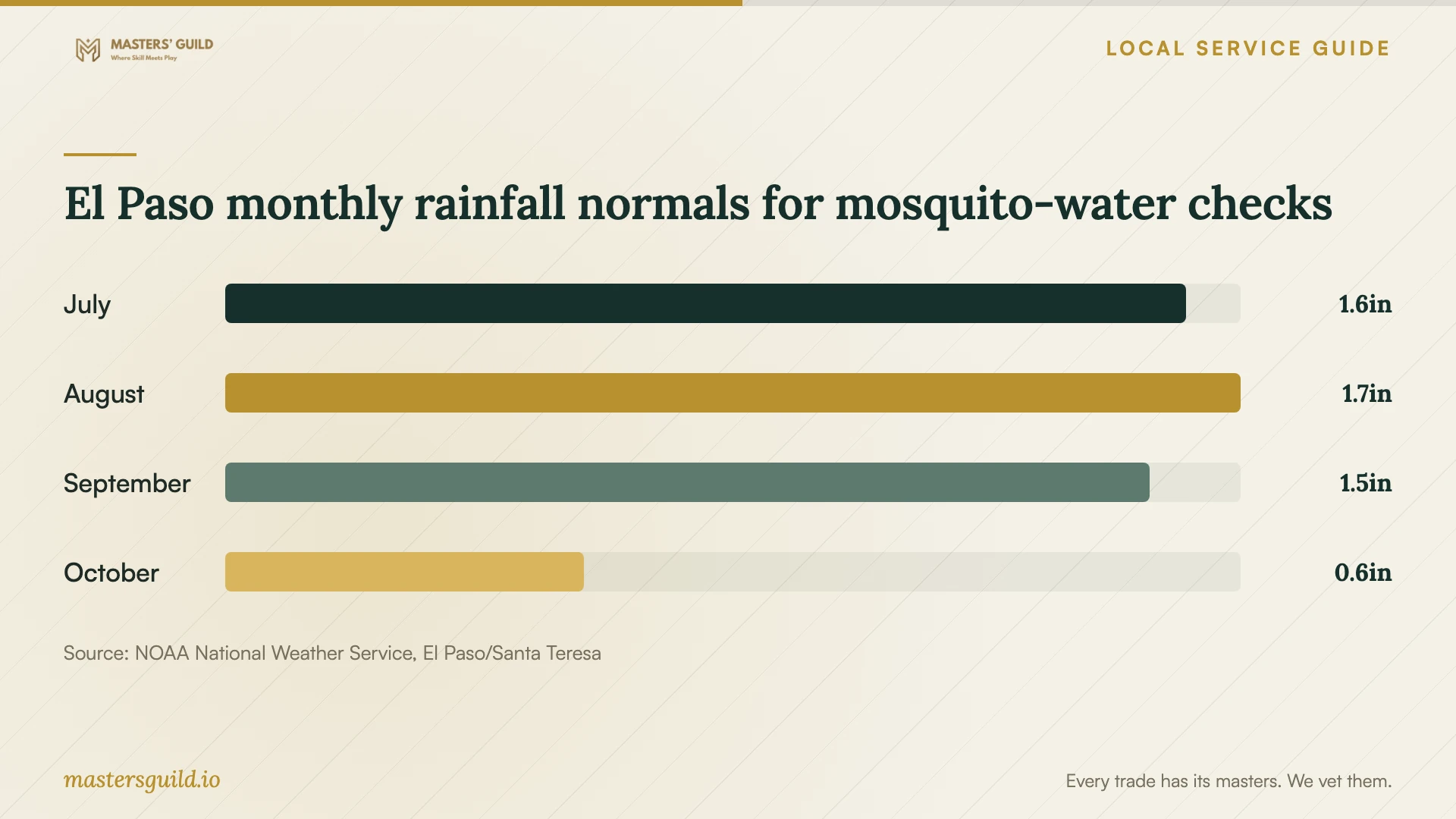
Use the rainfall chart as a reminder to inspect water-holding areas during the wetter part of the year. National Weather Service normals record 1.58 inches in July, 1.67 in August and 1.52 in September, compared with 0.59 in October. These historical averages do not establish current mosquito activity or justify a fixed treatment schedule. [5]
Prepare for the visit and judge the result
Get preparation and re-entry instructions before the appointment. Tell the provider about children, pets, aquariums and any household circumstances that affect access or treatment. Ask which belongings you should move, whether you need to leave, and when you may clean treated areas. Follow the instructions for the specific treatment you approve.
Agree on how you will assess progress. Ask the provider what you should record between visits and when it will reassess the plan. Save dated photographs and note where you see activity. Before the technician leaves, confirm the next appointment, the remaining work and the contact for questions about the service.
El Paso monthly rainfall normals for mosquito-water checks
Local details that affect your job
Use 311 for stagnant water and public mosquito concerns
El Paso's Vector Control team monitors and treats canals, ditches and reservoirs, addresses stagnant-water concerns and fogs public rights-of-way. Report the location through 311 or call 915-212-0134. Give staff a precise location and describe the water source; ask a private provider to define any separate work proposed for your own property. [1]
Canal proximity changes mosquito preparation
El Paso Public Health identifies living near irrigation canals as a local West Nile disease risk factor. If your property is near a canal, include that fact in the inspection request and take extra care to prevent bites. The department advises weekly standing-water removal, maintained screens and insect repellent used according to label instructions. [2]
Confirm the city's role before requesting bee work
The city's published Vector Control role includes confirming possible rodent infestations and selected insect infestations involving ticks and fleas, with bees excluded. For a bee problem, ask a private specialist whether the proposal covers yard removal or work inside a structure. Do not assume the city's infestation-confirmation service includes private treatment. [1]
Match the problem to the first step
| Situation | First step | Clarify before arranging work |
|---|---|---|
| Mosquitoes around a canal or stagnant water | Report the location to city Vector Control through 311. | Ask what the city can address and define any private property treatment. |
| Roaches, ants, rats or mice around the home | Request an inspection from a provider with appropriate pest control credentials. | Ask for pest identification, treatment scope and follow-up terms. |
| Suspected termites or wood-destroying insects | Ask for a provider whose credentials cover termite control. | Confirm whether the proposal involves termite treatment or structural fumigation. |
| Bees in the yard | Ask a private specialist about removal. | City Vector Control excludes bees from its stated infestation-confirmation role. |
| Treatment combined with live trapping or animal barriers | Request distinct service prices. | Ask how the provider applies tax to taxable and nontaxable services. |
Your hiring checklist
- Record sightings, affected rooms, visible damage and previous treatments.
- Request business license information and credentials for the assigned worker.
- Ask which license category covers the proposed service.
- Compare written scopes with inspection, treatment, follow-up and tax totals.
- Identify standing water and note nearby irrigation canals.
- Get preparation, pet arrangements and re-entry instructions before the visit.
- Confirm return-visit coverage, exclusions and cancellation terms.
Frequently Asked Questions
Does Texas require a pest control license?
Texas requires licensing for businesses and individuals performing structural pest control for hire. Ask for the company's license information and the assigned worker's credentials, and confirm that they cover the proposed service category. [3]
Can I report mosquitoes to the city?
Yes. Contact El Paso Vector Control through 311 or 915-212-0134 for mosquito and stagnant-water concerns. The program monitors bodies of water and fogs public rights-of-way. Ask staff about the specific location rather than assuming they provide private household treatment. [1]
Will I owe tax if an inspection finds no pests?
The Texas Comptroller says providers must collect sales tax on structural pest control services even when they find no pests. Ask whether the inspection has a charge and request the total including tax before booking. [4]
Should I choose a one-time visit or a recurring plan?
Ask the inspector to explain the proposed schedule for your identified problem. Compare the initial work, monitoring, return visits, exclusions and cancellation terms. Choose after you understand what each visit includes and how the provider will judge progress.
Sources and scope
This guide combines the sources below with practical planning guidance. Figures apply to the stated geography and period; request a written quote for your property.