
Local service guide
Mold Removal in El Paso, TX: Hiring and Planning
Arrange Mold Removal in El Paso by identifying the moisture source, checking Texas mold credentials and agreeing on assessment, cleanup and completion documentation before work begins. Texas prohibits licensed assessment and remediation providers from conducting both activities on the same project, except when employed by a school district and working on that district’s project. Separate exemptions allow some unlicensed work. Identify who will prepare the protocol, remove the mold and assess completion, and include moisture-source repairs and reconstruction in your planning. [1]
Choose the assessment and cleanup roles
Request each professional’s Texas license number and role. TDLR licenses mold assessment and remediation professionals, with exemptions for certain work. A licensed person or company may hold both assessment and remediation licenses but cannot conduct both activities on the same project, except when employed by a school district and working on that district’s project. This licensed-provider restriction is distinct from exemptions that allow some unlicensed work. [1]
Do not treat 25 square feet as a universal hiring rule. TDLR describes a minimum-area exemption for unlicensed people handling less than 25 contiguous square feet of visible mold. A licensed Mold Remediation Contractor handling that small project must follow the rules, including a work plan based on a licensed Mold Assessment Consultant’s protocol. Other owner and property exemptions depend on the circumstances. [1]
Have the provider explain any claimed exemption before you sign. Licensed assessors and remediators must give the client and property owner the Consumer Mold Information Sheet before mold-related activity begins. Request proof of insurance and identify the person supervising removal. [1]
Investigate moisture before commissioning removal
Include investigation and repair of the water source. TDLR identifies pipe leaks, roof leaks, sewage backups and overflowing fixtures among moisture problems associated with mold. Its guidance calls for fixing the underlying moisture problem, removing mold and keeping the home dry afterward. [1]
For a suspected supply-water leak, follow El Paso Water’s meter check: stop water use inside and outside, then watch the triangular dial. Movement suggests a leak. You can also compare readings after a couple of hours without water use. Give the repair professional your observations and the locations of damp materials. [2]
If your home uses an evaporative cooler, include its supply and overflow operation in the investigation. El Paso Water explains that a failed system can overflow continuously; a bleeder line draining into a sewer pipe can hide that water use. Its troubleshooting procedure includes shutting off the cooler and its supply valve, then checking whether meter consumption stops. [2]
Compare quotes by scope and responsibility
Give bidders the same proposed scope. Request separate descriptions for assessment, any proposed sampling, removal, moisture-source repairs, completion assessment and rebuilding. Identify exclusions and require an approval procedure for additional work after opening walls. Compare responsibilities alongside the total price.
Have the assessor explain how sampling would change the work. TDLR says identifying mold species is unnecessary in most residential situations. Testing to determine what kind of mold is present is not required before cleanup. If you choose sampling, have the licensed consultant establish interpretation criteria before work starts. [1]
Review how the contractor will handle affected materials. TDLR advises removing and discarding moldy porous materials such as drywall, carpet and insulation. Its guidance says painting over mold is ineffective, as is applying bleach to drywall without removing the mold source. [1]
Plan permits, access and reconstruction
Resolve permit questions before approving demolition or rebuilding. The City of El Paso requires permits to construct, enlarge, alter, repair, move, demolish or change the occupancy of a building or structure within its jurisdiction. Give Planning & Inspections the proposed scope and confirm the requirements for your address. [3]
Put responsibility for applications, inspections and reconstruction in the agreement. Discuss which rooms you can use, how to prepare belongings and whether workers need access to plumbing, cooling equipment or roof areas. Request a proposed sequence for repairs, removal and rebuilding before choosing a start date.
Discuss containment access before work begins. TDLR says licensees should explain entry risks and protection requirements if an owner requests access. A contractor may include a contract provision prohibiting owner entry. Arrange access to needed belongings beforehand. [1]
Agree on completion documents before work starts
Tell the consultant what documentation you need before commissioning cleanup. Under TDLR guidance, a consultant who did not prepare the remediation protocol in advance cannot declare that the project achieved clearance. The agency describes a separate post-remediation inspection and consultant certification option for determining that a property contains no evidence of mold damage. [1]
Confirm which portions of the Certificate of Mold Damage Remediation apply and who will sign them. TDLR states that only a licensed remediator can issue a CMDR; a licensed assessment consultant may complete the separate consultant certification portion in the circumstances the agency describes. Keep the protocol, work plan, repair records, photographs and final documents together. [1]
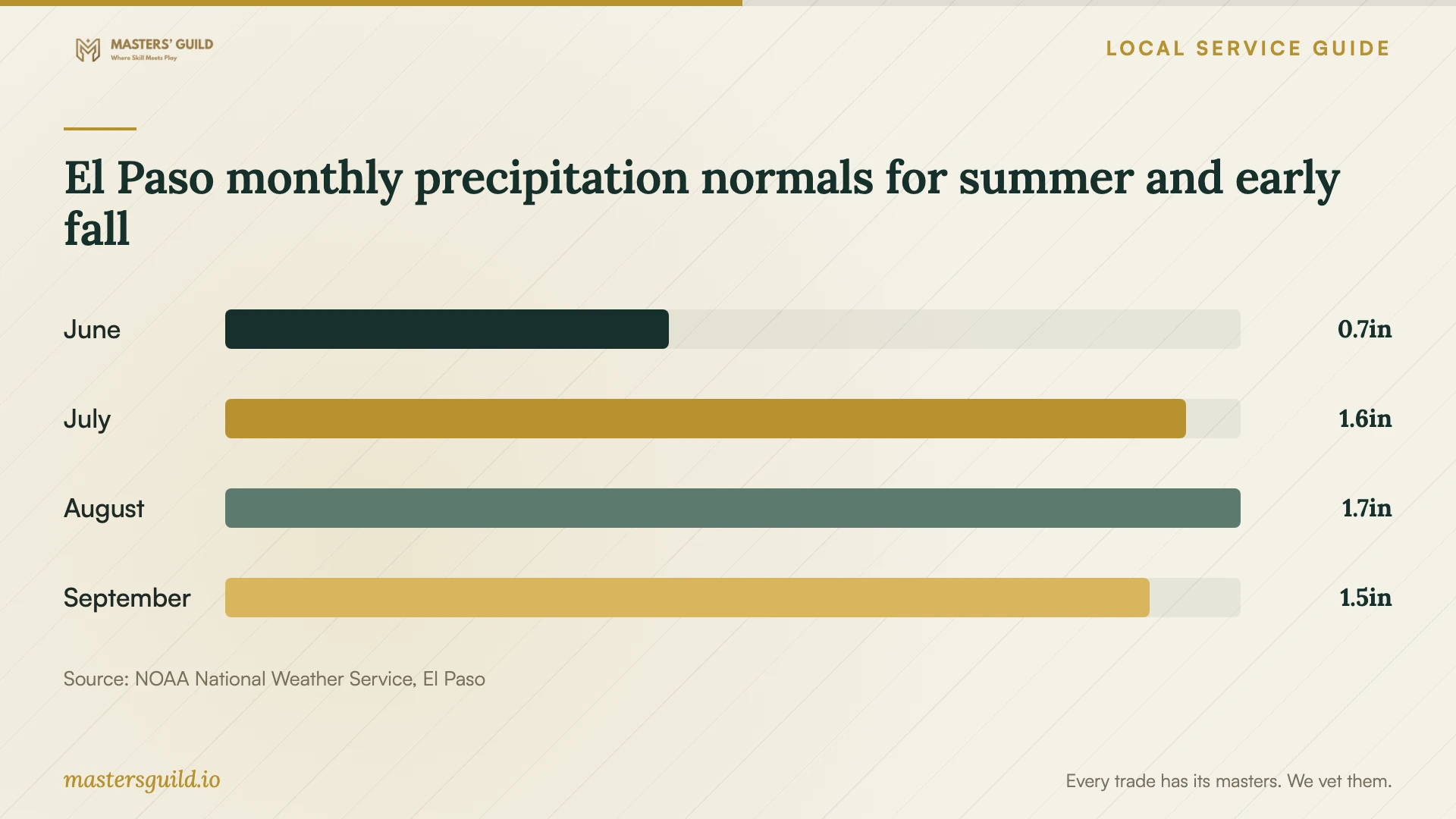
El Paso monthly precipitation normals for summer and early fall
Local details that affect your job
Confirm repair permits through the One-Stop Shop
El Paso’s One-Stop Shop at 811 Texas Ave. serves as the primary intake point for building permits. Call Planning & Inspections at (915) 212-0104 with your address and proposed removal, repair and rebuilding scope. The city offers its Citizen Access Portal for electronic plan submission, application status and payments. Resolve permit responsibility before setting the start date. [3]
Include outdoor water equipment in the leak investigation
El Paso Water’s guidance covers evaporative coolers and irrigation equipment. For irrigation, it recommends checking wet spots, greener grass, depressions, valve boxes and leaking lines. Report those signs near affected parts of the house to the person investigating moisture. For a cooler, report overflow concerns and meter changes so the repair professional can investigate that equipment alongside indoor plumbing. These observations do not establish the cause of indoor mold. [2]
Choose the next step for your situation
| Situation | Next step | Question to resolve |
|---|---|---|
| Small visible patch | Clarify applicable exemptions; a licensed remediator still needs a consultant’s protocol. | Who will prepare the protocol if I hire a licensed contractor? |
| Musty odor without a clear source | Arrange an inspection that considers hidden areas and moisture causes. | Which areas will you inspect before proposing removal? |
| Meter movement with water use stopped | Investigate a possible supply-water leak using El Paso Water’s guidance. | Who will locate and repair the leak? |
| Removal involving building repairs | Confirm applicable permits with El Paso Planning & Inspections. | Who handles applications and inspections? |
| Formal clearance desired | Arrange the consultant’s protocol before remediation begins. | What criteria and documents will establish completion? |
Your hiring checklist
- Photograph visible growth and damp materials; record when you noticed them.
- Describe known leaks, cooler problems and recent water intrusion to the assessor.
- Request license numbers, proof of insurance and an explanation of any claimed exemption.
- Identify who prepares the protocol, performs remediation and assesses completion.
- Compare written inclusions, exclusions and approval procedures for additional work.
- Confirm permit responsibility and room-access arrangements before scheduling.
- Agree on completion criteria and the documents you will receive.
Frequently Asked Questions
Can the same company assess and remove the mold?
A licensed person or company may hold both Texas licenses but cannot conduct assessment and remediation on the same project, except when employed by a school district and working on that district’s project. Separate exemptions allow some unlicensed work. Identify each provider’s license, role and any claimed exemption before signing. [1]
Do I need a test to identify the mold species?
TDLR says identifying species is unnecessary in most residential situations. Testing to determine what kind of mold is present is not required before cleanup. If an assessor proposes sampling, discuss which decision the results will inform and establish interpretation criteria in advance. [1]
Should I investigate moisture even without recent rain?
Yes. TDLR identifies pipe leaks and overflowing fixtures among moisture problems that can lead to mold. El Paso Water also describes evaporative-cooler and irrigation leaks. Include relevant equipment and plumbing in the investigation. [1] [2]
Can I arrange formal clearance after doing the cleanup myself?
TDLR says a consultant who did not prepare a protocol before remediation cannot declare that the project achieved clearance. Its guidance describes a separate inspection and consultant certification option. Discuss your documentation goal with a licensed consultant before starting. [1]
Sources and scope
This guide combines the sources below with practical planning guidance. Figures apply to the stated geography and period; request a written quote for your property.