
Local service guide
Tax preparation and accounting in Edmonton
Arrange Tax preparation and accounting in Edmonton by defining your business structure, tax years and record cleanup needs, then comparing written quotes for that work. Verify a claimed CPA designation and the practice registration applicable to your engagement. For a corporation, include an assessment of Alberta AT1 filing obligations and agree who handles payment planning and provincial notices. [1] [2] [3]
Compare quotes for the same work
Tell prospective providers whether you operate as a sole proprietor or corporation and identify the years needing attention. Describe missing receipts, unreconciled accounts, payroll records and outstanding notices. Have each provider separate bookkeeping cleanup, return preparation and ongoing accounting in the proposal.
For corporate work, include an assessment of the Alberta corporate income tax return, called an AT1. Unless exempt, a corporation must file this return if it had a permanent establishment in Alberta at any time during the taxation year. Have the accountant identify the provincial work included in their quote. [3]
Budget using written quotes for comparable work. Request a fixed fee for defined tasks or an hourly estimate with a spending limit. Confirm who approves additional charges and whether the fee covers amendments, assessment explanations and responses to government questions. Compare exclusions alongside the total.
Verify the CPA and applicable practice registration
CPA Alberta provides separate verification routes for members, firms and CPA professional corporations. If a member search produces no result, the regulator advises trying without a city. Use the provider’s full professional name and resolve any mismatch before signing an engagement. [1]
CPA Alberta lists accounting services and taxation advice among services that CPAs must provide through a registered Professional Accounting Firm. It includes tax-return preparation when the preparer combines it with the listed professional services. A CPA professional corporation also needs separate Professional Accounting Firm registration. [2]
The regulator also specifies a Professional Service Provider provision. A CPA member providing accounting services, taxation advice or the other specified services on behalf of a corporation whose primary business is not accounting must register a Professional Service Provider. Examples include banks and financial planning firms. Have the provider explain which registration applies to your engagement, then verify it. [2]
Identify who prepares the work, who reviews it and who answers questions after filing. Describe matters needing particular attention, such as an ownership change or disputed assessment. Request an explanation of the provider’s approach and whether the engagement includes that work.
Get a filing and payment calendar
Alberta requires AT1 filing within six months after a corporation’s tax year end. In general, corporations pay provincial corporate income tax through monthly instalments and settle the balance by the end of the second month after year end. Qualifying Canadian-controlled private corporations can defer their total payment until the end of the third month under the province’s conditions. [3]
Have the accountant determine your corporation’s payment obligations before you rely on the filing deadline. Request a calendar that distinguishes instalments, balance payments and return submission. Specify whether the engagement includes calculations and reminders, and name the person who approves payments.
For taxation years beginning after December 31, 2024, Alberta requires corporations to net file AT1 returns except insurance corporations, non-resident corporations, corporations reporting in functional currency and corporations exempt under section 35 of the Alberta Corporate Tax Act. Confirm the applicable filing method; AT1 net filing requires TRA-certified preparation software. [3]
Prepare records and review the completed work
Get the provider’s document list before transferring records. Gather prior returns and assessments, bookkeeping exports, bank and credit-card statements, receipts and notices for the agreed period. Mark missing documents and arrange a secure transfer method. Set a date for responding to follow-up questions.
Before approving a return, request an explanation of the amount payable, payment dates and unresolved assumptions. Obtain copies of completed returns, filing confirmations and remaining actions. Keep these with your accounting records, and confirm how you will receive a bookkeeping export if you later change providers.
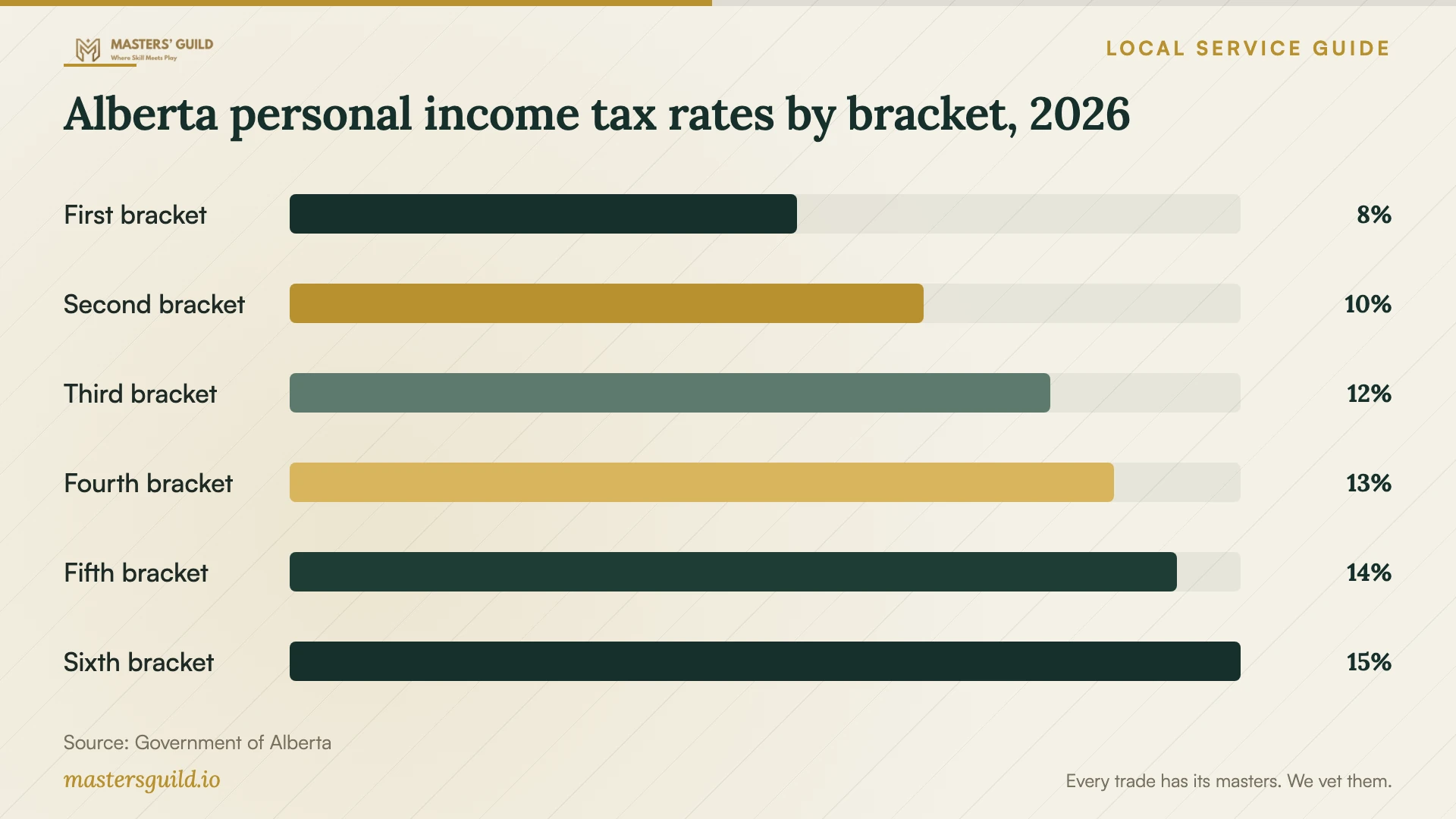
Alberta personal income tax rates by bracket, 2026
Local details that affect your job
Assign responsibility for Alberta corporate notices
Since April 1, 2026, Alberta has used TRACS online mail by default for new corporations incorporated with Alberta Corporate Registry, existing corporations with a TRACS account and corporations granting a third-party organization access. These provincial rules apply to Edmonton corporations in those groups. Name a notice monitor; if you prefer paper assessment and reassessment notices, use Alberta’s paper-mail request process. [3]
Prepare for the announced November access change
Alberta has announced TRACS access changes for November 14, 2026. Account owners will need to be listed directors and satisfy identity-verification requirements. Alberta-resident owners need a verified Alberta.ca account; directors without Alberta government-issued ID use Interac’s Document Verification Service. Before that date, check director records and match your name across registry and account records. Account representatives can continue using a basic Alberta.ca account. [3]
Separate personal and corporate account arrangements
The CRA administers Alberta personal income tax, while Alberta Tax and Revenue Administration administers provincial corporate income tax. If you engage one provider for your personal return and corporation, identify the authorization and correspondence arrangements for each authority. Alberta permits properly authorized business individuals to consent to disclosure of corporate account information to a representative; review the privileges requested. [3] [4]
Choose the engagement that fits your work
| Your situation | Work to specify | Point to resolve |
|---|---|---|
| Personal return alongside corporate work | Separate personal and corporate responsibilities | CRA administers Alberta personal tax; TRA administers provincial corporate tax. |
| Corporation with an Alberta permanent establishment | AT1 obligation and exemption assessment | Does the quote include provincial preparation and submission? |
| Incomplete bookkeeping | Defined cleanup task and approval limit | Which records must you supply before preparation starts? |
| CPA accounting or taxation advice | Member and applicable practice-registration verification | Confirm the PAF requirement and whether the PSP provision for work on behalf of a non-accounting corporation applies. |
| Corporate account using TRACS | Notice monitoring and authorized representative access | Who checks correspondence and maintains access? |
Your hiring checklist
- Identify your business structure, tax years and requested services.
- List missing records and cleanup tasks before comparing fees.
- Verify claimed CPA membership and the applicable practice registration.
- Include an assessment of Alberta corporate filing obligations.
- Obtain separate filing, instalment and balance-payment dates.
- Name the person responsible for government notices.
- Confirm additional-charge approval and the documents you will receive.
Frequently Asked Questions
Does an accountant have to be a CPA in Alberta?
CPA Alberta states that anyone in Alberta can call themselves an accountant without registering with it. Verify membership if a provider claims the CPA designation. Review qualifications, responsibilities and the proposed work when choosing any provider. [1]
Does the AT1 filing deadline give me six months to pay?
No. Alberta allows six months after corporate year end for filing. Its general balance-payment deadline falls at the end of the second month, with third-month deferral for qualifying Canadian-controlled private corporations. Have your accountant determine the applicable instalment and balance obligations. [3]
How should I compare accounting fees?
Give providers the same description of your records and required work. Compare cleanup, preparation, filing, review and follow-up support. Request written exclusions and an approval process for extra work before comparing the final prices.
Can the chart estimate my corporation’s tax?
No. It shows Alberta’s 2026 personal income tax rates by bracket. Use it to discuss your personal tax estimate with the preparer. Request a separate corporate calculation and an explanation of the deductions and credits used. [4]
Sources and scope
This guide combines the sources below with practical planning guidance. Figures apply to the stated geography and period; request a written quote for your property.