
Local service guide
Pest control in Durham, NC: Hiring and Planning
Pest control in Durham starts with an inspection and comparison of 2-3 companies. Match the provider’s North Carolina credentials to the proposed work, then compare total charges, preparation duties, included visits, and warranty terms. For yard mosquitoes, confirm whether Durham County still has larvicide Dunks from its limited-supply giveaway before choosing a service. [1] [2] [3]
Identify the pest before choosing treatment
Have the inspector show you the insects or other evidence supporting the diagnosis. NC State Extension recommends inspection before treatment and proof before accepting costly services. For suspected bed bugs, its guidance calls for a live specimen from your dwelling before treatment. [2]
Describe where you saw activity, how often it occurs, and which rooms or outdoor areas concern you. Keep photos and a short activity log. During the inspection, discuss monitoring, cleaning, sealing entry points, moisture correction, and any proposed pesticides. Request an explanation of your role in each part of the plan.
Choose a recurring contract after discussing the problem and your tolerance for pest encounters. NC State Extension describes monthly, quarterly, or yearly service as a homeowner preference and recommends discussing preventive service alongside treatment when pests appear. Have the provider explain why it recommends that schedule for your home. [2]
Check the company and the person doing the work
North Carolina divides structural pest control into phases. P-phase covers household pests, including mice and rats, without fumigation. W-phase covers termites and other wood-destroying organisms without fumigation. F-phase covers pesticides applied as gas; the state distinguishes fumigation from aerosols, fogs, and mists. [3]
Request the supervising licensee’s name, license number, and applicable phase. The state’s February 2026 guidance explains that registered technicians and certified applicators work under a structural licensee. A worker’s technician registration or applicator certification does not authorize independent operation of a structural pest-control business. [4]
Have the person inspecting or treating your home show their NCDA&CS identification card. NC State Extension says employees who sell structural pest-control contracts or perform the services must have the department’s card, which includes their employer’s structural license number. Use those details when checking the company’s credentials. [2]
Compare scope, charges, and termite coverage
Give each bidder the same description of your problem. Compare inspection-based proposals, including the total charges and included visits. Request the target pest, treatment areas, methods, return-visit conditions, preparation duties, and exclusions in writing. Clarify whether the price includes sealing entry points or whether you need to arrange that work separately.
NC State Extension says North Carolina requires a written proposal before ongoing pest-control work or treatment involving termites and other wood-destroying insects. For those insects, the proposal must include a building diagram describing the problem. Have the inspector distinguish evidence of active infestation from old damage or conditions that favor infestation. [2]
For termite work, discuss whether the provider plans to treat the whole structure and whether access restrictions require a waiver. Extension identifies low crawlspaces, unwanted indoor drilling, and wells or cisterns as possible reasons for deviations from standard treatment. Compare the areas each company would omit before signing. [2]
Read the warranty and annual renewal terms alongside the treatment proposal. Extension recommends comparing damage-repair coverage with retreatment-only coverage. Have the company explain who pays for repairs, which exclusions apply, and what happens if you miss a renewal or cannot provide inspection access. [2]
Arrange preparation and follow-up before treatment day
Get preparation instructions before choosing an appointment. NC State Extension notes that providers may require homeowners to bag items for bed bug treatment, protect or remove food before cockroach treatment, reduce clutter, or remove crawlspace debris. Tell the company which tasks you cannot complete and request a quote for any additional labor. [2]
Request product-specific instructions for household members, pets, treated surfaces, and return to treated areas. Confirm which spaces the technician needs to reach and who will move stored belongings. Keep the preparation sheet with the proposal so you can check the agreed work on treatment day.
Agree on how to report continued activity and when the provider will reassess it. Extension explains that some baits work slowly and that weather can affect pesticide applications. Have the technician describe expected progress and the next inspection before adding another pesticide treatment yourself. [2]
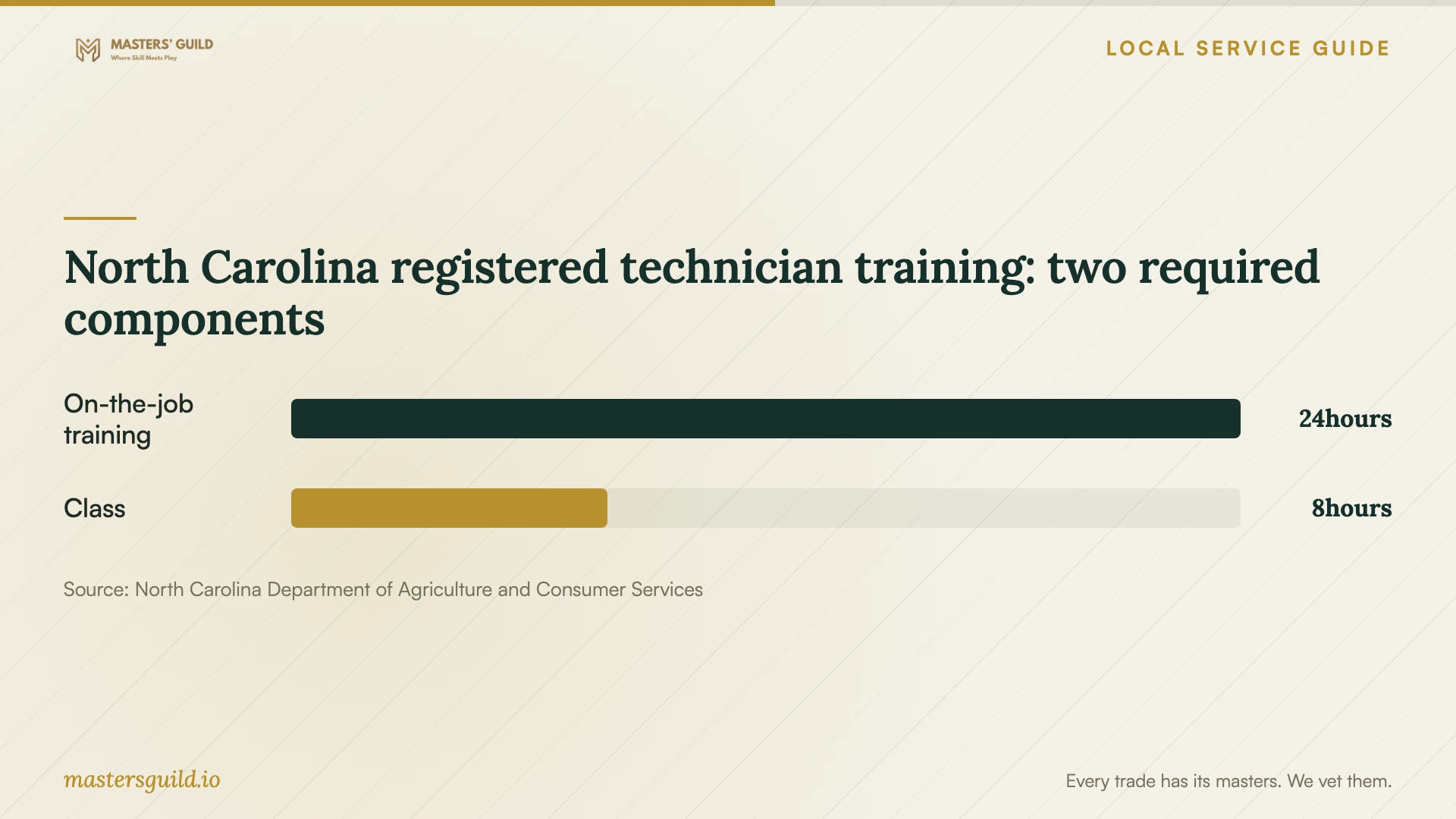
North Carolina registered technician training: two required components
Local details that affect your job
Confirm county mosquito Dunk pickup before traveling
Durham County announced a second and final giveaway on August 12, 2026, while supplies last. The announcement targets households that missed July’s giveaway, but also describes access for any Durham County household. Call Environmental Health at 919-560-7800 to confirm eligibility and remaining stock. The announced limit is one six-Dunk pack per household, with a household address required. The county lists pickup at Clinic 25, Environmental Health’s front desk, 414 E. Main St., Monday-Friday, 8:30 AM-5:00 PM. It describes Bti Dunks as controlling mosquito larvae in standing water for up to 30 days. Discuss that larval treatment separately from any proposed adult-mosquito spraying. [1]
Check credentials for both house and yard applications
North Carolina’s February 2026 regulator guidance distinguishes treatments directed against, above, into, or under a building from pesticide applications over land. For nonstructural applications, the state bases pesticide categories on the application site. If a proposal combines house-perimeter treatment with yard spraying, have the provider explain the credentials covering each part. This distinction matters when you compare an outdoor service with a household pest-control contract. [4]
Resolve termite access restrictions before signing a waiver
NC State Extension says North Carolina requires an owner-signed waiver for deviations from termite treatment guidelines. If your crawlspace limits access or you decline drilling through finished flooring, have each bidder identify the omitted areas and explain coverage. Compare those omissions and warranty terms before choosing a proposal; providers may offer different scopes for the same house. [2]
Choose the next step for your pest problem
| Situation | Next step | Question to resolve |
|---|---|---|
| Ants, cockroaches, mice, or rats | Request an inspection and P-phase structural coverage. | Which entry points, food sources, and monitoring tasks need attention? |
| Suspected termites or wood-destroying insects | Request W-phase coverage and a detailed written proposal. | What evidence shows active infestation, and what does the warranty cover? |
| Suspected bed bugs | Request inspection and identification before approving treatment. | Can the inspector show a live specimen, and what preparation must you complete? |
| Mosquitoes around standing water | Confirm county Dunk availability and discuss larval control. | Do you qualify for pickup, and which mosquito life stage does the proposed service target? |
| Proposed fumigation | Confirm F-phase coverage and obtain another assessment. | What evidence supports the extent of treatment proposed? |
Your hiring checklist
- Record sightings, affected areas, and dates; keep photos for the inspection.
- Request the supervising licensee’s number and credentials for each proposed service.
- Have the inspector show evidence supporting the pest identification.
- Compare written treatment areas, methods, included visits, exclusions, and total charges.
- Read termite waivers, annual renewal terms, and repair or retreatment coverage.
- Confirm preparation, access, pet arrangements, and return instructions.
- Agree on a follow-up date and a way to report continuing activity.
Frequently Asked Questions
Do I need a recurring pest-control contract?
Choose the schedule after discussing the identified pest and your tolerance for sightings. NC State Extension describes recurring service as a personal preference and recommends discussing preventive contracts alongside treatment when pests appear. Request a reason for the proposed visit frequency. [2]
Must my technician hold an independent structural license?
Registered technicians and certified applicators can work under a structural licensee. North Carolina requires each pest-control business to have a licensee overseeing those workers. Request the worker’s NCDA&CS identification card and the supervising licensee’s details. [2] [4]
Does a termite warranty include damage repairs?
Read the agreement before assuming it does. NC State Extension distinguishes damage-repair warranties from retreatment-only warranties and recommends comparing annual renewal costs and treatment exclusions. Have the company explain your coverage in writing. [2]
Can I collect free mosquito Dunks this October?
Confirm before visiting. Durham County’s August 2026 announcement offers supplies on a limited basis and contains differing descriptions of eligibility. Call Environmental Health at 919-560-7800 to check stock and whether your household qualifies. [1]
Sources and scope
This guide combines the sources below with practical planning guidance. Figures apply to the stated geography and period; request a written quote for your property.