
Local service guide
Lighting Installation in Durham, NC
For Lighting Installation in Durham, hire an electrical contractor whose North Carolina license covers your project, then agree on fixture locations, wiring work and approval responsibilities before booking. Before buying exterior fixtures, have Planning confirm whether your property has local historic designation and needs review. Send fixture specifications and photos so the contractor can quote your actual scope. [2] [3] [4]
Define the installation before comparing quotes
Tell the contractor whether you want to replace an existing fixture, move a light, add recessed lights or create an outdoor layout. Mark proposed locations on photos. Include each fixture’s model, dimensions and weight, plus ceiling height and preferred switch locations. Have the contractor assess the existing electrical box and fixture support before you accept the scope.
Describe the task you want to light: reading beside a chair, preparing food at a counter or walking from parking to the door. Discuss placement, light output and controls against that task. Before buying a dimmer, have the installer confirm compatibility with your chosen fixture. For exterior work, provide photos showing nearby windows, paths and property boundaries.
Request separate quote details for installation labor, fixtures, wiring, switches, access equipment and patching or painting. Agree on who removes old fixtures and packaging. Set a process for pricing concealed problems and approving extra work before the contractor proceeds. Installation budgets require project-specific quotes; compare the included work as well as the total.
Verify the business and its license classification
North Carolina defines electrical contracting as the business of installing, maintaining, altering or repairing electrical work and equipment. Subject to statutory exceptions, contractors need a license in the applicable classification. Obtain the legal business name and license number, then check that business through the board’s Verify License Search. [2] [4]
Check the classification alongside the business name. North Carolina provides a separate classification for projects pertaining to single-family detached dwellings. If you own a condominium or a unit in an apartment or mixed-use building, have the contractor explain which classification covers the proposed work. [4]
Request proof of insurance and written workmanship terms. Permit requirements depend on the actual scope. Have the contractor identify any required permits and inspections, confirm those requirements with the authority handling your property, and state who will arrange them. Resolve those responsibilities before setting an installation date.
Confirm local historic review before buying exterior lights
For locally designated historic districts and locally designated historic landmarks, Durham includes exterior light fixtures among the features subject to certificate of appropriateness review. Owners must obtain a COA before covered work begins, whether or not another permit is required. Have Planning confirm your property’s local designation and the review needed for your proposal. [3]
Take Planning photographs of the existing fixture and specifications for the replacement, including finish, size and mounting position. Durham exempts ordinary maintenance or repair that does not involve a substantial change in design, material or outer appearance under its local review criteria. Confirm whether your replacement qualifies before treating it as exempt. [3]
Durham’s COA section exempts interior changes from COA review while preserving required building permits. The online UDO is not the official version and may omit recent amendments. Confirm current historic-review requirements with Planning, and keep that approval discussion separate from the contractor’s electrical-permit assessment. [3]
Check outdoor boundaries and mounting heights
Durham’s outdoor lighting section addresses nonresidential and multifamily developments; it defines multifamily as at least three dwelling units. For a covered property, have the installer review shielding, mounting heights and illumination at relevant boundaries before ordering equipment. Confirm applicability with Planning if you are arranging lighting for a detached home. [1]
For covered developments, Durham sets property-edge illumination maximums of 0.5 foot-candles beside residential zoning and 5.0 foot-candles beside nonresidential zoning or a street. For a unified development with shared parking or other measures shown on a site plan, these limits apply only to exterior project lot lines; interior lot lines are exempt from this boundary provision. [1]
Durham limits directional or full-cutoff fixtures to 15 feet above grade within 50 feet of a residential property line, and 30 feet above grade at least 50 feet away. It also requires lighting orientation that avoids glare or excessive illumination toward streets and adjacent residences. Confirm current requirements with Planning because the unofficial electronic UDO may omit recent amendments. [1]
Arrange a walkthrough with the installer before accepting the job. Check the switches, dimmers and sensor settings included in your agreement. For exterior work, review aiming after dark from the paths and relevant boundaries. Keep fixture specifications, the written scope and any approval or inspection records with your home documents.
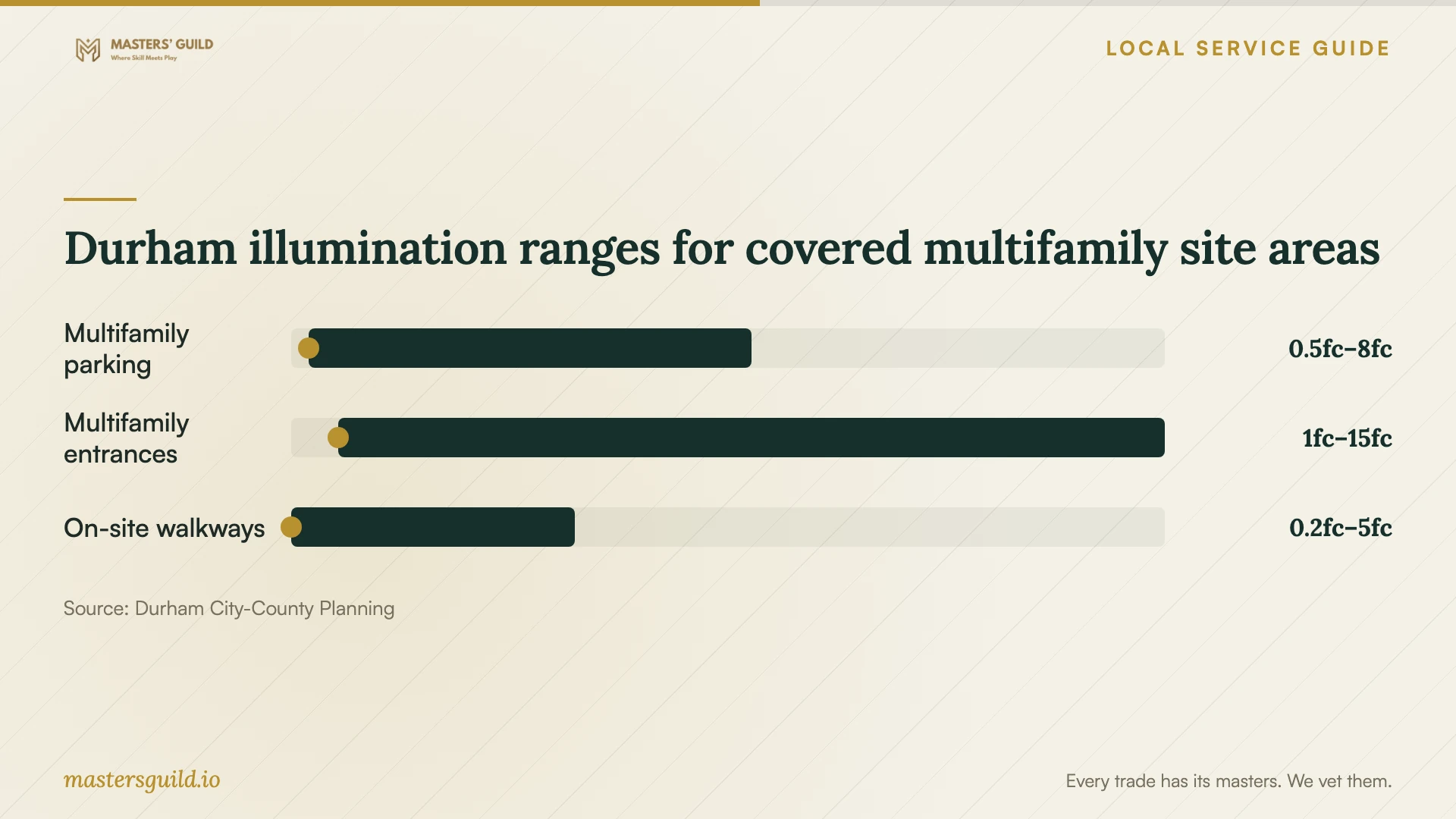
Durham illumination ranges for covered multifamily site areas
Local details that affect your job
Local historic designation changes purchasing and scheduling
Before changing exterior lights in a locally designated historic district or at a locally designated historic landmark, have Planning confirm the designation, current COA requirements and any maintenance exception. Durham requires approval for covered work independently of other permits. Its electronic UDO is unofficial and may omit amendments, so resolve current review requirements before buying fixtures or booking installation. [3]
Residential boundaries change outdoor fixture choices
For developments covered by Section 7.4, Durham sets a 0.5 foot-candle boundary maximum beside residential zoning. Directional or full-cutoff fixtures may reach 15 feet above grade within 50 feet of a residential property line, or 30 feet above grade at least 50 feet away. In qualifying unified developments, the boundary illumination limits apply to exterior project lot lines and exempt interior lot lines. Have the installer review the site plan and confirm current rules with Planning before selecting mounting positions. [1]
Match your project to the next step
| Project | Next step | Question to resolve |
|---|---|---|
| Existing indoor fixture replacement | Send photos and fixture specifications for a defined quote. | Who assesses the existing box and fixture support? |
| New light location or recessed layout | Agree on wiring, controls and surface repairs. | Who confirms and handles any required permits or inspections? |
| Exterior change in a locally designated historic district or at a locally designated historic landmark | Have Planning confirm current COA requirements or a qualifying maintenance exception. | Does the proposed fixture’s design, material and appearance need approval before work? |
| Outdoor lighting at a covered multifamily development | Review illumination, mounting heights and relevant boundaries against Section 7.4. | Does a unified site plan exempt interior lot lines from boundary illumination limits? |
Your hiring checklist
- Send photos with proposed fixture and switch locations marked.
- Provide fixture models, dimensions, weights and control preferences.
- Verify the contracting business and confirm its license classification.
- Have Planning confirm local historic designation and current review requirements for exterior changes.
- Assign responsibility for any required permits, inspections and approvals.
- Agree on wiring, access equipment, cleanup and surface repairs.
- Require written approval of extra work before the contractor proceeds.
- Arrange a walkthrough and an after-dark check for exterior lighting.
Frequently Asked Questions
Can I install a light on my own property?
North Carolina’s licensing law includes an exception for a person working on their own property for their own benefit when the property is not intended for rent, lease or sale. That exception concerns contractor licensing. Confirm applicable permits and code requirements before deciding to do the work, and hire a licensed contractor if you cannot assess the installation. [4]
Does replacing an exterior light require historic approval?
For a locally designated historic district or locally designated historic landmark, Durham requires a COA for covered exterior changes. Qualifying ordinary maintenance or repair without substantial changes in design, material or outer appearance has an exception. Have Planning confirm local designation and current requirements before ordering, since the electronic UDO is unofficial and may omit amendments. [3]
How much should I budget?
Get a project-specific quote for your fixture list and wiring scope. Request separate details for fixtures, labor, wiring, controls, access equipment and repairs. Have the contractor explain how changes affect the price and obtain your approval before adding work.
Do the chart values apply to my detached house?
Section 7.4 addresses nonresidential and multifamily developments, with multifamily defined as at least three dwelling units. Confirm applicability with Planning. Use the chart to discuss covered development lighting rather than as a general brightness specification for a detached home. [1]
Sources and scope
This guide combines the sources below with practical planning guidance. Figures apply to the stated geography and period; request a written quote for your property.