
Local service guide
Data Recovery and Backup in Durham, NC
Arrange Data Recovery and Backup in Durham by requesting a written assessment, an approved recovery scope, and a separate backup setup with a demonstrated restore. Agree on access to business records, subcontractor transfers, and incident reporting before handing over a device. North Carolina DOJ advises businesses to verify third-party requests for personal information and restrict access to sensitive files. [2]
Define the job before requesting a quote
Separate the files you need recovered from the backup and disposal work you want afterward. North Carolina DOJ advises businesses to back up and transfer their files before sanitizing an old hard drive. Use that sequence to define acceptance: check the transferred files before authorizing destruction of the original storage. [2]
Tell the provider whether you need missing files recovered, an existing backup restored, or a new backup arrangement installed. Describe the device, what happened, and the last time you could open the files. Avoid repeated experiments on the affected device while you arrange an assessment.
Put current accounts, customer records, project folders, and application data in priority order. Ask how you will check the returned material, including which application you need to open it. For collection or drop-off, record the device identifier and accessories on the receipt. Confirm the work location and ask who must approve a transfer to another company.
Set approval, cost, and turnaround terms
Include an incident-reporting obligation alongside the recovery deadline. North Carolina DOJ says businesses holding North Carolina residents' personal information on another company's behalf must notify the owner or licensee immediately following discovery of a security breach. Ask the provider to name the person who will contact you and record your designated recipient in the agreement. [1]
Request separate amounts for assessment, recovery work, shipping, return storage, and backup configuration. Ask what you owe if you decline the proposed work or the provider cannot return your priority files. Agree on a spending limit and require approval before the provider exceeds it.
Ask for an assessment date and a delivery estimate after diagnosis. For rush work, have the provider identify the promised milestone and its fee. Decide which business tasks you can perform without the missing data and which require a verified restore. Put update intervals in the agreement so you can plan staffing and customer commitments.
Control access to customer and employee records
North Carolina DOJ recommends limiting access to files containing personal information to managers who need it, verifying third-party requests, and using passwords or multi-factor authentication to limit computer access. Apply that guidance when deciding what access to give a recovery technician. [2]
Ask who will handle the device and recovered copies, how the provider will protect transfers, and when the provider will delete working copies. Agree on a secure method for sharing required credentials. Specify whether subcontractors may access the records and who authorizes that access.
North Carolina DOJ's breach definition concerns unauthorized access or acquisition of covered personal information, together with illegal use, likely illegal use, or material risk of harm. Drive failure alone does not establish those elements. If you suspect exposure, request an incident assessment alongside recovery and seek advice about notification duties. [1]
Accept the recovery and test the backup
North Carolina DOJ advises businesses to back up and transfer data before sanitizing old hard drives and to destroy obsolete computer disks and backup tapes. Keep disposal as a separate authorization. Ask for a record of the approved disposal method after you accept the transferred files. [2]
Ask the technician to restore a sample of priority files to a separate destination and open them with you. Include the applications or settings you need to resume work in the acceptance plan. Record which files the provider recovered, which remain missing, and where you keep the accepted copy.
For ongoing backup, agree on the folders and systems to include, the schedule, retention, and access permissions. Assign an employee to review backup results. Request a restore demonstration and instructions another authorized employee can follow. Choose the backup frequency based on how much recent work you can afford to recreate.
Use drive statistics within their limits
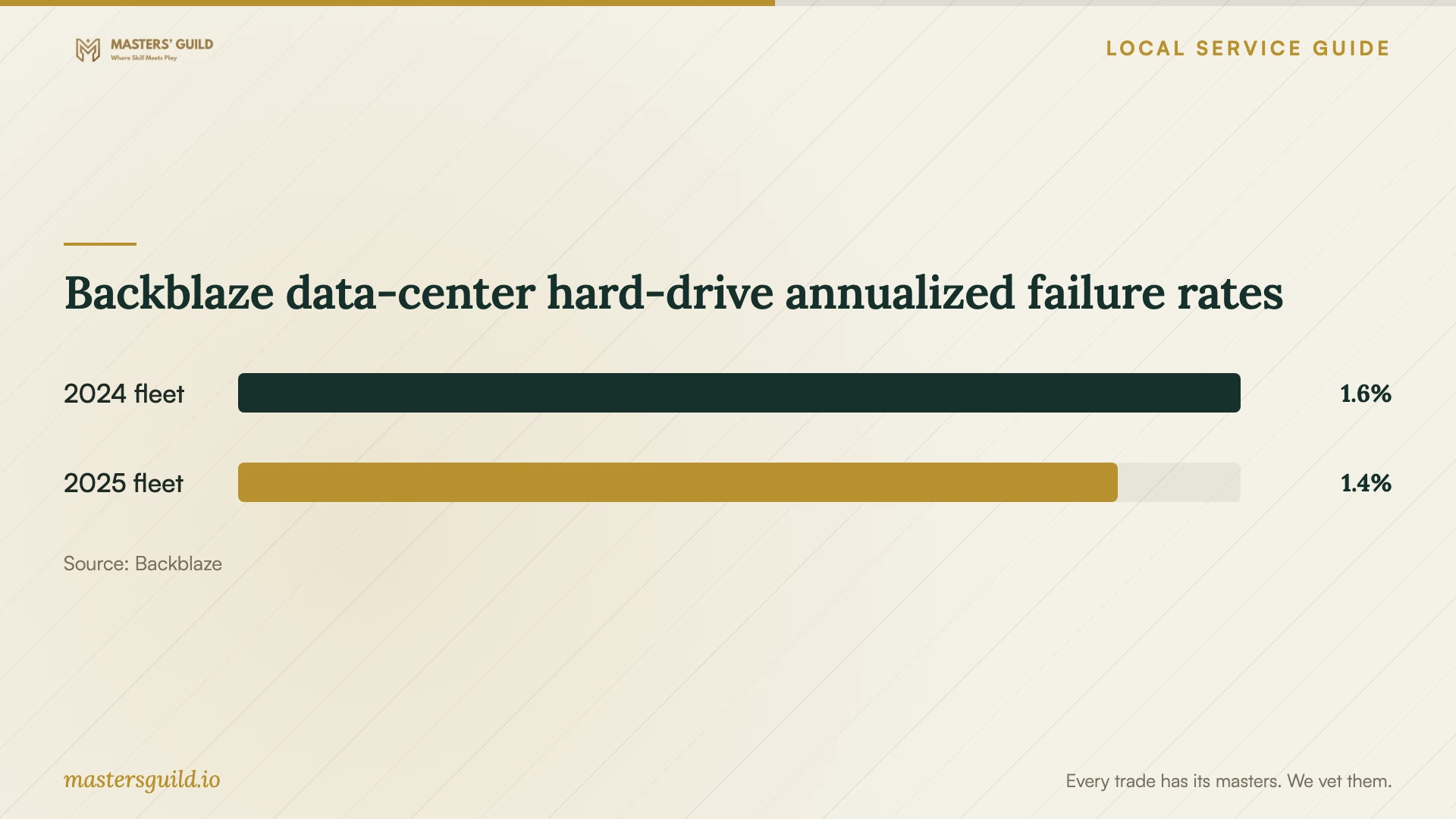
Backblaze reported annualized hard-drive failure rates of 1.55% for 2024 and 1.36% for 2025 in its data-center fleet. Its 2025 annual analysis covered 344,196 drives across 30 models after exclusions. These are fleet observations, not measurements of local service outcomes. [3]
Use the comparison as context for planning a backup and restore process. Backblaze measured drive failures, so these figures do not establish your device's recovery prospects or a local service price. Ask the provider to explain the assessment and uncertainties for your device before approving recovery work. [3]
Backblaze data-center hard-drive annualized failure rates
Local details that affect your job
North Carolina breach escalation and reporting
For a Durham business handing over North Carolina residents' personal information, specify immediate notification to your designated contact if the provider discovers a security breach. North Carolina DOJ requires businesses holding those records for another company to notify the owner or licensee immediately following discovery. If your business discovers a qualifying breach, DOJ says affected people must receive notice without unreasonable delay and identifies additional reporting to the Attorney General's Consumer Protection Division and the three major consumer reporting agencies. Arrange advice and reporting alongside recovery. [1]
State guidance changes the disposal sequence
North Carolina DOJ's statewide business guidance places backup and file transfer before old-hard-drive sanitization and calls for destruction of obsolete disks and backup tapes. Apply that sequence to your office's storage replacement: include transfer verification in the recovery scope and hold disposal authorization until you have checked the files you need. Ask the provider to document disposal as a separate completed task. [2]
Choose the scope that matches your situation
| Your situation | Requested scope | Acceptance or next step |
|---|---|---|
| You have a backup to try | Restore assessment and test | Open priority files at a separate destination |
| Priority files remain missing | Diagnosis and recovery proposal | Approve cost and define which returned files count as success |
| You suspect unauthorized access | Recovery plus incident assessment | Assess North Carolina breach notification and reporting duties |
| You plan to retire storage | Verified transfer and approved sanitization | Check transferred files before authorizing disposal |
| You need ongoing backup | Configuration and restore demonstration | Assign someone to review backup results and repeat restore checks |
Your hiring checklist
- Record the device identifier, symptoms, incident timing, and recovery attempts.
- List priority files, required applications, and the latest backup you can access.
- Confirm the handoff location, work location, and approval for subcontractor transfers.
- Approve an itemized scope, spending limit, and unsuccessful-recovery terms.
- Agree on credential sharing, access permissions, incident contacts, and copy deletion.
- Open priority files and witness a backup restore before accepting the job.
- Authorize storage disposal after verifying the transferred data.
Frequently Asked Questions
What should I ask about an unsuccessful recovery?
Ask what counts as success, whether partial recovery changes the fee, and which assessment, shipping, or storage charges remain payable. Put your priority files in the agreement so you can assess the result against your business needs.
Does a failed drive mean I must report a breach?
Drive failure alone does not establish the unauthorized access or acquisition and associated harm criteria in North Carolina DOJ's breach definition. If you suspect exposure of personal information, seek an incident assessment and advice on whether notification duties apply. [1]
Should the technician dispose of the original drive?
Approve disposal after checking the returned files and backup restore. North Carolina DOJ advises businesses to back up and transfer files before sanitizing old hard drives. Specify the disposal method and ask for a record of completion. [2]
Can drive failure statistics predict my recovery result?
Backblaze reports failures in its data-center drive fleet. Those observations do not measure recovery outcomes for your device. Ask the provider to explain the diagnosis, uncertainties, and proposed work for your case. [3]
Sources and scope
This guide combines the sources below with practical planning guidance. Figures apply to the stated geography and period; request a written quote for your property.