
Local service guide
Bathroom Remodeling in Detroit: Plan and Compare
For Bathroom Remodeling in Detroit, give contractors the same written scope and choose a proposal that names materials, exclusions, repair pricing, approval responsibilities, and bathroom downtime. Before demolition, ask whether the proposed work reaches water or sewer service infrastructure. If it does, have the contractor confirm applicable utility reviews and inspections with DWSD.
Prepare a scope contractors can price
Describe the problems you want to solve: leaks, difficult cleaning, limited storage, or awkward access. Give each bidder photographs, measurements, and a list of fixtures to retain. Request separate proposals for keeping the layout and moving fixtures if you have not decided between them.
Ask bidders to itemize demolition, debris removal, surface repairs, shower construction, waterproofing, tile, fixtures, lighting, ventilation, painting, and cleanup. Require product names or model numbers. For allowances, record the purchase amount included and ask how your selections would affect installation charges.
Request credential and insurance documents for the contractor and proposed trades. Identify the person supervising the work, the person handling questions, and the person authorized to price changes. Compare written warranty terms and the procedure for reporting a problem after completion.
Separate room work from utility service approvals
Ask the contractor to describe bathroom plumbing work and any water or sewer service work as separate items. For proposed service work, prepare a short description of what changes, where the work occurs, and whether the contractor anticipates a service disconnection or reconnection. Use that description when asking DWSD which review or inspection applies.
DWSD’s approved FY 2027 schedule lists water and/or sewer services permit plan review for residential zoning of four units or fewer at $150 for the first cycle and $75 for subsequent cycles. It also lists separate water and sewer permit inspections at $650 each, with fees relative to scope and permits valid for one year from issue. [1]
These entries concern the utility activities named in the schedule. They do not establish which approvals an interior bathroom remodel needs or provide a complete building or trade permit process. Ask the contractor to confirm project-specific requirements with the responsible authorities, identify who submits each application, and include inspection arrangements in the written proposal. [1]
Agree on repairs and bathroom downtime
Require photographs, a repair description, a price, and your written approval before added work begins. Discuss how the contractor will protect the exposed room while you review a change and how a pause would affect the completion date. Ask for separate prices for optional improvements so you can distinguish them from proposed repairs.
For your only bathroom, record the periods when you cannot use the toilet or shower and arrange an alternative. Agree on water shutoff notice, work hours, access, and daily cleanup. Tie demolition to delivery of your selected materials and confirmation of the people needed for the next stage.
Before accepting the schedule, ask the contractor to identify inspection checkpoints and explain which work must remain accessible for review. Include responsibility for scheduling, attendance, corrections, and any return visit in the proposal. Avoid accepting a completion promise without discussing these dependencies.
Choose fixtures using your existing bathroom as the baseline
EPA’s calculator assumes about 5 gallons per flush for toilets installed before 1980, 3.5 for installations from 1980 through 1994, and 1.6 after 1994. It uses 1.28 gallons per flush or less for WaterSense-labeled toilets. Use fixture markings or documentation when available instead of inferring flush volume from the house’s age. [2]
EPA states that WaterSense-labeled products undergo independent testing against efficiency and performance criteria. Include the proposed model in the quote, then check its dimensions, seat height, controls, and appearance against your preferences before authorizing purchase. [2]
Keep whole-house research in context. Researchers evaluated 160 WaterSense-labeled homes in the Las Vegas metropolitan region using annual water-use estimates for October 2020 through September 2021. They included indoor and outdoor use, estimated some missing months, and lacked separate indoor and outdoor metering. Those observations cannot isolate savings from one bathroom remodel in Detroit. [3]
Review costs and savings as separate decisions
Obtain construction prices for your proposed scope through contractor site visits. Compare the base price, allowances, optional work, exclusions, and repair approval terms. Ask bidders to explain any utility charge by naming the service involved rather than using a general permit allowance.
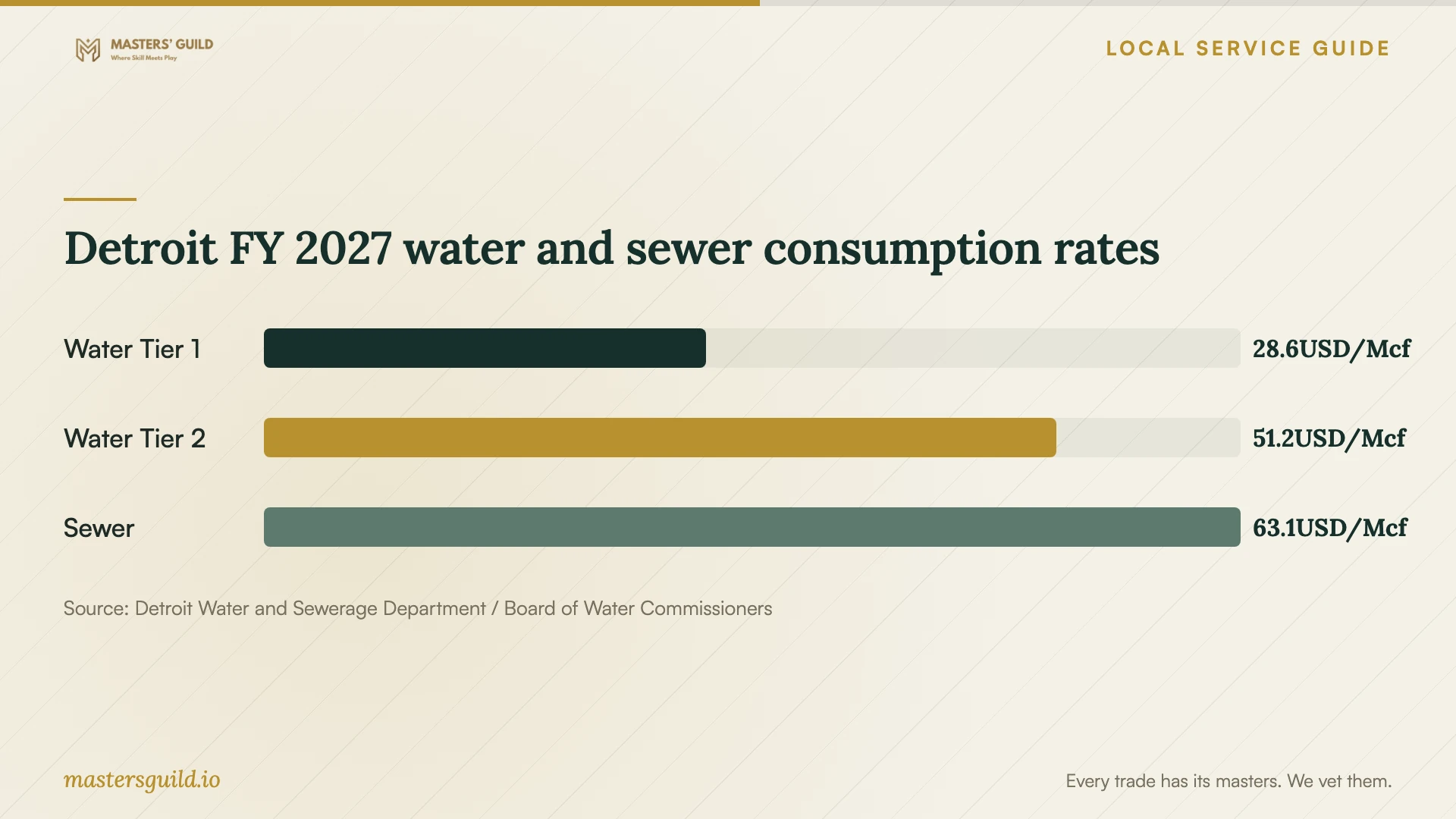
The Detroit Board of Water Commissioners approved the FY 2027 rates and fees resolution on March 24, 2026. The chart reproduces its consumption rates. Confirm the schedule applicable to your account and billing period before using those figures in a savings calculation. [1]
EPA’s calculator uses national average costs and assumes replacement or retrofitting of all applicable household fixtures. EPA advises comparing relative savings between scenarios because actual savings can vary. For a single bathroom, ask anyone preparing a forecast to identify the fixtures counted, usage assumptions, and account rates. [2]
Detroit FY 2027 water and sewer consumption rates
Local details that affect your job
Clarify utility plan review before pricing service work
For water and/or sewer services permit plan review, DWSD’s FY 2027 schedule distinguishes residential zoning of four units or fewer: $150 for the first review cycle and $75 for subsequent cycles. If your proposal includes service work, ask DWSD whether this review category applies and have the contractor identify submission and revision responsibilities. The fee table does not establish a review requirement for ordinary interior fixture replacement. [1]
Confirm inspection scope and permit timing
DWSD lists separate $650 water and sewer permit inspections, describes the fees as relative to scope, and states that each permit remains valid for one year from issue. For a project involving those utility permits, ask which inspection applies and coordinate the application date with the construction schedule. Do not treat either amount as a standard bathroom inspection charge. [1]
Keep recurring charges out of fixture savings
DWSD’s FY 2027 schedule lists monthly service rates of $8.68 per equivalent unit for water and $7.23 for sewer, plus drainage charges per billable acre. Ask an estimator to separate those categories from consumption charges when discussing fixture savings. [1]
Resolve scope questions before accepting a bid
| Your situation | Ask for | Next step |
|---|---|---|
| Keep the layout | An itemized list of retained and replaced items | Compare equivalent materials and allowances |
| Move fixtures | A separate relocation scope and price | Confirm approval and inspection responsibilities |
| Proposal includes utility service work | Confirmation of applicable DWSD review and inspection categories | Check the service scope before accepting fees |
| Replace a toilet | Existing flush volume and proposed model | Compare with EPA’s WaterSense reference of 1.28 gallons per flush or less |
| Remodel the only bathroom | Periods without toilet or shower access | Arrange an alternative before demolition |
Your hiring checklist
- Give bidders matching photographs, measurements, and fixture lists.
- Separate layout changes and utility service work from the base scope.
- Specify waterproofing products and ask how installation will be checked.
- Assign applications, inspection scheduling, and correction responsibilities.
- Confirm material delivery and alternative bathroom access before demolition.
- Require photographs, pricing, and written approval for added repairs.
- Review fixture operation, drainage, finish details, and cleanup before completion.
Frequently Asked Questions
How should I compare bathroom remodeling quotes?
Give bidders the same scope and resolve omissions before comparing totals. Review allowances, exclusions, repair pricing, supervision, cleanup, approval responsibilities, and written warranty terms.
Does the DWSD schedule establish my bathroom permit requirements?
The schedule names utility service review and inspection fees. It does not provide a complete interior remodeling approval process. Have the contractor confirm requirements for your specific scope with the responsible authorities before construction. [1]
Should a quote include both $650 utility inspections?
DWSD lists water and sewer permit inspections as separate activities and describes fees as relative to scope. Ask which activity applies to the proposed work and confirm that with DWSD before accepting either charge. [1]
Will efficient fixtures reduce the whole utility bill?
Assess consumption charges separately from DWSD’s service and drainage charges. EPA also cautions that actual savings can vary from calculator estimates. Review the existing fixtures, household assumptions, and applicable billing rates before accepting a forecast. [1] [2]
Sources and scope
This guide combines the sources below with practical planning guidance. Figures apply to the stated geography and period; request a written quote for your property.