
Local service guide
Kitchen Remodeling in Des Moines, IA
For Kitchen Remodeling in Des Moines, choose a contractor after comparing written scopes, checking Iowa registration, and agreeing on who handles trade work, permit questions, and inspections. Before authorizing demolition, settle the layout, appliance dimensions, material selections, and kitchen shutdown plan. For work disturbing paint in a pre-1978 home, ask about Iowa lead-safe certification and the applicable work practices. [1] [2]
Define the kitchen you want contractors to price
Start with the problems you want to solve: limited preparation space, awkward storage, worn finishes, or an appliance arrangement that interrupts cooking. Separate essential work from optional changes. Give bidders the same list so you can compare the work they propose.
Ask for separate proposals if you are deciding between retaining the layout and moving the sink, range, or walls. Have the contractor identify the plumbing, electrical, ventilation, and structural work included in each option. Ask the relevant city or county authority to confirm permit requirements for your address and scope before setting a demolition date. [2]
Record cabinet construction and finish, countertop material, backsplash coverage, flooring boundaries, lighting fixtures, and appliance model numbers. Ask who measures, orders, receives, and checks each item. For owner-supplied appliances, agree on who handles missing parts, delivery damage, and installation compatibility.
Check the business and the people doing trade work
Ask for the contractor’s legal business name and Iowa registration number, then check the record through DIAL. The state requires registration for construction businesses meeting its $2,000 annual earnings threshold. A general contractor’s registration does not cover subcontractors. [2]
Ask the remodeler to name the plumbing and mechanical contractors before you sign. DIAL requires businesses providing plumbing, mechanical, HVAC, refrigeration, sheet metal, or hydronic services to obtain the applicable Plumbing and Mechanical Systems Board contractor license. Check those credentials alongside construction registration. [2]
Request evidence of liability insurance and ask who supervises the work each day. Have the contractor identify who will perform electrical work and how you can verify the applicable credentials. In the contract, name the person responsible for applications, inspection scheduling, and correcting work that does not pass inspection.
Set demolition and household arrangements before work starts
If your home predates 1978, tell bidders before they price demolition. Iowa’s lead guidance covers renovation that disturbs painted surfaces in these homes, subject to stated exceptions. The state requires firms conducting covered renovation to hold certification and assign a certified lead-safe renovator to the job. [1]
For covered work, ask the contractor to describe containment, occupant warning signs, waste handling, cleaning, and post-renovation cleaning verification or clearance testing. Iowa lists these among the renovator’s project responsibilities. If the contractor proposes an exception based on paint testing, request the testing documentation. [1]
Agree on a temporary food preparation area, refrigerator location, water access, and the route workers will use. Ask for a schedule showing demolition, trade work, inspections, cabinet installation, countertop measurement, and final connections. Have the contractor explain which deliveries or approvals must happen before each stage.
Compare the complete bill and approve changes in writing
Request a written total that identifies demolition, disposal, installation, trade work, permit allowances, delivery, and cleanup. For each allowance, ask what product or quantity it covers and how the contractor will calculate an overage or credit. Keep a separate household reserve for work you might authorize after opening walls.
Ask the bidder to explain tax treatment for the actual scope. Iowa distinguishes repairs from qualifying remodeling. For qualifying remodeling, the contractor pays sales or use tax on building materials and supplies and does not charge the homeowner sales tax on those materials or remodeling labor. Repairs and retail purchases can receive different treatment. [3]
Tie payments to defined progress and record changes before the contractor performs them. Each change should state the work, price, and schedule effect. Before the final payment, walk through cabinet operation, appliance connections, finish repairs, cleanup, warranty documents, and any outstanding inspection items.
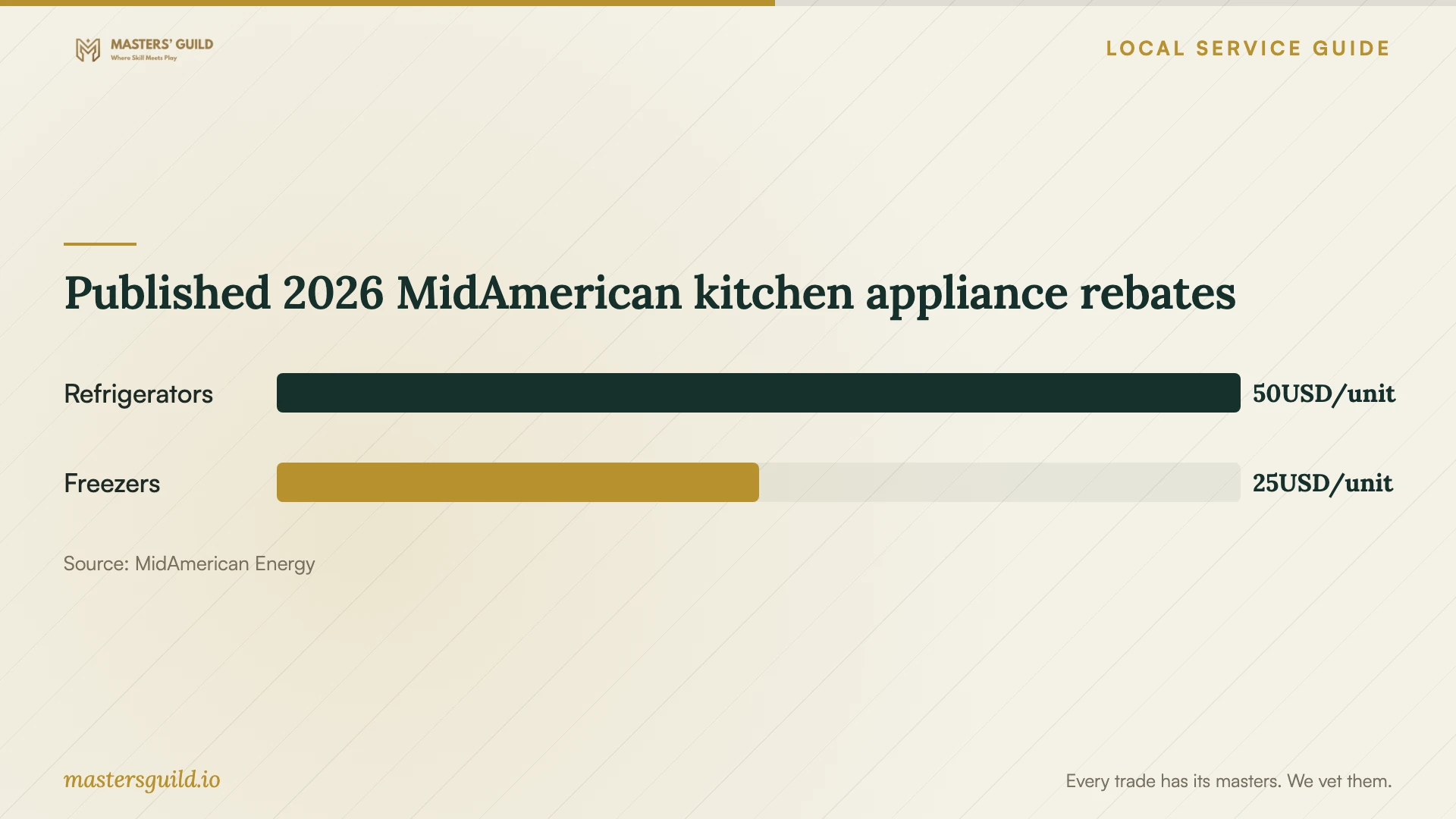
Published 2026 MidAmerican kitchen appliance rebates
Local details that affect your job
Iowa paint-disturbance rules affect demolition bids
For a pre-1978 kitchen, ask bidders to identify painted wood, plaster, and drywall they intend to disturb. Iowa uses different minor-maintenance thresholds for these surfaces, so avoid treating a small demolition area as an automatic exemption. DIAL also states that individuals must receive its lead-poisoning booklet before renovation of more than one square foot of painted surfaces. Request the applicable certification and occupant information before work begins. [1]
Iowa distinguishes cabinet repairs from remodeling for tax
Iowa lists replacement or repair of worn kitchen cabinet doors as a repair example, while cabinet replacement with some structural modification to the kitchen layout qualifies as remodeling. Ask bidders to explain their classification. If your contract combines qualifying remodeling with separate taxable repairs, request itemization so you can see which charges receive tax. [3]
MidAmerican’s year-end deadline affects appliance purchasing
If MidAmerican supplies the primary electricity to your appliance, check its 2026 refrigerator and freezer rebates before ordering. Qualifying models must carry ENERGY STAR certification and have at least 10 cubic feet of capacity. The utility requires purchase, installation, and operation during 2026, with applications due within 90 days of purchase or by December 31, 2026, whichever comes first. For a fall remodel, confirm the installation date before counting a rebate in your budget. [4]
Match your scope to the next planning step
| Your situation | Decision or check | Request from the bidder |
|---|---|---|
| You want to retain the layout | Define what stays and what the contractor replaces. | An itemized scope covering cabinets, surfaces, appliances, and connections. |
| You want to move walls or fixtures | Confirm trade work and local requirements before demolition. | A proposed layout and named responsibility for permit questions and inspections. |
| Your pre-1978 kitchen has painted surfaces to disturb | Check Iowa lead-safe requirements and any claimed exception. | Firm and renovator certification, work practices, and applicable testing records. |
| You are comparing cabinet-door repairs with a larger remodel | Ask how Iowa’s repair-versus-remodeling tax distinction applies. | A scope-specific explanation and itemization of separate taxable repairs. |
| You plan to claim an appliance rebate | Confirm MidAmerican eligibility and the 2026 installation deadline. | The appliance model, delivery and installation dates, and itemized receipt. |
Your hiring checklist
- Give each bidder the same layout, appliance models, finish selections, and list of work.
- Request registration numbers, trade-contractor names, and evidence of insurance.
- Ask the relevant permitting authority to confirm requirements for your address and proposed changes.
- Resolve paint-disturbance questions and request the contractor’s demolition and containment plan.
- Record allowances, exclusions, payment milestones, and the written change process.
- Confirm delivery dates and temporary kitchen arrangements before authorizing demolition.
- Keep appliance receipts, warranty information, and rebate application records together.
Frequently Asked Questions
What should I compare besides the total bid?
Compare the exact products, quantities, trade work, demolition, disposal, delivery, and cleanup. Ask each bidder to identify exclusions and allowances. Resolve who pays for missing installation parts, concealed-condition work, and changes you request after signing.
Does Iowa contractor registration cover subcontractors?
No. DIAL states that subcontractors need their own registration. Plumbing and mechanical contractors also need the applicable contractor license through the Plumbing and Mechanical Systems Board. Ask for the businesses’ names and credentials before they start. [2]
Can a remodeler skip lead-safe practices after testing the paint?
Iowa exempts surfaces tested and determined to contain no lead-based paint from lead-safe work practices. DIAL says that testing requires documentation and certification. Ask for the records supporting the exception rather than accepting an undocumented assurance. [1]
Does MidAmerican offer a rebate for any new refrigerator?
No. Its published 2026 offer covers qualifying ENERGY STAR-certified refrigerators of at least 10 cubic feet, with MidAmerican supplying the primary electricity. The rebate is $50 per unit. Purchase, installation, operation, and application must meet the program deadlines and conditions. [4]
Sources and scope
This guide combines the sources below with practical planning guidance. Figures apply to the stated geography and period; request a written quote for your property.