
Local service guide
Data recovery and backup in Des Moines
Data recovery and backup in Des Moines starts with choosing the right scope: restoring files, assessing a failed device, or responding to a security incident. Ask for a written assessment, an approval limit, privacy terms, and a plan to verify recovered files. For suspected ransomware, isolate affected systems and coordinate incident response before restoring business operations. CISA recommends recovery on a clean network and precautions against reinfection. [3]
Choose the work you need
Tell the provider what happened, which devices or accounts hold the missing information, and which files you need first. Include the last known usable backup and any steps you have taken since the loss. Request an assessment of the specific device or system before authorizing recovery work.
For a failed device, ask whether the provider performs the assessment and recovery itself or sends the device to another company. Confirm the destination, who can access the contents, how the provider records transfers, and who returns the original device. Request terms for retaining and deleting working copies of your data.
For suspected ransomware, ask for incident-response capability as part of the scope. CISA advises isolating affected systems, preserving evidence, and investigating the compromise before rebuilding. It cautions that powering down can destroy evidence in volatile memory, so its response sequence prioritizes network disconnection when possible. [3]
Make the recovery quote reviewable
Request separate amounts for assessment, recovery, replacement storage, transport, and any urgent service. Ask which charges apply if the provider cannot recover your priority files. Set a spending limit and require approval before the provider exceeds it or transfers the job elsewhere.
Write down the acceptance test before work begins. Name the folders, date ranges, and business records you need. Ask how you will check that recovered documents open and that your business application can use the restored information. A file listing alone should not be your acceptance test.
Obtain a written quote and estimated assessment and recovery schedules for your device or system. Have the provider state when it will give you the next update. Plan temporary operations around the information it can confirm.
Buy a backup service you can restore
Ask the provider to document what it backs up, how often it copies data, how long it retains versions, and who receives failure alerts. Agree on how much recent work you can afford to lose and how long you can operate without each critical application.
CISA recommends offline, encrypted backups and regular disaster-recovery tests. It explains that ransomware can delete or encrypt accessible backups. Ask the provider to demonstrate how it protects a recovery copy from compromised business accounts and how it restores data after an incident. [3]
Require a sample restore before accepting the setup. Choose a business record and, where relevant, an application restore. Have the provider record the result, explain any missing dependencies, and assign responsibility for future tests. Ask how you will retrieve your data and regain administrative control if you end the service.
CISA recommends phishing-resistant multifactor authentication and limiting third-party access to the provider's responsibilities. Ask who holds backup administrator access, who can delete copies, and how the provider documents its security commitments in the contract. [3]
Prepare for a security incident
CISA describes ransomware incidents that also involve stolen data. If you suspect unauthorized access, engage your IT responder and coordinate forensic and legal work alongside recovery. Ask them to preserve relevant evidence and identify which systems and information the incident affected. [3]
For an Iowa business, record the affected resident count and the date of consumer notification with the person handling legal response. The Attorney General's guidance identifies a state reporting threshold and deadline, and it notes possible federal obligations for some organizations. Do not treat a successful restore as the end of that review. [2]
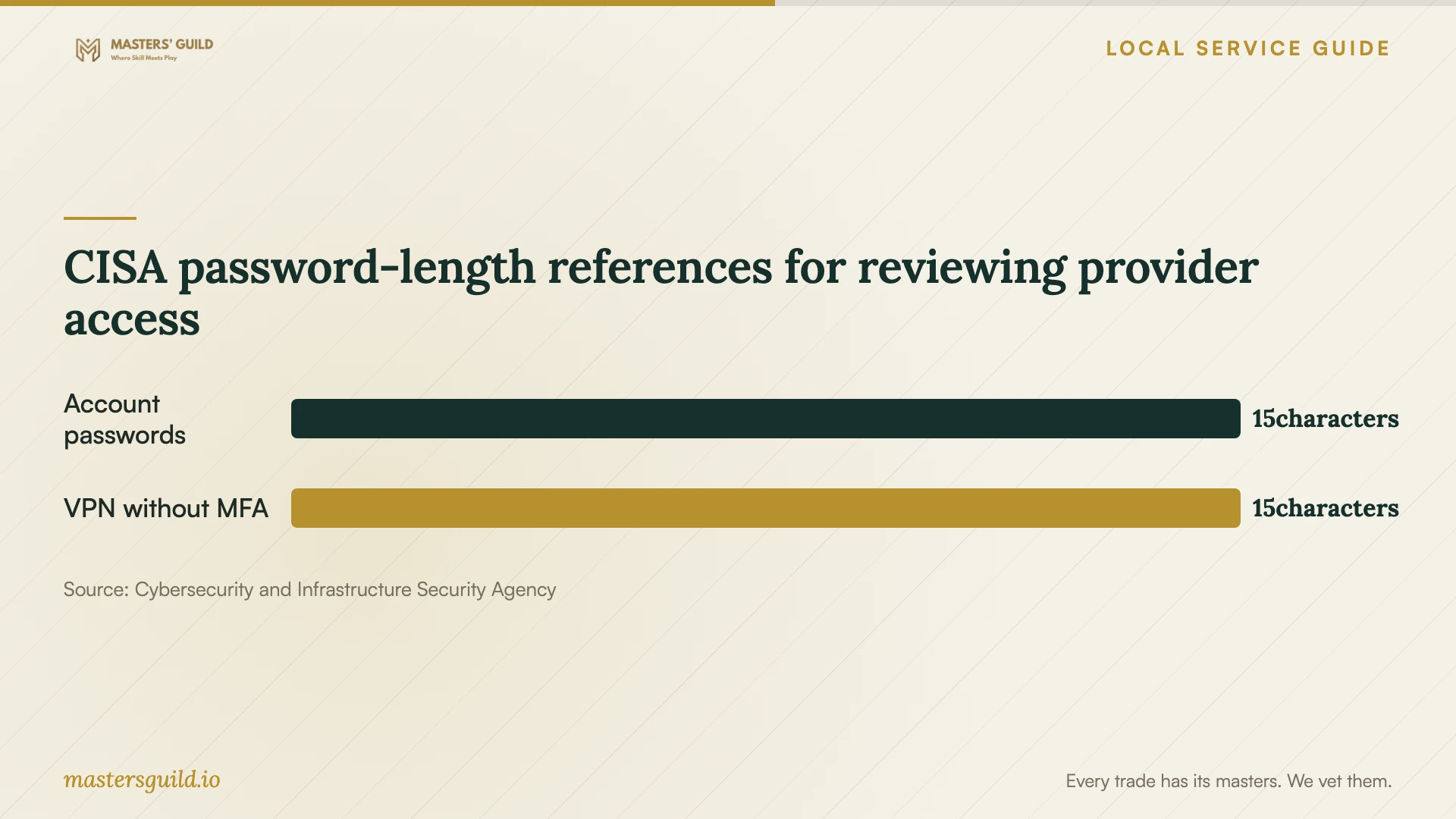
CISA password-length references for reviewing provider access
Local details that affect your job
Iowa tax can change the backup subscription quote
Iowa's Department of Revenue states that electronic file storage is subject to state sales tax and applicable local option tax; it also identifies software as a service as taxable. Its commercial-enterprise exemption covers qualifying storage and software purchases used exclusively by or furnished to that enterprise, with noncommercial use limited to de minimis use. For your Des Moines business, ask the seller to itemize storage, software, and other work and confirm whether your purchase qualifies before comparing totals. Do not assume the exemption covers the entire recovery job. [1]
Iowa breach notices need a separate owner
The Iowa Attorney General states that when a breach requires notice to more than 500 Iowa residents, the business must also send written notice to the Attorney General within five business days after notifying consumers. This statewide requirement applies to the reporting review for a Des Moines business; it is not a city-specific recovery rule. Assign someone to coordinate resident counts, consumer notices, and legal review while the technical team restores operations. The office also flags potential federal requirements depending on the business and data. [2]
Match the situation to the scope
| Situation | Scope to request | Acceptance question |
|---|---|---|
| Missing files with a usable backup | Restore assessment and verification | Can you open the priority records and use them in the relevant application? |
| Failed device with no confirmed backup | Device assessment and written recovery proposal | Who handles the device, and what do you owe if priority files cannot be recovered? |
| Suspected ransomware or unauthorized access | Incident response, evidence preservation, and recovery on a clean network | Who confirms containment and coordinates the Iowa notification review? |
| Ongoing backup setup | Protected recovery copies, alerts, access controls, and restore tests | Who demonstrates the restore and takes responsibility for future testing? |
Your hiring checklist
- List the priority files, applications, devices, and accounts before requesting an assessment.
- Record the symptoms, last usable backup, and actions taken since the loss.
- Confirm who performs the work and document any transfer to another company.
- Request itemized charges, unsuccessful-recovery terms, and an approval limit.
- Agree on privacy, access, working-copy deletion, and original-device return terms.
- Define a restore test using records and applications you need to operate.
- Ask the seller to identify Iowa tax treatment and any applicable business exemption.
- For a suspected breach, assign separate technical-response and notification responsibilities.
Frequently Asked Questions
Should I shut down computers after discovering ransomware?
CISA prioritizes isolating affected systems from the network. It recommends powering down when you cannot disconnect them to prevent further spread, but warns that shutdown loses potential evidence in volatile memory. Coordinate those steps with your incident responder. [3]
Does my business qualify for tax-free backup storage?
Iowa provides a commercial-enterprise exemption for qualifying electronic storage and other listed purchases under its use conditions. Ask the seller to confirm eligibility and required documentation for your purchase. Do not assume that business ownership makes all recovery services exempt. [1]
How do I check a proposed backup service?
Ask for a restore demonstration, a list of covered data, retention terms, failure-alert responsibilities, and administrator access rules. CISA recommends offline encrypted backups and regular tests of availability and integrity. Include those requirements in the written scope. [3]
Does restoring files settle a breach?
Complete the notification review alongside technical recovery. Iowa's Attorney General describes consumer-notice requirements, a separate Attorney General reporting threshold, and potential federal overlap. Ask your legal adviser to determine which obligations apply to the incident. [2]
Sources and scope
This guide combines the sources below with practical planning guidance. Figures apply to the stated geography and period; request a written quote for your property.