
Local service guide
Special Item Transport in Denver, CO
Arrange Special Item Transport in Denver by choosing a mover who will review your item, both access routes, and destination setup before quoting. Get the handling scope and damage terms in writing, check the company through the appropriate regulator, and settle street access before booking. Colorado’s Attorney General directs consumers to the PUC for moves within Colorado and FMCSA for interstate moves. Denver requires a permit for a moving truck or van parked in the street. [1] [2]
Define the item, route, and finished job
Describe the object you need moved: an upright or grand piano, pool table, safe, sculpture, or another item needing a handling plan. Include its make and model, dimensions, available weight documentation, and condition photos. Share manufacturer handling instructions and identify loose parts or existing damage. Have the estimator identify any missing information before offering a price.
Document the route from the item’s current position to the truck and from the truck to its final position. Include doorway widths, stair counts, landing dimensions, tight turns, exterior steps, and carrying distance. For an elevator, obtain dimensions, load limits, reservation rules, and moving hours from the building manager. Provide photos of both routes and arrange an inspection where the mover needs one.
Write down what completion means. For a piano, discuss disassembly, reassembly, and arrangements for tuning. For a pool table, specify whether you want transport alone or disassembly, reassembly, and leveling. For a safe, discuss emptying, anchoring, and placement. For artwork, identify who will pack or crate it and remove the packing materials. Let the mover explain which tasks the crew can undertake.
Screen the company and compare the complete price
Use the regulatory check that matches your trip. The Colorado Attorney General identifies the Colorado PUC as the agency responsible for permitting companies that move people within the state. For interstate moves, the office directs consumers to FMCSA. Obtain the legal business name and identifying details of the company that will perform the work. [2]
The Attorney General recommends speaking with at least three companies and seeking in-home estimates. The office identifies pressure to commit and reluctance to provide an in-home estimate as warning signs. During the estimate, have the mover explain the crew, equipment, packing, and route it proposes for your item. [2]
Compare written totals against the same scope. Have bidders identify charges for stairs, carrying distance, packing, disassembly, waiting, permits, and destination setup. Include the deposit, cancellation terms, payment schedule, and approval process for extra work. Agree on what happens if the crew discovers an access problem on arrival.
Obtain written damage and loss terms, including coverage limits, exclusions, any deductible, and the claim process. Identify who takes responsibility during packing, loading, transit, unloading, and reassembly, including subcontracted tasks. Keep condition photos and an inventory, then inspect the item with the crew before signing the delivery record.
Resolve Denver street access before applying
Denver’s Right-of-Way Services FAQ requires a permit to park a moving truck or van in the street. Its moving-vehicle answer distinguishes a Parking Meter Request Form for metered locations from a ROW Street Occupancy Request Form for locations without meters. Identify the intended truck position at each address and assign application responsibility in your agreement. [1]
The FAQ gives conflicting submission instructions for street occupancy applications. The moving-vehicle answer tells applicants to email the form, while another answer says street occupancy permits must go through E-Permits. Before applying, contact DOTI Permit Operations at 303-446-3759 to establish the current moving-truck process. The city lists a normal minimum Street Occupancy Permit review time of five days; allow for review without treating that figure as a promised approval date. [1]
For work in the street or public right-of-way, Denver’s FAQ requires a Traffic Control Plan for each right-of-way closure and identifies cranes and boom trucks as work requiring sidewalk closures. If your mover proposes a lift, have DOTI and the mover determine which permits and closures that specific plan requires. The cited guidance does not establish the requirements for a lift conducted entirely on private property. [1]
Prepare access and a weather fallback
Reserve building access and arrange for someone to meet the crew at both addresses. Clear furniture and loose objects from the route and keep children and pets outside the work area. Discuss protection for floors, thresholds, and walls with the crew. Mark the intended destination position so you can resolve placement questions before unloading.
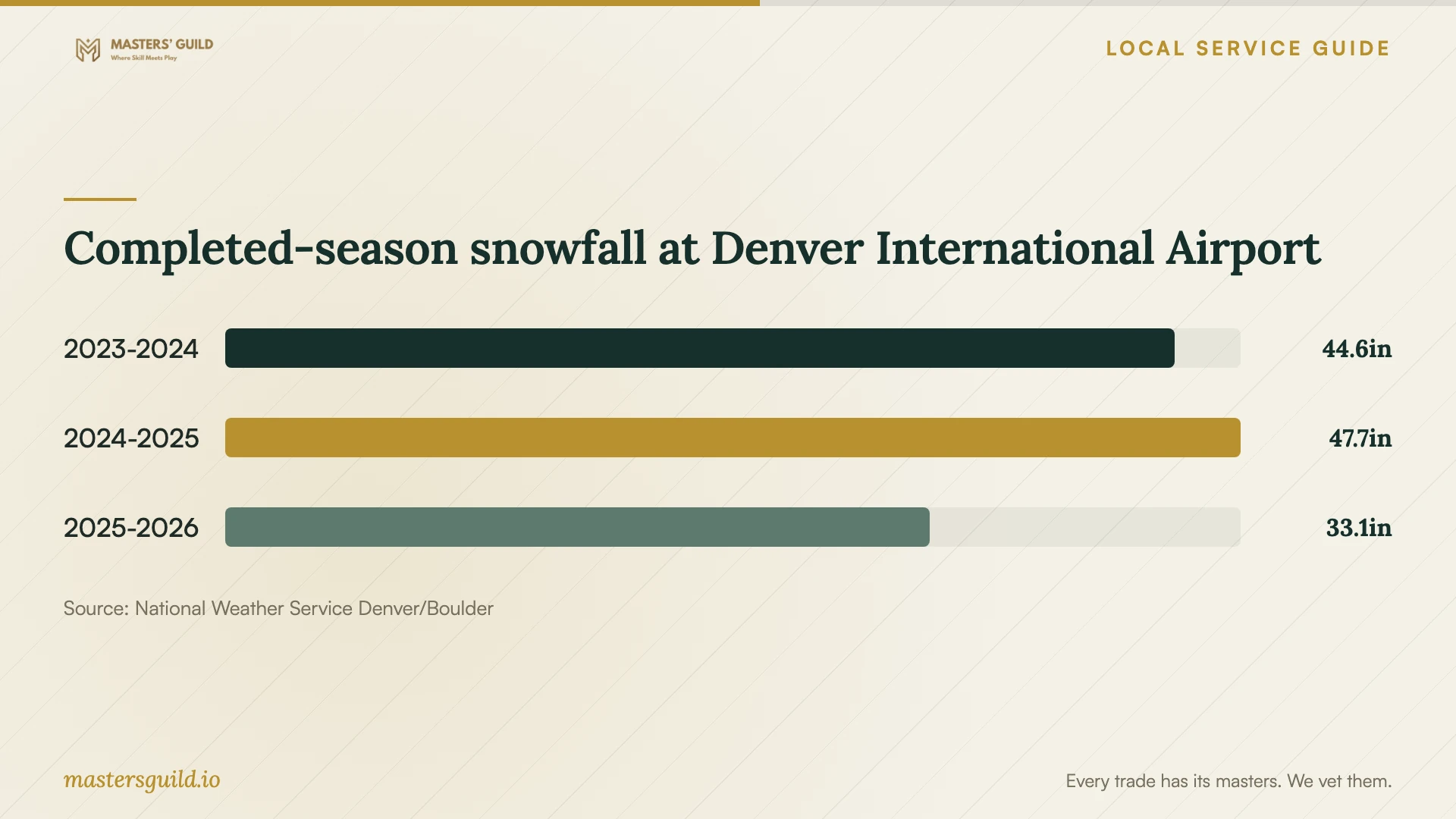
NWS explains that Denver’s official snowfall observations moved to Denver International Airport in 2007 and that snowfall varies across the region. The chart provides seasonal context from the airport. Inspect your own driveway, steps, and loading area, and check the forecast for both addresses before the truck departs. [3]
Agree on who will remove snow and address ice along the route, who can postpone the move, and how a delay affects deposits, building reservations, and permit dates. Have the mover explain the conditions under which the crew will proceed. Keep a contact available to report access problems before the crew travels.
Completed-season snowfall at Denver International Airport
Local details that affect your job
Resolve the city’s conflicting submission guidance
Denver distinguishes metered moving-truck parking from street parking without meters, but its FAQ gives both email and E-Permits instructions for street occupancy applications. Before submitting, call DOTI Permit Operations at 303-446-3759 to establish the current process for your loading location. Put the applicant’s name and permit responsibility in the moving agreement. [1]
Choose the regulator by the trip’s state boundary
Colorado’s Attorney General directs consumers to check movers with the Colorado PUC for moves within Colorado and to use FMCSA resources for interstate moves. Give prospective movers the full pickup and delivery addresses, then screen the company that will perform that trip. [2]
Choose the next step for your move
| Situation | Next step | Settle before booking |
|---|---|---|
| Move stays within Colorado | Check the mover with the Colorado PUC. | Legal identity of the company performing the work. |
| Move crosses a state line | Use FMCSA resources for the mover check. | Full pickup and delivery addresses. |
| Truck will park at Denver meters | Discuss the Parking Meter Request Form with DOTI. | Current application process, location, dates, and applicant. |
| Truck will park on a Denver street without meters | Resolve the FAQ’s email and E-Permits conflict with DOTI before submitting a ROW Street Occupancy Request. | Submission process, review timing, and applicant. |
| Mover proposes a crane or boom truck | Have DOTI and the mover assess the specific lift. The FAQ addresses sidewalk closures for this equipment during street or right-of-way work. | Applicable permits, closures, traffic control, and building approval. |
Your hiring checklist
- Send item identification, dimensions, weight documentation, and condition photos.
- Document the full carrying route at both properties.
- Define packing, disassembly, transport, and destination setup in writing.
- Complete the mover check appropriate to the trip.
- Resolve street access, application responsibility, and building reservations.
- Record price inclusions, extra-work approval, and damage claim terms.
- Agree on weather delays and inspect the item at delivery.
Frequently Asked Questions
How much should I budget for a specialty-item move?
Get an item-specific written estimate after the mover reviews both routes. Include handling, transport, permits, and setup in the agreed total, along with the circumstances that allow extra charges. Compare bidders using the same scope and review their exclusions.
Does Denver require a permit for a moving van on the street?
Yes. Denver’s FAQ requires a permit for a moving truck or van parked in the street. It distinguishes metered and unmetered locations but gives conflicting email and E-Permits instructions for street occupancy submissions. Establish the current process with DOTI Permit Operations before applying. [1]
Does a crane lift require a sidewalk closure?
Denver’s FAQ identifies cranes and boom trucks as requiring sidewalk closures in its guidance about street and right-of-way work. Have DOTI and the mover determine the requirements for your specific lift, including where the equipment will stand. Do not apply that statement to every private-property lift. [1]
What should I do if a mover holds my item for extra payment?
The Colorado Attorney General says to contact local law enforcement immediately if a moving company holds your belongings hostage. Keep the contract, estimate, payment records, and messages available. The office also accepts reports of scams, fraud, and suspicious business activity. [2]
Sources and scope
This guide combines the sources below with practical planning guidance. Figures apply to the stated geography and period; request a written quote for your property.