
Local service guide
Business Plan Consulting in Denver, CO
For Business Plan Consulting in Denver, hire around a defined decision: launching, seeking financing, or expanding. Ask for a written scope covering research, financial assumptions, editable files, and revisions. If you need help defining that scope, Denver Economic Development & Opportunity offers free one-on-one business advising and partner referrals before you commission paid work. [1]
Define the work before comparing consultants
Write a brief that identifies your business, the decision at hand, the intended reader, and your deadline. For financing, obtain the recipient’s current document requirements before commissioning the plan. For internal planning, name the question you need answered, such as whether you can afford another employee or a second location.
Separate writing from analysis in the proposal. Ask which customer interviews, competitor checks, financial calculations, and owner meetings the consultant will perform. Specify whether you want a narrative plan, a financial workbook, a presentation, or a combination. Request editable documents and a walkthrough so you can update the assumptions after handoff.
Ask for financial assumptions you can explain
Ask the consultant to connect projected sales to prices, customer volume, and your capacity to deliver. Give them your lease proposal, staffing plans, equipment quotes, and existing financial records where available. Mark uncertain inputs as assumptions and request a slower-sales scenario before committing to spending.
For a financing assignment, agree on who will confirm eligibility, assemble application documents, and answer follow-up questions. BUILD Denver offers coaching focused on loan readiness and application assistance. Ask the program partner what support it will provide before purchasing overlapping consulting work. [2]
For a business that expects city-contract revenue, ask the consultant to separate prospective opportunities from signed work. Denver distinguishes city certifications from federal transportation certifications and recommends asking clients which certifications they recognize. Confirm the relevant route before budgeting application work. [3]
Compare scope, fees, and revision terms
Request an itemized quote for discovery, research, financial modeling, drafting, and revisions. Ask what triggers an extra charge, including a change in funding recipient or a revised business concept. Keep consultant fees separate from filing costs and third-party research purchases so you can compare proposals on the same scope.
Ask candidates for a redacted sample relevant to your assignment. During the interview, have them explain how they would test one assumption in your business. Clarify who will do the work, how you will review drafts, and how they will protect financial records. Set milestone dates for owner inputs, the first draft, feedback, and final handoff.
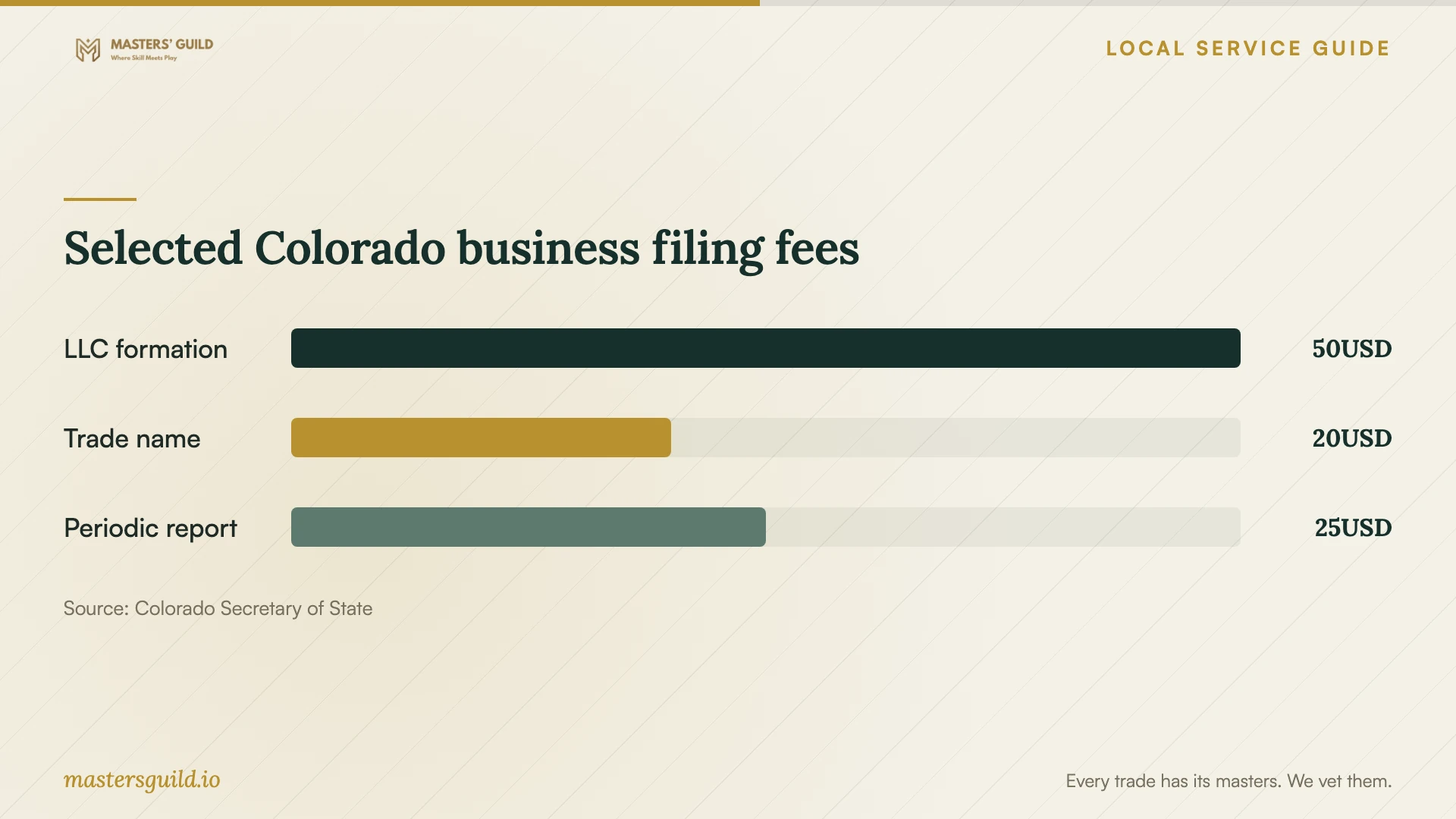
The Colorado Secretary of State lists a $50 online LLC formation fee, a $20 trade name statement fee, and a $25 periodic report fee. Treat these as separate administrative budget items where applicable. They do not establish a consultant’s price or your total startup cost. [4]
Prepare for the first working meeting
Prepare a short description of your offer, target customers, pricing, and sales process. Gather existing bookkeeping reports and list debts, owner contributions, and planned purchases. For a startup, bring supporting quotes and explain how you developed your sales assumptions. Tell the consultant which information you still need to obtain.
Agree on an acceptance standard before work begins: you should be able to trace major figures to a record or stated assumption, understand the cash needs, and edit the final files. Include a review meeting and define whether the fee covers responses to the recipient’s feedback. Ask for explanations of unfamiliar calculations before approving the final version.
Selected Colorado business filing fees
Local details that affect your job
Start with the city’s free advising
Denver Economic Development & Opportunity offers no-cost one-on-one advising, technical assistance, and referrals. Its Business Advancement team also helps businesses navigate city processes, permits, and requirements. If your plan depends on opening premises, use that support to identify unresolved requirements before asking a consultant to finalize an opening budget. [1]
Check city boundaries before planning around BUILD Denver
BUILD Denver requires businesses to operate, or establish a startup, within the City and County of Denver at funding, with intent to remain there. Applicants must also meet good-standing and underwriting requirements; the program focuses on businesses facing barriers to conventional financing. Confirm your address and eligibility with the program partner before paying for application preparation. A Denver-area mailing description alone does not establish eligibility. [2]
Allow time for city certification
For city certifications, Denver requires at least six months of active business operations. DSBO says review can take up to 90 days once it receives an application. If you expect to pursue work through these certifications, ask the consultant to account for that process when forecasting revenue. DSBO’s certification review does not evaluate profitability or financial viability, so treat financial planning as a separate task. [3]
Choose a starting point for your planning work
| Your situation | Starting point | Scope to request |
|---|---|---|
| You need help defining the problem | Denver’s free one-on-one advising | Clarify resources and gaps before commissioning paid work. |
| You are considering BUILD Denver | Confirm location and program eligibility | Coordinate with available loan-readiness coaching before buying application support. |
| You want to test an expansion | Define the spending decision | Request cash-flow scenarios and documented operating assumptions. |
| You plan to pursue city contracts | Confirm the certification route | Account for eligibility and review timing in the forecast. |
Your hiring checklist
- Identify the plan’s reader, purpose, and submission deadline.
- Obtain the funding recipient’s document requirements.
- Gather financial records, debts, owner contributions, and supplier quotes.
- Identify assumptions that need research or confirmation.
- Specify the narrative, financial workbook, and editable files you expect.
- Agree on milestones, revision limits, payment terms, and extra charges.
- Confirm responsibility for applications and follow-up questions.
Frequently Asked Questions
Should I pay for a complete plan before speaking with a lender?
Ask the lender for its requirements first. Then commission the missing work. Specify whether the consultant will respond to questions after submission and whether those revisions fall within the quoted fee.
Can I get free business-planning help in Denver?
Denver Economic Development & Opportunity offers free one-on-one business advising, technical assistance, and partner referrals. Ask what help fits your situation and which deliverables you would need to commission elsewhere. [1]
Does hiring a consultant guarantee BUILD Denver funding?
No. The city states that submitting an application and meeting basic eligibility criteria does not guarantee approval. Colorado Enterprise Fund evaluates applications under its underwriting procedures. Ask a consultant to explain the application work they will deliver. [2]
How much should I budget for consulting?
Obtain a written quote based on your research needs, financial model, deliverables, and revision terms. The sources here do not establish a Denver consulting price range. The filing fees shown below are administrative charges, separate from professional fees. [4]
Sources and scope
This guide combines the sources below with practical planning guidance. Figures apply to the stated geography and period; request a written quote for your property.