
Local service guide
Dallas mold removal: Hiring and Planning
Arrange mold removal in Dallas by identifying the moisture source, checking Texas mold credentials, and agreeing on assessment, cleanup, repairs, and completion documents before work starts. For licensed remediation, obtain an independent assessment consultant’s protocol and the remediator’s work plan. Assign responsibility for fixing the leak and checking Dallas permit requirements for the repair. [1] [2] [4]
Define the problem before authorizing cleanup
Give the assessor your leak history and point out visible growth, musty odors, and previous repairs. TDLR advises inspecting concealed areas and correcting the underlying moisture problem. Include plumbing access areas, closets, and other affected spaces in the discussion rather than limiting the visit to the visible patch. [1]
TDLR says identifying the mold species is generally unnecessary. Before paying for sampling, have the consultant explain what decision the results will change and establish criteria for interpreting them. TDLR cautions that sample results require the context of a physical inspection and the building’s characteristics. [1]
For licensed remediation, obtain the consultant’s protocol before cleanup. The assessment scope should identify the rooms, material quantities, remediation methods, and clearance criteria. The remediator then prepares a work plan. Agree on who will assess completion and deliver the findings. [1] [2]
Check Texas credentials and project exemptions
Texas requires non-exempt mold assessors and remediators to hold TDLR licenses. Verify the providers’ license status with TDLR, identify the responsible consultant and remediation contractor, and review complaints and company reputation before signing. [2]
Treat 25 contiguous square feet as a regulatory threshold rather than a blanket rule for choosing DIY cleanup. TDLR describes exemptions for unlicensed people handling smaller areas of visible mold and certain property exemptions. A licensed remediation contractor must follow the mold rules even on a smaller project, including using a consultant’s protocol and preparing a work plan. [1]
A person may hold assessment and remediation licenses but cannot perform both roles on the same ordinary residential project. The Attorney General also states that a person cannot own an interest in both firms performing those roles on the same project. Have providers explain their relationship before accepting a bundled proposal. [1] [2]
Compare complete written estimates
Request project-specific written estimates against the same assessment protocol. Separate assessment, remediation, moisture-source repair, and rebuilding. Include material quantities, access arrangements, disposal, completion assessment, and exclusions. Set a written approval process for additional work if the crew discovers more affected material.
Review whether each total includes completion documentation and any required notification fee. Identify who will handle the leak repair, who will replace finishes, and whether either task requires a separate contract. Keep payment milestones tied to the agreed scope and deliverables.
If you plan to use insurance, review coverage and bids with your insurer before assuming it will pay for assessment, cleanup, or repairs. The Attorney General cautions that residential policies do not cover all water and mold damage. Your insurer may assist with contractor selection but cannot require a specific remediation company. [2]
Agree on timing and access
For projects subject to notification, the Attorney General describes notice to TDLR at least five days before work begins, except in emergencies. TDLR identifies a notification threshold of 25 contiguous square feet or more and a $25 submission fee. Have the contractor explain whether notification applies and account for it in the proposed start date. [2] [3]
TDLR defines an emergency as a situation where delay would increase mold contamination due to water damage. The mold licensee determines whether an emergency exists. The remediation contractor or company must submit notification no later than the following working day after identifying the emergency. Discuss immediate water-damage response and scheduled remediation as separate parts of the plan. [3]
Before the crew arrives, settle room access, belongings, working hours, and use of adjacent spaces. Have the contractor explain containment restrictions. TDLR advises licensees to explain entry risks and ensure protection for owners who choose to enter containment. [1]
Plan completion before replacing finishes
TDLR says painting over mold does not solve the problem. Its guidance calls for removing moldy porous materials such as drywall, carpet, and insulation, correcting the moisture source, and keeping the home dry. Assign someone to verify the repair before you authorize replacement finishes. [1]
For licensed remediation, the Attorney General states that the remediator must provide the owner a remediation certificate within ten days after completing the work. The certificate includes an assessor’s statement about cleanup and indicates whether the providers corrected the underlying cause. It covers mold removal rather than other water-damage repairs. [2]
Arrange formal clearance requirements before cleanup. TDLR says a consultant who did not prepare a protocol before remediation cannot declare that the project achieved clearance. A separate post-remediation inspection and certification route may apply. Discuss the documentation you need before choosing your cleanup approach. [1]
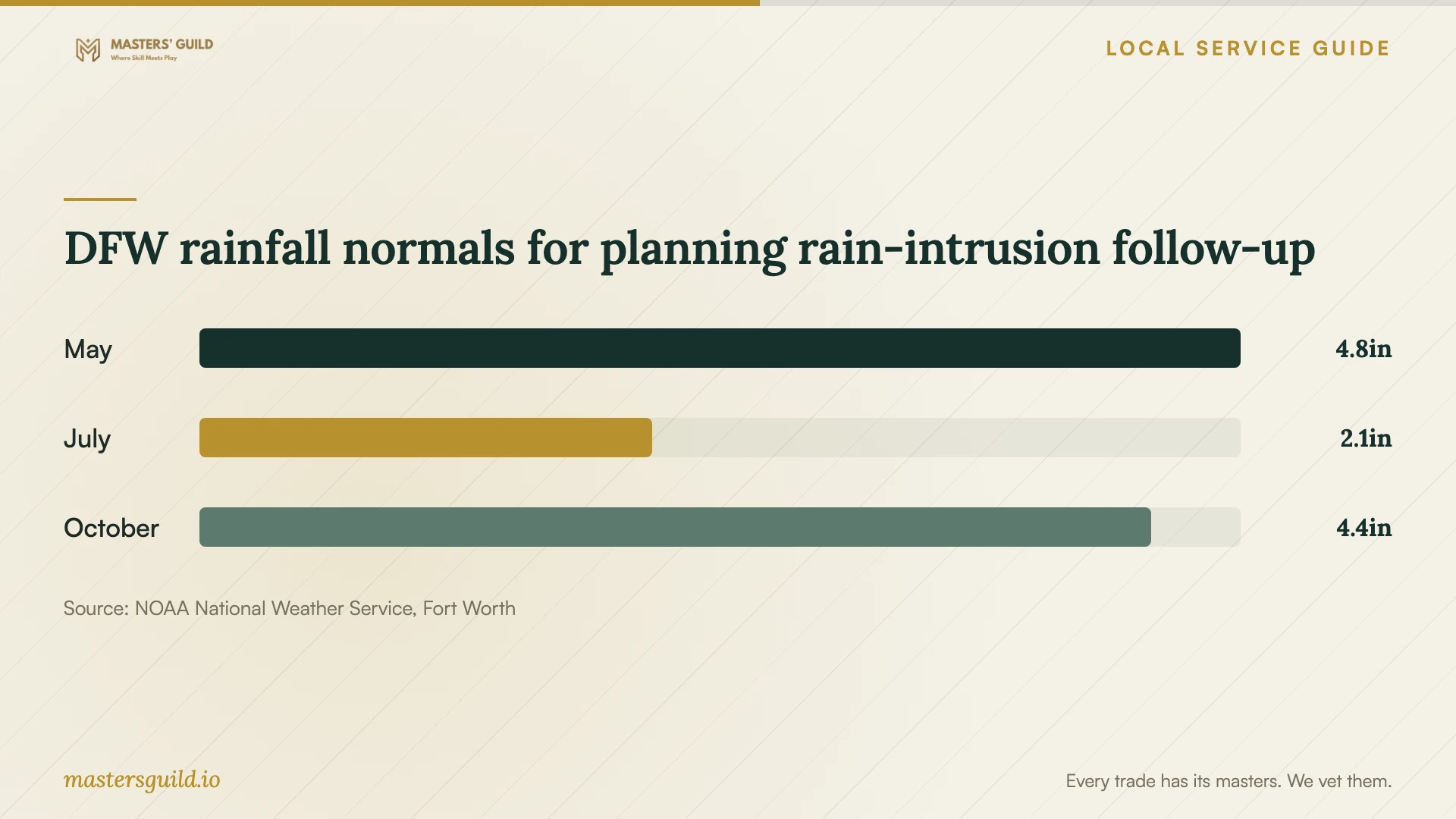
DFW rainfall normals for planning rain-intrusion follow-up
Local details that affect your job
Check Dallas permits against the repair scope
Dallas generally requires a building permit for structural work. Its exemptions include stopping plumbing leaks without replacing or rearranging valves, pipes, or fixtures, and certain nonstructural interior remodeling in single-family or two-family dwellings. Have the repair contractor document the applicable exemption or permit responsibility. For scope clarification, contact Planning and Development’s Plan Review and Field Service Inspections at 214-948-4480. [4]
Review property designation before exterior repairs
If fixing rain intrusion involves exterior work in a City of Dallas designated historic district, the city requires approval of a certificate of appropriateness before work begins. Conservation districts have district standards and a work review process. Check your property’s designation before choosing exterior replacements or committing to a repair start date. [4]
Plan a follow-up after rain
The National Weather Service’s Dallas/Fort Worth precipitation normals show 4.78 inches in May and 4.37 inches in October for 1991–2020. For rain-related damage, agree with the repair provider on how to inspect the repaired area after subsequent rain. These regional averages do not establish the moisture source in your home. [5]
Choose your next step
| Situation | Next step | Planning point |
|---|---|---|
| Small visible patch | Discuss the applicable Texas exemption before choosing cleanup | A licensed remediator still needs a consultant’s protocol and work plan |
| Musty odor or suspected hidden growth | Arrange inspection of affected and concealed areas | Discuss the purpose and interpretation of sampling before paying for it |
| Remediation subject to notification | Have the contractor account for notice in the start date | The mold licensee determines an emergency; the remediation contractor or company files notice |
| Structural or exterior repairs | Check Dallas permits and property designation | Historic-district exterior work requires advance approval |
| Formal clearance needed | Arrange the consultant’s protocol before remediation | A later inspection cannot replace that prerequisite for formal clearance |
Your hiring checklist
- Photograph affected areas and record when you noticed moisture or odor.
- Prepare a history of leaks, overflows, and previous repairs.
- Record each provider’s responsible professional and license details.
- Obtain the assessment protocol and contractor work plan before licensed remediation starts.
- Compare cleanup, repair, rebuilding, and completion assessment as separate estimate items.
- Document responsibility for permits and exterior-work review.
- Set access arrangements, working hours, and change-order approval terms.
- Collect completion findings, the certificate, photos, and invoices.
Frequently Asked Questions
Do I need testing before removing visible mold?
TDLR says testing to identify the kind of mold is not required before cleaning or remediation. Licensed remediation still requires a consultant’s protocol. Have the consultant distinguish inspection and scope development from sample collection. [1]
Can one company assess and remove the mold?
Texas allows people to hold both licenses, but they cannot perform both roles on the same ordinary residential project. The Attorney General also prohibits an ownership interest in both firms doing those jobs on the same project. [1] [2]
Does Dallas require a permit for mold cleanup?
Evaluate the repair and rebuilding scope with Dallas Planning and Development. The city generally requires permits for structural work and lists exemptions for certain leak repairs and nonstructural interior remodeling. Its guidance does not establish a universal permit requirement for mold cleanup. [4]
What documents should I keep?
Keep the assessment, remediation contract, certificate, photos, and invoices. The Attorney General says remediators must give homeowners copies of project-record photos. If you sell, you must give the buyer copies of remediation certificates issued for the property. [2]
Sources and scope
This guide combines the sources below with practical planning guidance. Figures apply to the stated geography and period; request a written quote for your property.