
Local service guide
Door and Window Repair in Dallas, TX
For Door and Window Repair in Dallas, choose a contractor who explains which components need work and gives you a written scope before ordering parts. Check approvals before setting the installation date. Dallas generally exempts like-for-like replacement when structural opening size and wall sections stay unchanged; new or enlarged openings require a permit. Landmark properties need a Certificate of Appropriateness before exterior work, including routine maintenance. [1] [2]
Choose a scope before choosing a replacement
Describe the problem in terms the contractor can inspect: the door catches, the lock will not engage, the window will not stay open, or you see moisture. Photograph the entire opening and the affected part. For moisture, note whether you see it on a surface or between panes and whether it appears during rain.
Ask the contractor to name the components they propose to repair, retain, or replace. Request their reasoning for replacing the whole assembly and ask for a repair option where they consider one feasible. For fogging, have them describe the proposed treatment and promised result in writing.
Keep people away from broken or loose glass while you arrange professional assessment. Discuss temporary protection before booking permanent work. Include who will secure the opening between visits, who will measure for parts, and who will handle an incorrect order.
Understand the three approval documents
Building permit: Dallas uses building permits for construction work that requires City authorization and inspections. Its door-and-window guidance says like-for-like replacement typically needs no permit if structural opening size and wall sections remain unchanged. Adding or enlarging an opening requires a permit. Confirm the proposed dimensions and wall work with permit staff at (214) 948-4480. [1]
Certificate of Appropriateness: This is the exterior-work approval required for structures and lots in a Landmark District or individually designated as Dallas Landmarks. Preservation staff review qualifying routine maintenance; the Landmark Commission reviews more substantial alterations. The City requires the certificate even for routine-maintenance work. [2]
Conservation District Work Certificate: The City guide's dedicated conservation sections identify this approval for exterior changes in conservation districts. Its general windows-and-doors summary instead uses Certificate of Appropriateness terminology for both historic and conservation districts. Ask Planning to confirm the correct document for your address and proposal rather than choosing an application from that summary alone. [1]
Follow the approval sequence before construction
1. Check the address. The City guide directs owners to its GIS maps for historic and conservation district status. It also identifies individually designated Landmarks as properties requiring exterior-work approval. Ask Planning to confirm your property's status and the approval route for your proposed work. [1] [2]
2. Obtain the applicable exterior approval. For Landmark work, submit the Certificate of Appropriateness application and required supporting items through DallasNow. Staff do not process incomplete applications. Ask preservation staff whether the repair qualifies for routine-maintenance review. For conservation-district work, confirm the Work Certificate process with the Conservation District Office. [1] [2]
3. Obtain any required building permit. The City guide places historic or conservation approval before the building-permit application. For Landmark work, the Historic Preservation Office says construction can begin after you post the certificate at the front of the property and obtain applicable building permits. [1] [2]
For planning, ask the contractor to make ordering and installation commitments conditional on the required approvals. Agree in writing who prepares the application, responds to staff questions, pays fees, and arranges inspections. Keep those responsibilities separate from the repair price so you can compare proposals.
Compare quotes, taxes, and contractor responsibilities
Request a quote for each opening with parts, installation, trim repairs, painting or staining, cleanup, and temporary protection identified. Have the contractor list exclusions and obtain your written agreement before charging for concealed damage. Compare proposals using the same scope and ask for payment milestones, cancellation terms, and parts and workmanship warranties.
Texas does not tax labor to repair residential real property. Under a lump-sum residential repair contract, the contractor pays tax when buying supplies and materials and does not charge the customer tax. Under a separated contract, the contractor collects applicable sales tax on incorporated materials and specified services; construction labor remains nontaxable. Ask the contractor to explain the tax calculation and contract type. [4]
For a contractor who will pull a permit, use the City's account-free DallasNow registration lookup. Search by business name or registration number, then check Active status, registration category, and expiration date. The City also recommends requesting current insurance documentation and references from recent Dallas projects. [1]
Prepare the opening and inspect the completed work
Discuss access, alarms, pets, blinds, and furniture before the visit. Agree on floor protection and how the contractor will protect an exposed opening if rain interrupts installation. Ask for the ordering interval and installation date as separate commitments.
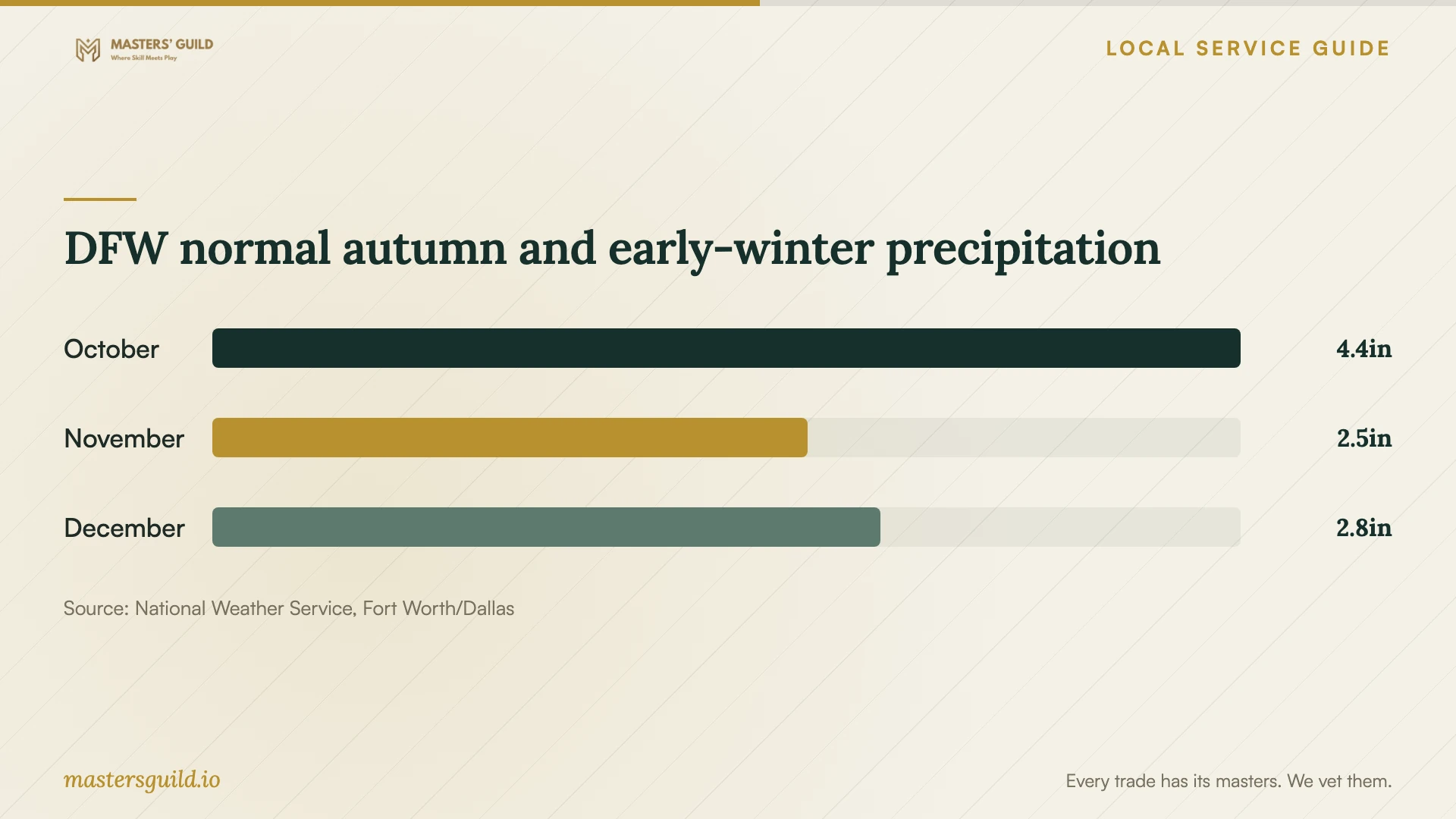
DFW's 1991–2020 normal October precipitation is 4.37 inches. Use that regional figure as a reason to discuss rain protection for autumn exterior work, then check the forecast for the appointment. It does not describe rainfall at your home or predict installation-day weather. [3]
Before final payment, operate each repaired door or window with the contractor present. Check opening, closing, latching, and locking against the agreed scope. Review trim and finish work, photograph the result, and record remaining tasks with completion dates. Keep the invoice, warranty, product specifications, and approval records together.
DFW normal autumn and early-winter precipitation
Local details that affect your job
Opening changes trigger a permit decision
Dallas conditions its typical like-for-like permit exemption on leaving structural opening size and wall sections unchanged. A new or enlarged opening requires a permit. Before approving a product, confirm whether the contractor will alter either feature and describe that scope to permit staff at (214) 948-4480. [1]
Landmark review affects the start date
For complete routine-maintenance applications, the Historic Preservation Office states processing within 21 days, with most processed within 7–10 business days. Incomplete applications receive no processing. Ask staff to classify the work before scheduling, and begin approved work after posting the certificate at the property's front and obtaining applicable building permits. [2]
Conservation approval needs address-specific confirmation
Check the City's district maps and ask the Conservation District Office at (214) 670-4209 about exterior door or window changes. The dedicated guide specifies a Conservation District Work Certificate, while the general replacement summary uses conflicting terminology. Confirm the application route before committing to materials. [1]
Approval decisions before ordering
| Proposed work | City approval consideration | Your next step |
|---|---|---|
| Like-for-like replacement | Typically no building permit if structural opening size and wall sections remain unchanged | Confirm the scope and check exterior district approvals |
| New or enlarged opening | Building permit required | Assign application and inspection responsibilities |
| Exterior Landmark repair | Certificate of Appropriateness required, including routine maintenance | Ask staff to classify the work and submit a complete application |
| Exterior conservation-district change | Dedicated guidance specifies a Conservation District Work Certificate | Confirm the correct application with Planning because the general summary uses different terminology |
Your hiring checklist
- Photograph each opening and record the operating or moisture complaint.
- Ask which components the contractor proposes to repair, retain, or replace.
- Confirm property status and approval responsibilities before scheduling construction.
- Approve measurements and product specifications before ordering.
- Compare matching scopes, including finish work, protection, cleanup, and tax.
- Agree on payment milestones and written approval for additional charges.
- Operate each completed opening together and retain warranty and approval documents.
Frequently Asked Questions
Should I accept a whole-window replacement proposal?
Ask the contractor to identify the affected component and explain the replacement recommendation. Request a repair option where they consider one feasible. Compare the complete scope, warranty, and payable total before deciding.
Does matching the original window avoid Landmark approval?
No. Dallas requires a Certificate of Appropriateness before exterior Landmark work, including routine maintenance. Minor repairs using the original material and design may qualify for staff review. Ask preservation staff to confirm the classification. [2]
Can a permit exemption remove conservation-district approval?
The City's dedicated conservation guidance requires a Work Certificate for exterior changes. Check that requirement separately from the conditional building-permit exemption for like-for-like replacement, and ask Planning to confirm the document for your address. [1]
Why do residential quotes show different tax line items?
Texas distinguishes lump-sum contracts from separated materials-and-labor contracts. For residential repair, the contractor pays purchasing taxes under a lump-sum contract without charging customer tax. Under a separated contract, the contractor collects applicable tax on incorporated materials and specified services, while construction labor remains nontaxable. [4]
Sources and scope
This guide combines the sources below with practical planning guidance. Figures apply to the stated geography and period; request a written quote for your property.