
Local service guide
Bricklaying and Masonry in Dallas: Plan Your Job
For Bricklaying and Masonry in Dallas, hire a contractor who explains the damage, specifies compatible materials and puts permit responsibility in writing. Before accepting a cosmetic repair, ask whether the wall needs structural work. Check retaining-wall height and loads with City staff. For exterior work on a Dallas landmark property, obtain preservation approval and post the certificate on the front of the property before starting. [1] [2] [3]
Choose the repair after understanding the damage
Ask the contractor to distinguish deteriorated mortar, damaged bricks and movement in the wall. The National Park Service identifies several possible crack causes, including foundation settlement, thermal and moisture movement, and failed support over openings. Ask for an assessment before treating a stair-step crack as proof of foundation trouble. [3]
Request an explanation of whether you have solid masonry, a cavity wall or nonstructural veneer. For cracks around doors or windows, ask the contractor to examine the support above the opening. NPS describes cracking and displacement caused by lintels that deflect or rust, and advises addressing structural problems before repairing the masonry surface. [3]
Photograph the affected area from the same position and record when you first noticed it. Ask whether the contractor recommends monitoring movement or obtaining a structural assessment before pricing the repair. If you see leaning, bulging or loose masonry, keep people away from the affected area while you arrange an assessment.
Specify the mortar and finished appearance
For historic brickwork, choose a contractor who can explain mortar compatibility beyond color matching. NPS advises matching the existing mortar's color, hardness and permeability. It warns that hard mortar with high concentrations of portland cement can accelerate deterioration of surrounding historic masonry. [3]
Ask for a small sample area before approving work across a visible wall. Record your agreement on brick selection, mortar color, joint width and tooling. NPS advises matching historic joint appearance and keeping mortar off brick faces during application and cleanup. [3]
Discuss cleaning or coatings as a separate decision. NPS warns that abrasive cleaning can remove a brick's hard outer surface and that nonpermeable coatings can trap moisture in historic masonry. Ask the contractor to explain the proposed treatment before agreeing to sandblasting, painting or waterproofing. [3]
Compare bids with the same scope
Give each bidder the same photographs and description. Ask each to identify the repair area, brick replacements, mortar specification, access equipment, cleanup and exclusions. For new brickwork, request drawings or dimensions that show the location, height, openings and intended finish. Agree on who will handle design questions, permits and inspections.
Get site-specific written bids for your repair scope. Have bidders separate optional work from the work they consider necessary, and explain how they will price damage uncovered after removal. Before accepting a bid, agree on how the contractor will document additional work and obtain your approval for its cost.
Check tax line items against the contract type. For residential repair under a lump-sum contract, the Texas Comptroller says the contractor pays tax on purchases and does not charge the customer tax. Under a separated contract, the contractor collects tax on incorporated materials and certain services; construction labor remains nontaxable. [4]
Agree on responsibility and completion
For permit work, use DallasNow to check the contractor's registration status, expiration date and registration type. The City provides a public contractor search without an account and tells owners to confirm Active status. Ask for a current Certificate of Insurance and references from recent Dallas projects. [1]
Put the permit applicant, inspection scheduling, payment stages and change-order process in the agreement. Ask the contractor to describe weather contingencies and protection for unfinished work. Before final payment, walk the repair together, compare it with the agreed sample and scope, and collect any applicable inspection records and written warranty terms.
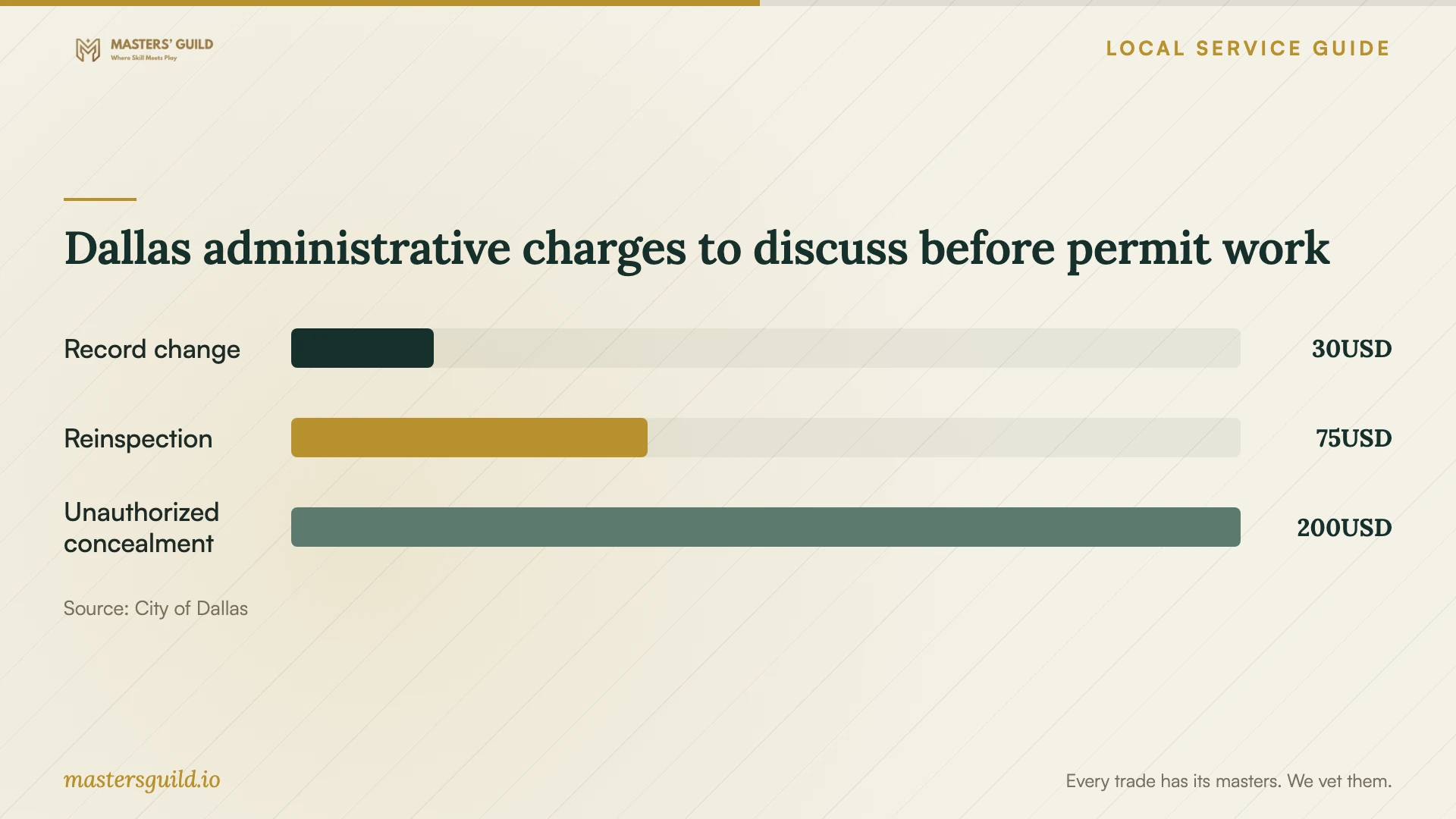
Dallas administrative charges to discuss before permit work
Local details that affect your job
Retaining-wall height includes the footing
Dallas's development guide says retaining walls over four feet require a permit and may need sealed engineering plans. The City defines height from the bottom of the footing to the top of the wall. Walls four feet or less can also require a permit when they support a surcharge, such as a driveway, a fence directly on top or a steep artificial slope behind them. Send staff the dimensions and nearby loads before treating a short garden wall as permit-exempt. Confirm current requirements at (214) 948-4480 or 320 E. Jefferson Blvd. [1]
Landmark repairs need approval before work
On a property in a Landmark District or individually listed as a Dallas Landmark, obtain a Certificate of Appropriateness before exterior work begins. Minor repairs using the original material and design may qualify for staff-level routine maintenance review, but staff must confirm eligibility. The preservation office states that it processes routine-maintenance certificates within 21 days, with most taking 7 to 10 business days. Plan the start date after approval. Before beginning approved work, post the certificate on the front of the property and obtain any applicable building permits. [2]
Check slope-related review in Southwest Dallas
For a new wall or earthwork project in Southwest Dallas or Oak Cliff, ask Engineering whether the address lies in the Escarpment Zone or a Geologically Similar Area. The City describes mandatory pre-application review and additional geotechnical requirements for affected properties before building-permit issuance. Contact Engineering before commissioning a standard wall design; ask staff to check the parcel against the geological maps rather than assuming its neighborhood determines eligibility. [1]
Match the job to the next step
| Situation | Next step | Include in the scope |
|---|---|---|
| Deteriorated mortar in historic brickwork | Discuss compatible repointing materials | Mortar properties, joint profile and sample area |
| Cracks or displacement around an opening | Assess the lintel and other support before cosmetic repair | Diagnosis and any structural repair |
| Retaining wall over four feet | Confirm the permit path with Dallas staff | Footing-to-top measurement and any engineering plans |
| Short retaining wall supporting a driveway or fence on top | Ask staff about the surcharge exception | Nearby loads and permit responsibility |
| Exterior repair on a Dallas landmark property | Obtain a Certificate of Appropriateness and post it on the front of the property before work | Approved materials, certificate and applicable building permits |
Your hiring checklist
- Photograph the whole wall and close-ups of damaged joints, bricks and openings.
- Describe your goal: repair existing masonry, rebuild a section or construct new work.
- Ask the bidder to explain the cause of damage and any assessment needed before repairs.
- Give bidders identical dimensions, access information and finish requirements.
- Ask City staff which permit and preservation steps apply to your address and scope.
- Request insurance documentation and ask about applicable Dallas contractor registration.
- Agree on a sample area, written changes, payment stages and completion documents.
Frequently Asked Questions
Does a retaining wall under four feet need a Dallas permit?
It can. Dallas measures height from the bottom of the footing, and the City identifies surcharge loads as an exception to the usual exemption for walls four feet or less. Explain any driveway, fence on top or steep artificial slope to staff before work. [1]
Can I begin a like-for-like brick repair on a landmark property?
Obtain preservation approval first. Dallas requires a Certificate of Appropriateness even for routine maintenance on landmark structures and lots. Staff determine whether your repair qualifies for their review or needs Landmark Commission review. Before starting approved work, post the certificate on the front of the property and obtain any applicable building permits. [2]
Should a residential masonry repair quote include sales tax on labor?
Texas does not tax residential real-property repair labor. Under a lump-sum contract, the contractor pays tax on purchases and does not charge you tax. Under a separated contract, the contractor collects tax on materials and certain services. Ask the bidder to identify the contract type and explain each tax charge. [4]
Sources and scope
This guide combines the sources below with practical planning guidance. Figures apply to the stated geography and period; request a written quote for your property.