
Local service guide
Art instruction in Dallas: Choose Your Class
Choose art instruction in Dallas by matching your goal to the teaching format: ask a recreation center about an introductory class, compare private instructors for focused feedback, or explore Dallas College for sustained studio study. Before booking, confirm the medium, student age range, teaching plan, total cost and supplies. Dallas Parks lists several visual-art mediums, while Dallas College describes a credit pathway with drawing, design and studio electives; neither page establishes current seats for your preferred class. [1] [3]
Choose a format around your learning goal
Describe what you want to learn before comparing instructors. For drawing, you might request help with proportion and shading. For painting, ask for instruction in color mixing or brush control. Bring examples of your work and explain where you get stuck. Ask the teacher to describe the first lesson and how they will give feedback.
Dallas Park and Recreation lists drawing, painting, sculpting, ceramics and photography among its art offerings. Contact a listed center to ask which of those mediums it teaches during the session you want. Confirm whether the class involves demonstrations, guided practice and individual feedback, and check the age range before registering. [3]
For private lessons, ask to see the instructor’s work in your chosen medium and examples of their teaching approach. For a child, discuss parent presence, pickup arrangements and communication before the first meeting. Consider an initial lesson before committing to a package, and agree on what you want to assess afterward.
Check recreation-center access before registering
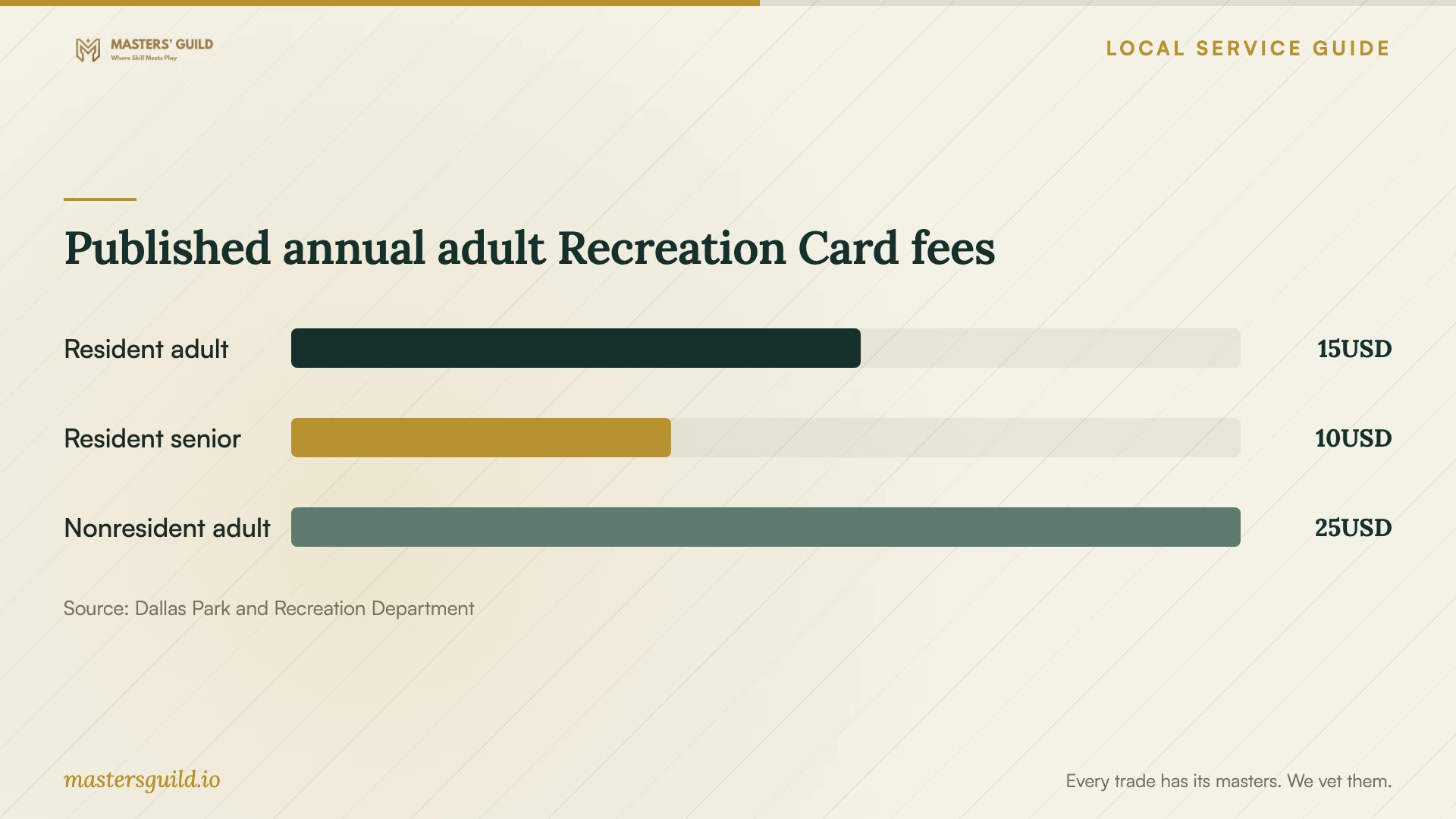
Dallas allows residents and nonresidents to use its recreation centers. Participants need a Recreation Card, and residents must present identification establishing Dallas residency to receive the resident rate. Cards last one year from purchase. The published adult resident fee is $15 for ages 18–59; the senior fee is $10 for ages 60 and older; the adult nonresident fee is $25. [4]
The city lists free card fees for preschool and youth age groups. Guests 17 and younger need a parent or legal guardian to sign a release before the city issues a card. Children five and younger must have supervision from a guardian older than 16. Ask the center how these access rules apply to your child’s selected class and whether the parent needs to remain during instruction. [4]
The city lists a $5 daily drop-in charge when you do not present a valid card. Ask staff to separate the class charge, access charge and supply costs in your registration total. Do not treat the card fee as the price of an art course. [4]
Compare college study with your available time
Dallas College’s 2026–2027 Studio Art and Design Studies/Graphic Design pathway includes Drawing I, Drawing II and design courses, with studio choices such as painting, ceramics, photography and watercolor. The college describes it as an Associate of Arts transfer pathway and warns that the example sequence does not guarantee course availability. Ask a success coach about enrollment requirements and the course that fits your goal. [1]
For credit classes, Dallas College publishes tuition of $99 per credit hour for Dallas County residents, $169 for out-of-county residents and $250 for out-of-state or out-of-country residents. Its tuition page gives $297 as the Dallas County price for a three-credit-hour class. Continuing-education tuition varies by course, so request the price for the exact course rather than applying the credit rate to a workshop. [2]
Before enrolling, ask about weekly attendance, work outside class, supply purchases and access to studio equipment. Compare that commitment with your household schedule. If you want a hobby class without pursuing a degree, explain that goal to the college and ask which enrollment route to use.
Request a complete lesson quote and prepare your space
Ask a private instructor for a written quote that states the number of students, lesson length, location and teaching goal. Have them separate instruction, travel, supplies and any equipment charges. For a package, confirm expiration dates, missed-lesson rules, rescheduling and refunds before paying.
For lessons at home, send the instructor a description of the workspace. Discuss table protection, lighting, water access, cleanup and storage between lessons. Ask which materials they plan to use and what preparation they require. For ceramics, confirm where the instructor will arrange firing and how you will collect finished work.
After the first lesson, review whether the teacher addressed your goal and gave you a practice task you understand. Ask what you should work on before returning. Use that discussion to decide whether to continue with the same format, change the medium or request more focused instruction.
Published annual adult Recreation Card fees
Local details that affect your job
Call a listed center about the actual class
Dallas Parks names Kidd Springs, Lake Highlands and Harry Stone among its visual-art program locations and tells readers to contact centers for details. Choose a location you can attend, then ask staff for the current medium, age group, schedule, fees and supplies. The citywide list does not establish that each center teaches each medium. [3]
Use the correct residency category
Dallas recreation access uses Dallas residency, while Dallas College’s lowest published credit tuition uses Dallas County residency. Check your eligibility with each organization before comparing totals. Bring residency identification for a recreation card and ask the college which documents it needs to classify your tuition. [2] [4]
Confirm the campus and course together
Dallas College lists its art and design pathway at Brookhaven, Cedar Valley, Eastfield, El Centro, Mountain View, North Lake and Richland. It also warns that the pathway does not guarantee course availability. Confirm the specific studio course, campus and meeting times before arranging transportation or buying supplies. [1]
Choose your next inquiry
| Your goal | Option to investigate | Confirm before committing |
|---|---|---|
| Explore a visual-art medium | Dallas recreation-center art class | Current medium, age range, class fee, supplies and Recreation Card |
| Get feedback on specific work | Private instruction | Teaching approach, first-lesson goal, full quote and cancellation terms |
| Pursue sustained credit study | Dallas College art and design pathway | Enrollment requirements, course availability, campus and residency tuition |
| Take a course outside a degree plan | Ask Dallas College about continuing education | Whether a suitable course is available and its course-specific tuition |
Your hiring checklist
- Name your medium, current skill level and learning goal.
- Confirm the student age range and parent-presence arrangements.
- Ask the center or instructor for the exact schedule and available place.
- Request a total that separates instruction, access, supplies and travel.
- Check residency requirements before relying on a published fee.
- Agree on cancellations, missed lessons and package expiration.
- Confirm workspace preparation, cleanup and equipment arrangements.
- Ask for a practice plan before committing to further lessons.
Frequently Asked Questions
Does the recreation card fee include an art class?
Dallas publishes the card fee as an access requirement for recreation centers, classes and programs. Its arts page directs readers to individual centers for program details. Ask the center for the class price and supply charges in addition to the card requirement. [3] [4]
Can a nonresident take a Dallas recreation-center class?
Dallas allows residents and nonresidents to use recreation centers. Its published Recreation Card fee for nonresident adults is $25. Confirm the selected class’s registration requirements and availability with the center. [4]
Is $297 the price of any Dallas College art class?
The college publishes $297 for a three-credit-hour class for Dallas County residents. That figure does not establish the total for your selected art course. Confirm its credit hours and supply costs; continuing-education courses have course-specific tuition. [2]
What should I ask a private art instructor before booking?
Ask how they teach your chosen medium, how they assess your starting point and what you will practice in the first lesson. Confirm lesson length, materials, travel charges, cleanup and cancellation terms. For a child, agree on supervision and parent communication.
Sources and scope
This guide combines the sources below with practical planning guidance. Figures apply to the stated geography and period; request a written quote for your property.