
Local service guide
Mold Removal in Corpus Christi, TX: Hiring Guide
For Mold Removal in Corpus Christi, arrange an assessment of the affected materials and moisture source before agreeing to cleanup and reconstruction. A Texas-licensed mold remediation contractor must use a work plan based on a licensed mold assessment consultant’s protocol, including on projects under 25 contiguous square feet. Review city repair requirements before approving rebuilding. [1] [2]
Choose the assessment and cleanup team
Collect each provider’s business name, individual license holder, license category, and license number. Use TDLR’s license search to check the credentials. TDLR regulates mold assessment and remediation professionals in Texas; confirm the mold license rather than relying on a restoration company description or training certificate. [1]
Identify who will write the assessment protocol and who will perform remediation. Texas allows a person or company to hold both licenses but prohibits them from conducting both activities on the same project, subject to the school-district exception. Licensed assessors and remediators must give the client and property owner the Consumer Mold Information Sheet before mold-related activity begins. [1]
Have the assessor explain the affected materials, removal boundaries, moisture-source repair, and completion criteria. Before booking, agree on who coordinates the assessor, cleanup contractor, and rebuilding trades. Request an explanation of any proposed sampling and the decisions the results would support.
Define the problem before buying testing
TDLR says identifying mold species before cleanup is unnecessary and advises against routine sampling. The agency notes that authorities have not established standards for an acceptable quantity of indoor mold. If you purchase sampling, have the licensed consultant explain how they will interpret the results and what recommendations they will make. [1]
Arrange an inspection for visible mold or a musty odor. TDLR recommends checking hidden areas, including plumbing access spaces, attics, closets, and areas behind furnishings. Its guidance calls for fixing the moisture problem, removing mold, and keeping the home dry. It advises removing and discarding moldy porous materials such as drywall, carpet, and insulation; painting over mold does not resolve the problem. [1]
Keep the licensing exemption separate from your cleanup decision. TDLR allows certain unlicensed people to handle projects below 25 contiguous square feet of visible mold under the minimum-area exemption. A licensed remediation contractor must still follow the rules, including a work plan based on a licensed consultant’s protocol. Describe recurring growth and suspected hidden damage when requesting an assessment. [1]
Compare complete scopes and budgets
Build your budget from an inspected scope and written offers. Request separate prices for assessment, proposed sampling, remediation, moisture-source repairs, completion inspection, and reconstruction. Have bidders identify removal areas, debris handling, access arrangements, and exclusions. Compare offers against the same protocol so you can see which tasks each price includes.
Require written approval for additional work discovered during removal. Have each provider separate confirmed work from allowances for unopened areas. Agree on room access, worker entry, belongings, and the person responsible for coordinating rebuilding. Request a schedule that identifies dependencies, including repairs and the completion assessment.
Coordinate insurance and completion records
TDI says most homeowner policies cover sudden and accidental water damage, such as a burst pipe, while policies usually exclude gradual leaks and seepage. Most home policies exclude floods and require a separate flood policy for that risk. TDI also says most home policies exclude mold cleanup and testing after removal of a damaged item. [4]
Report damage to your insurer, photograph affected materials, and keep receipts. TDI advises making temporary protective repairs, retaining damaged items until the adjuster sees them, and delaying permanent repairs until the insurer sees the damage. Coordinate inspection and disposal instructions with stopping the leak and starting drying. [4]
Agree on completion documentation before cleanup begins. TDLR says a consultant who did not prepare the protocol before remediation cannot declare clearance. The agency distinguishes clearance from a later inspection and certification that the property shows no evidence of mold damage. Confirm which process and certificate your project will receive, and retain the protocol, work plan, repair records, and completion documents. [1]
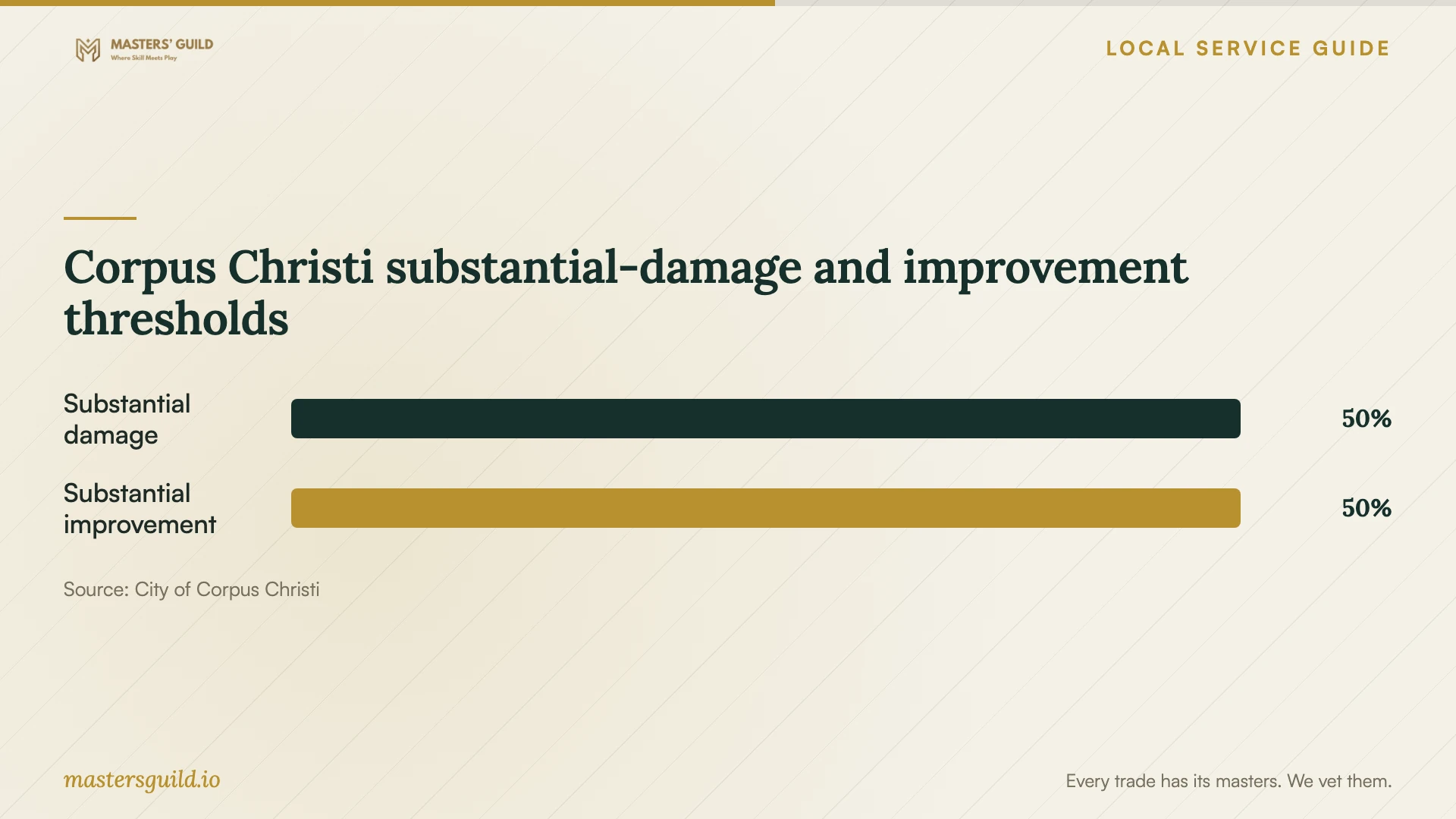
Corpus Christi substantial-damage and improvement thresholds
Local details that affect your job
Prepare the city repair submission
Contact Corpus Christi Development Services at (361) 826-3240 with the proposed repair scope. The city’s guidance addresses remodeling and repairs; ask Development Services which permits your exact scope requires. For interior remodeling submissions, the city lists a residential building permit application, existing and proposed floor plans, a scope of work, and an elevation certificate for property within a floodplain. Windstorm-related repairs require an engineer. Through the Dynamic Portal, you can submit applications, upload documents, pay fees, and schedule inspections. First-time users need an account. [2]
Resolve floodplain requirements before rebuilding
For a flood-damaged home, contact the city’s Floodplain Management Division at (361) 826-1875 about a substantial-damage determination and whether a Repair Cost Form applies. The city defines substantial damage as restoration costs reaching or exceeding 50% of the structure’s pre-damage market value. The calculation includes all costs needed to restore the structure, regardless of how much work you intend to perform. A substantially damaged or improved building must meet city floodplain regulations, which may require elevation. Review the full restoration estimate before approving reconstruction. [3]
Choose the next step for your situation
| Situation | Next step | Basis |
|---|---|---|
| Visible mold or a musty odor | Arrange an inspection of affected and hidden areas. | TDLR recommends inspection and correction of the moisture problem. |
| A licensed contractor quotes a small patch | Request the consultant’s protocol and contractor’s work plan. | Licensed contractors must follow the mold rules below 25 contiguous square feet. |
| Cleanup includes interior rebuilding | Review the repair scope with Development Services. | The city lists application, floor-plan, and scope requirements for interior remodeling. |
| Flood damage requires substantial repairs | Review the full restoration estimate with Floodplain Management. | The city defines substantial damage using an inclusive 50% structure-value threshold. |
| You intend to file an insurance claim | Discuss damaged materials, cleanup, and testing separately. | TDI distinguishes water-damage coverage from mold cleanup and testing expenses. |
Your hiring checklist
- Photograph affected rooms and record when you discovered the leak or odor.
- Collect provider names, Texas mold license categories, and license numbers.
- Identify separate assessment and remediation responsibilities.
- Request the protocol, work plan, exclusions, and itemized prices.
- Identify who will repair the moisture source and coordinate reconstruction.
- Review the proposed repair scope with Development Services and, if applicable, Floodplain Management.
- Agree on room access, belongings, change approvals, and completion records.
Frequently Asked Questions
Can one company assess the mold and remove it?
Texas prohibits a person or company from conducting both assessment and remediation on the same project, even if they hold both licenses. TDLR identifies an exception for school-district employees working on their district’s project. [1]
Does mold removal itself need a city building permit?
The city’s guidance addresses remodeling and repairs; ask Development Services which permits your exact scope requires. Include material removal, reconstruction, and exterior repairs in the description you provide. [2]
Can I get clearance after cleaning the mold myself?
TDLR says a consultant who did not prepare a protocol before remediation cannot declare clearance. A licensed consultant may conduct a later inspection and complete the applicable certification that the property shows no evidence of mold damage. Discuss the documentation you need before starting. [1]
Will my homeowners insurance pay for everything?
Have your insurer review the cause and your policy. TDI says most policies cover sudden accidental water damage, usually exclude gradual leaks, and exclude floods. TDI says most home policies exclude mold cleanup and testing after a damaged item is removed. Ask whether your insurer offers added cleanup coverage for a covered loss and whether testing is included. [4]
Sources and scope
This guide combines the sources below with practical planning guidance. Figures apply to the stated geography and period; request a written quote for your property.