
Local service guide
Tree cutting in Columbus, OH: Hiring and Permits
Before arranging tree cutting in Columbus, ask the contractor to identify public trees and nearby power lines, then give you a written scope for pruning or removal, stump work, and cleanup. Columbus requires a Forestry permit for work on a public tree or within its Critical Root Zone. For work near an Ohio Power Company pole-to-house service line, call the utility to arrange disconnection before the contractor starts. [1] [2]
Identify the tree and the work you want
Ask an arborist to inspect the tree before you commit to removal if your concern involves its condition or whether pruning could meet your needs. Explain what you want to accomplish: clear a roof, address a damaged limb, remove a tree, or prepare space for a replacement. Ask the arborist to explain the proposed work and the consequences of leaving the tree in place.
For a tree beside the street, confirm ownership with Columbus Forestry before treating it as part of your yard. The City defines a public tree as a tree on City-owned property, including parks and rights-of-way. Its permit rules also cover work in the roots of a public tree, so a project on your property can require Forestry approval. [1]
Send bidders photographs taken from a safe location. Include the tree, the route from the street, gates, fences, overhead wires, and nearby structures. Ask each bidder to inspect access before promising an equipment plan. Identify which trees and limbs you want included so contractors quote the same work.
Arrange public-tree approval before the crew arrives
Columbus requires a Forestry permit for any work on or within the Critical Root Zone of a public tree. The City defines that zone as a circle with a minimum radius of 1.5 feet for each inch of trunk Diameter at Standard Height. Ask Forestry or the contractor to identify the affected area before scheduling stump work, excavation, or equipment access near a public tree. [1]
For adjacent-owner public-tree planting, pruning, or removal, the City directs the owner to hire a certified arborist who applies before work starts. Forestry issues the permit to the company performing the work, and a Forestry arborist inspects the proposal and approves, modifies, or denies it. Ask your contractor to provide the approved permit and explain its conditions before you authorize the crew. [1]
The City charges no Forestry permit application fee. Public-tree removal can require mitigation through replanting, payment into the Tree Fund, or both, with applicable mitigation fees due before permit issuance. Even a removal exempt from mitigation still requires a permit. Ask the bidder to separate contractor charges from City mitigation obligations. [1]
Coordinate power-line work with the utility
Ohio Power Company, formerly AEP Ohio, warns homeowners against cutting trees near its power lines and directs them to trained professionals. It does not maintain trees around the service line running from a pole to a house. If your private contractor will work near that line, call 800-672-2231 to arrange disconnection and coordinate the crew's schedule with the utility. [2]
For a fallen branch on a power line, a downed wire, or another immediate electrical hazard, stay away from the wire and anything it touches. Report the hazard to 911 or the utility at 800-672-2231. The utility's non-emergency tree form is not monitored around the clock and is unsuitable for urgent hazards. [2]
After utility restoration work, ask a private contractor to quote the remaining cleanup once the area is safe. Ohio Power Company assigns property owners responsibility for disposing of trees and branches its storm crews cut. Include the debris location and whether you want wood retained, hauled away, or cut into specified lengths. [3]
Compare complete written quotes
Request a site-specific price rather than setting your budget from an unsupported local average. Give each contractor the same scope and ask for separate entries for tree work, stump grinding, hauling, and any optional restoration. Request current liability insurance documentation, ask about coverage for the crew, and identify who will supervise the work.
For stump grinding, specify the proposed depth, whether the contractor removes grindings, and who fills the remaining depression. For removal, agree on the stump height if grinding is excluded. Ask how the crew will protect fences, paving, and retained trees, and record the access route and cleanup standard in the agreement.
Before accepting a bid, ask who handles permit applications and utility coordination. Require approval for changes to the agreed scope or price. Agree on payment timing, weather rescheduling, and how the contractor will document completion. Keep the quote, permit conditions, and photographs together for the final walkthrough.
Plan replacement planting around approved dates
For public-tree planting, Columbus lists a fall window of September 15 through December 31 and a spring window of March 1 through May 31. Forestry staff must approve planting outside those windows before planting. If your project includes a public-tree replacement, ask the arborist to include the species, planting location, and approved schedule in the proposal. [1]
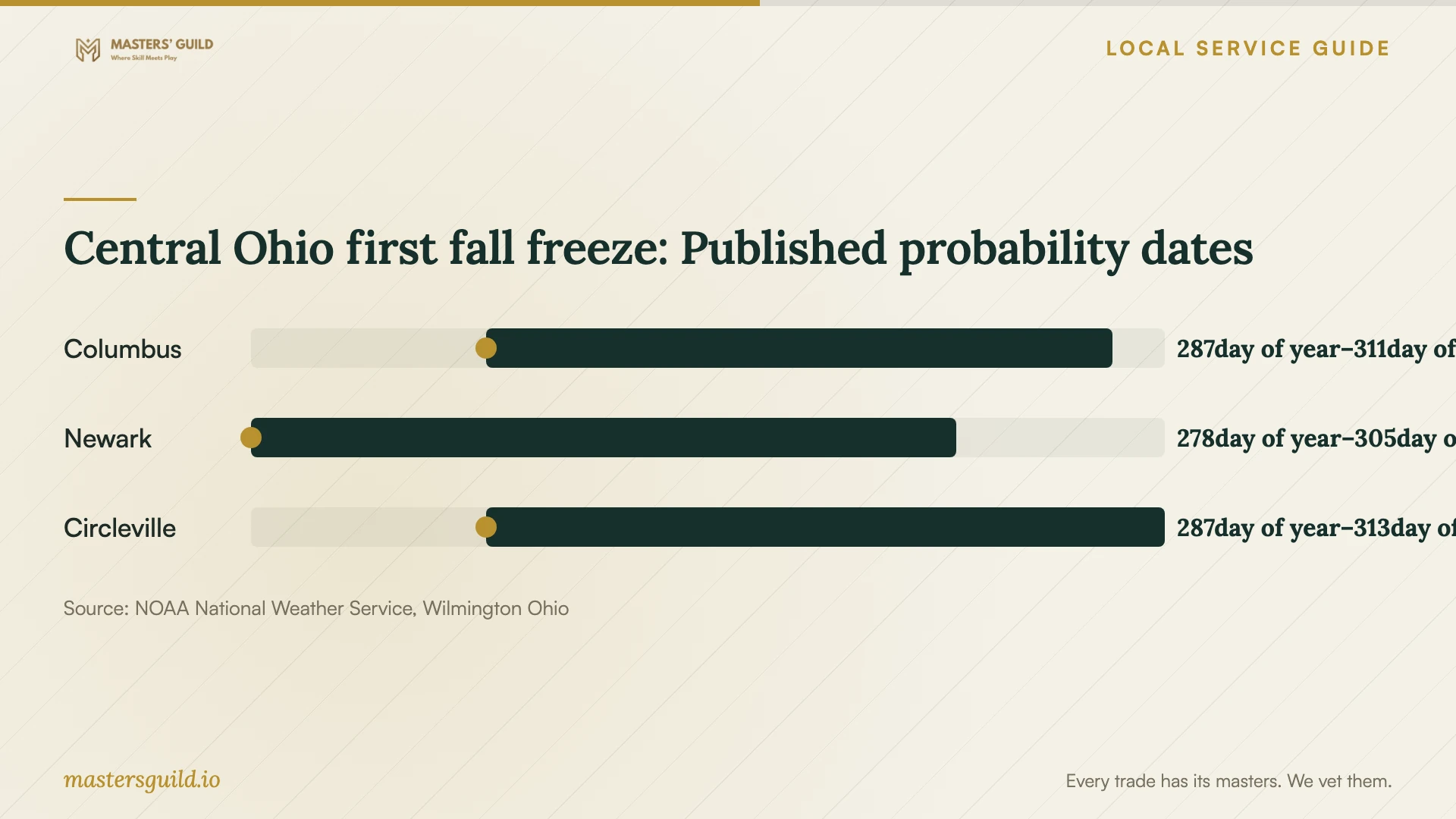
The National Weather Service's 1991–2020 reference table gives Columbus airport a normal first fall freeze date of October 27. Its probability dates span October 14 through November 7. Use the accompanying regional chart as background when discussing replacement-tree delivery and a weather contingency with the contractor. It does not establish a pruning deadline or predict this year's conditions at your property. [4]
Central Ohio first fall freeze: Published probability dates
Local details that affect your job
A backyard project can affect a public tree
Columbus requires Forestry approval for work within a public tree's Critical Root Zone, including work that occurs on adjacent private property. Before arranging excavation, stump grinding, or access near a street tree, ask the contractor to identify whether the project enters that zone. Public-tree removal and pruning require an ISA-certified arborist overseeing the crew. [1]
Pole-to-house branches need separate coordination
Ohio Power Company does not maintain trees and brush around the pole-to-house service line. If you hire a private contractor to work near it, call 800-672-2231 to arrange disconnection. Ask the contractor to confirm the utility appointment before fixing the work date. [2]
Utility storm cutting leaves a cleanup obligation
Ohio Power Company requires property owners to clean up and dispose of trees and branches cut by its storm-restoration crews once conditions are safe. Ask for a debris-only quote if utility crews have completed the cutting, and specify hauling rather than assuming it accompanies restoration. [3]
Choose the next step before booking
| Situation | Next step | What to confirm |
|---|---|---|
| Work on a public tree or within its Critical Root Zone | Arrange a Columbus Forestry permit before work starts. | Contractor responsible for the application and approved permit conditions. |
| Private contractor working near a pole-to-house service line | Call Ohio Power Company at 800-672-2231 to arrange disconnection. | Utility appointment coordinated with the contractor. |
| Tree or branch on a power line, or a fallen wire | Stay away and report to 911 or 800-672-2231. | Use emergency reporting rather than the non-emergency form. |
| Debris left by utility storm crews | Arrange cleanup and disposal once conditions are safe. | Written hauling scope and any wood you want retained. |
Your hiring checklist
- Photograph the tree and access route from a safe location.
- Confirm whether the work affects a public tree or its roots.
- Ask the arborist to explain pruning and removal options.
- Request insurance documentation and name the crew supervisor.
- Obtain a written scope covering stump work, hauling, and restoration.
- Confirm applicable Forestry approval before scheduling work.
- Coordinate any service-line disconnection with the utility and contractor.
- Agree on scope changes, payment timing, and the final walkthrough.
Frequently Asked Questions
Does every private-yard tree removal need a Columbus Forestry permit?
The City's cited guidance requires permits for public trees and work within their Critical Root Zones. It does not establish a blanket permit requirement for all private-yard removals. Ask Forestry whether your specific work affects a public tree before proceeding. [1]
How much does the Forestry permit cost?
Columbus charges no application fee. Public-tree removal can involve mitigation fees, which must be paid before permit issuance. Ask the contractor to distinguish those obligations from the price of cutting, grinding, and hauling. [1]
Will the utility remove a tree to protect my house?
Ohio Power Company says it does not trim or remove trees solely to protect private property. It also does not maintain vegetation around pole-to-house service lines. Arrange private tree work and contact the utility about disconnection when work will occur near that line. [2]
What should I ask a contractor about stump grinding?
Ask for the grinding depth, treatment of exposed roots, removal of grindings, backfill, and the finished condition of the area. Describe any replacement planting you want so the contractor can propose a scope that fits your plan.
Sources and scope
This guide combines the sources below with practical planning guidance. Figures apply to the stated geography and period; request a written quote for your property.