
Local service guide
Plan tree cutting in Columbus, GA
Arrange tree cutting in Columbus, GA by requesting an assessment and a written quote that covers the proposed cuts, stump treatment, debris hauling, and property protection. Before booking, ask city forestry to clarify any public right-of-way concern and coordinate service-wire work with your utility. Columbus requires contractors to remove waste from their work; Georgia Power asks customers to schedule a necessary service-wire disconnection at least 72 hours ahead. [1] [2] [3]
Choose an assessment, pruning, or removal
Start with the outcome you want: clearance above the roof, advice about a damaged tree, or removal for a planned project. Ask the arborist whether pruning could meet that goal and request an explanation of any removal recommendation. For an assessment, agree on whether you will receive photographs, written findings, and a proposed work plan.
Identify each tree on a photograph or site sketch. For pruning, ask the contractor to mark or describe the branches they propose to cut. For removal, specify whether you want the stump left, cut to an agreed height, or ground. Ask about grinding depth, exposed roots, removal of grindings, and filling the area.
Request the assessor's arborist credential details and evidence of insurance for the proposed work. Ask who will supervise the crew and whether another company will perform any part of the job. Keep the assessment fee and any follow-up work distinct in the quote so you can review the recommendation before approving cutting.
Settle city and utility responsibilities before booking
Columbus Urban Forestry and Right-of-Way describes municipal pruning, hazardous-tree removal, stump removal, and storm clearance of roadways and public rights-of-way. For a roadside tree or debris in a public area, ask the division to confirm responsibility for the specific location before including it in a private contractor's scope. [3]
For properties served by Georgia Power, contact the utility about service-wire conflicts. Georgia Power describes limited trimming around service lines, including limbs that substantially rub the wire or deflect its path. Its guidance assigns substantial tree work, including removals and limb removals over 3 inches in diameter, to the property owner. [2]
If safe tree work requires service-wire disconnection, Georgia Power directs customers to call 1-888-660-5890 and schedule at least 72 hours ahead. Ask your contractor which tasks depend on that appointment and who will coordinate with the utility. If another utility supplies your property, request its instructions before setting the crew date. [2]
Include hauling and understand city disposal charges
Columbus cites an ordinance requiring listed landscaping and other contractors to remove solid waste they accumulate through their work. Include loading, transport, and disposal in the written agreement. If a bidder proposes leaving the contractor's debris at the curb for routine collection, ask them to revise the cleanup plan. [1]
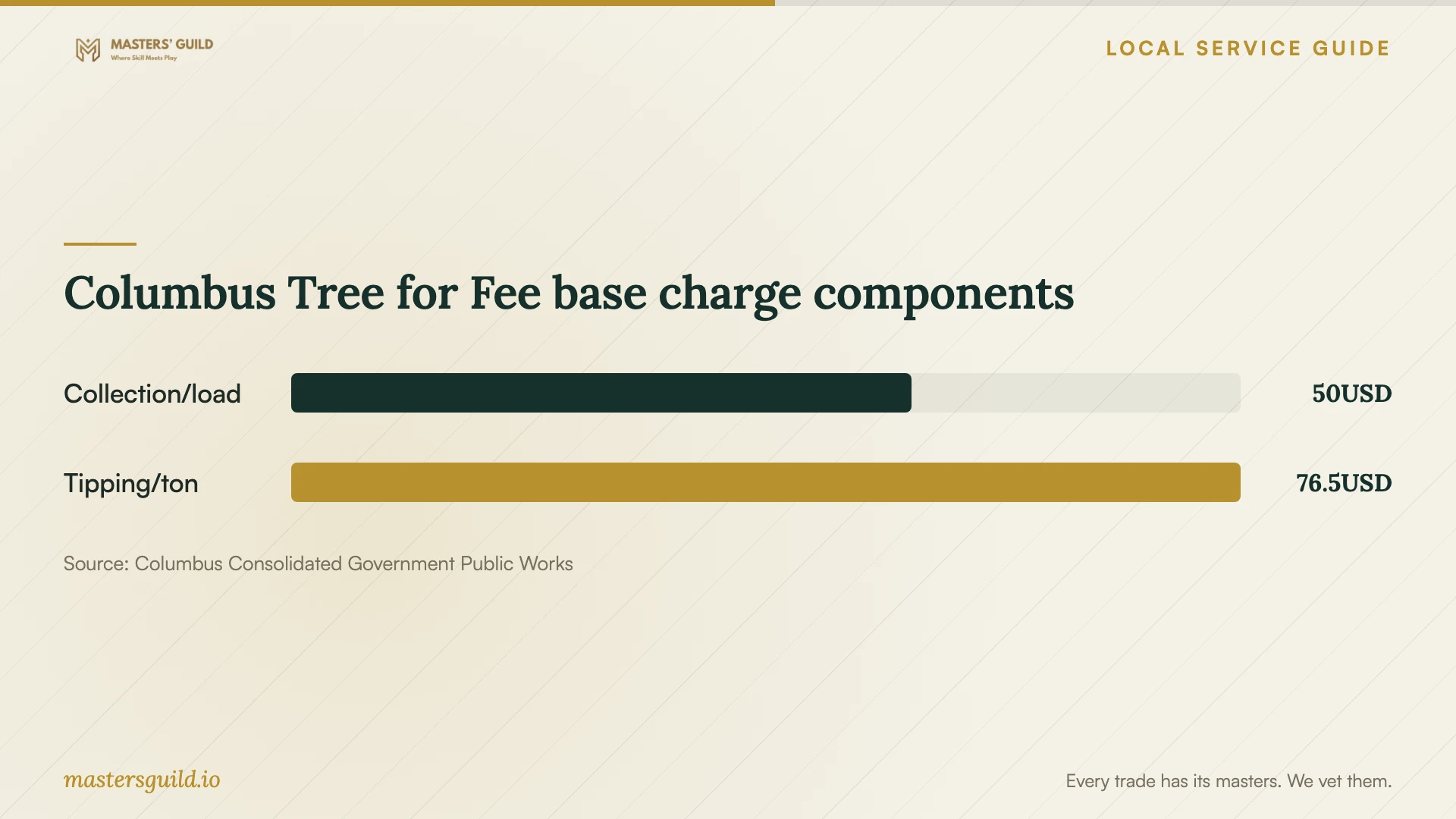
For residents arranging collection of trees cut on private property, the city describes a separate Tree for Fee service that requires the resident's request and authorization. Its published base charges are $50 per load for collection plus $76.50 per ton for tipping. Residents who pay a reduced garbage fee receive the same percentage reduction on this charge. The city asks residents to allow one week after requesting service. [1]
These municipal charges cover collection and disposal, not cutting or stump grinding. They do not replace the contractor's waste-removal obligation. To arrange Tree for Fee collection, the city directs residents to call 706-225-4661. Confirm eligibility, the applicable reduction, and the collection arrangement before setting out debris. [1]
Contractor prices depend on the quoted scope. Request line items for assessment, pruning or removal, stump work, and hauling, with any equipment charges and exclusions stated. Compare the complete job totals. Ask who must approve extra work and how the contractor will price it before the crew proceeds.
Prepare access and agree on rescheduling
Walk the equipment route with the contractor. Point out gates, fences, irrigation, driveways, and areas you want protected. Agree on parking, equipment staging, and the debris-loading area. If the proposed route crosses a neighbor's property, settle permission before work begins.
Discuss how the crew will assess ground conditions on the workday and when the contractor would reschedule. Ask how they plan to protect the lawn and driveway, who will repair any agreed damage, and whether a changed access plan could change the price. Put the rescheduling and payment terms in writing.
Before work starts, confirm the marked trees, work boundary, and cleanup standard. Keep children and pets outside the work area. At completion, walk the site with the contractor and compare the result with the agreement, including debris removal, stump treatment, and any promised follow-up.
Columbus Tree for Fee base charge components
Local details that affect your job
Curbside limits do not replace contractor hauling
Columbus requires listed yard contractors to remove their work waste. For city collection, limbs must measure no more than 4 feet long and 6 inches in diameter; the city refuses mixed bulk piles. A cut-down tree requires the resident to request and authorize Tree for Fee collection. Agree on contractor hauling before approving the job rather than assuming routine collection will cover it. [1]
Service-wire coordination can set the work date
Georgia Power directs customers to schedule a necessary service-wire disconnection at least 72 hours ahead through 1-888-660-5890. Confirm that Georgia Power serves your property, then coordinate the utility appointment with the contractor before committing to a cutting date. [2]
Ask city forestry about public-area work
The city's Urban Forestry and Right-of-Way Division clears tree debris from roadways and public rights-of-way during and after extreme weather. The division publishes [email protected] as its contact. Ask the city to clarify responsibility for the location before paying a private contractor to work there. [3]
Choose your first step
| Situation | First step | Detail to settle |
|---|---|---|
| You want to retain the tree | Request an arborist assessment | Ask for a pruning recommendation tied to your goal. |
| Private tree removal | Request a complete written quote | Include hauling under the city's contractor waste rule. |
| Tree or debris in a public right-of-way | Ask city forestry about the location | Confirm responsibility before authorizing private work. |
| Georgia Power service wire requires disconnection | Coordinate with the utility and contractor | Schedule at least 72 hours ahead. |
| Resident-arranged disposal of a privately cut tree | Request and authorize Tree for Fee collection | Confirm base charges, any reduced-fee discount, and the one-week allowance. |
Your hiring checklist
- Photograph and identify the trees and branches you want assessed.
- Request credential details, insurance evidence, and the name of the crew supervisor.
- Clarify responsibility for any tree or debris near a public right-of-way.
- Coordinate necessary utility appointments before booking the crew.
- Compare written scopes that include stump treatment, hauling, and exclusions.
- Walk the equipment route and agree on property protection.
- Record rescheduling terms, extra-work approval, payment terms, and the completion walkthrough.
Frequently Asked Questions
Can my contractor leave tree debris for city pickup?
Columbus requires listed yard contractors to remove waste accumulated through their work. Include hauling in the agreement. The separate Tree for Fee service does not replace that obligation. [1]
Will Georgia Power remove a tree near my service wire?
Georgia Power describes limited service-line trimming and assigns substantial work, including tree removals and limb removals over 3 inches in diameter, to the property owner. Ask the utility about the specific conflict and any necessary disconnection before booking the contractor. [2]
How much does city tree-debris collection cost?
Tree for Fee has published base charges of $50 per load for collection plus $76.50 per ton for tipping. Residents who pay a reduced garbage fee receive the same percentage reduction on this charge. The city asks residents to allow one week after requesting service. These charges cover collection and disposal, not cutting or stump grinding. [1]
What should I confirm before approving a removal?
Confirm the tree identification, recommendation, insurance evidence, equipment route, stump treatment, hauling, and complete price. Ask the city about requirements for your exact property and scope if permission or the public right-of-way boundary is uncertain. Record who will handle utility coordination and approve extra work.
Sources and scope
This guide combines the sources below with practical planning guidance. Figures apply to the stated geography and period; request a written quote for your property.