
Local service guide
Tile Setting in Columbus, GA: Plan the Job
For Tile Setting in Columbus, GA, choose an installer whose written quote covers preparation, layout, materials, debris removal, and room handover. Resolve permit questions for the complete remodel before setting a start date. Include hauling in the agreement: Columbus excludes construction and demolition material from curbside collection. [2]
Give installers a defined project
Describe the room and surfaces you want tiled, whether existing finishes need removal, and who will supply the tile. Share photographs of doorways, corners, adjoining floors, and visible damage. For repairs, show any spare matching tile you have. Identify your preferred pattern, grout color, and edge treatment before comparing proposals.
Arrange a site visit before accepting a final price. Have the installer identify the preparation included in the quote and any conditions they need to investigate after demolition. Separate demolition, surface repairs, tile, setting materials, grout, trim, and hauling. Agree on written approval for additional work before the installer incurs those charges.
Review the proposed installation
For a shower, review the proposed waterproofing assembly, product names, and checks before the installer covers the work. For a floor, discuss how the installer will assess the substrate, address uneven areas, and finish transitions. Have the installer explain the plan in terms you understand and include the agreed tasks in the contract.
Review photographs of comparable work and speak with a previous customer if the installer can arrange it. Obtain insurance documentation and warranty terms. Identify who handles a complaint, which work the warranty covers, and how you should report a problem. Resolve visible cuts and edge details before setting begins.
Settle permit responsibilities for the full remodel
Columbus Inspections & Code processes permits, schedules inspections, and enforces Georgia-adopted construction codes. The city's Inspections & Code page does not specify whether tile replacement requires a permit. Describe your complete project, including proposed plumbing, electrical, or structural changes, to obtain guidance for that scope. [1]
Record who will handle applications, fees, inspection appointments, and required corrections. Keep the department's guidance with the project agreement. If the city identifies inspection stages, work those appointments into the schedule before accepting the demolition date.
Price and organize demolition disposal
Columbus Public Works excludes construction and demolition material from curbside pickup and directs it to Pine Grove Landfill. Its collection page cites an ordinance requiring building contractors to remove waste they accumulate through their work. Include debris removal and final cleanup in the installation agreement. [2]
Pine Grove prohibits mixed loads and separation at the site. Plan loading around its separate household garbage, construction waste, and green waste categories. Contractors must bring proof of where they are working in Muscogee County, such as a work order or invoice. [3]
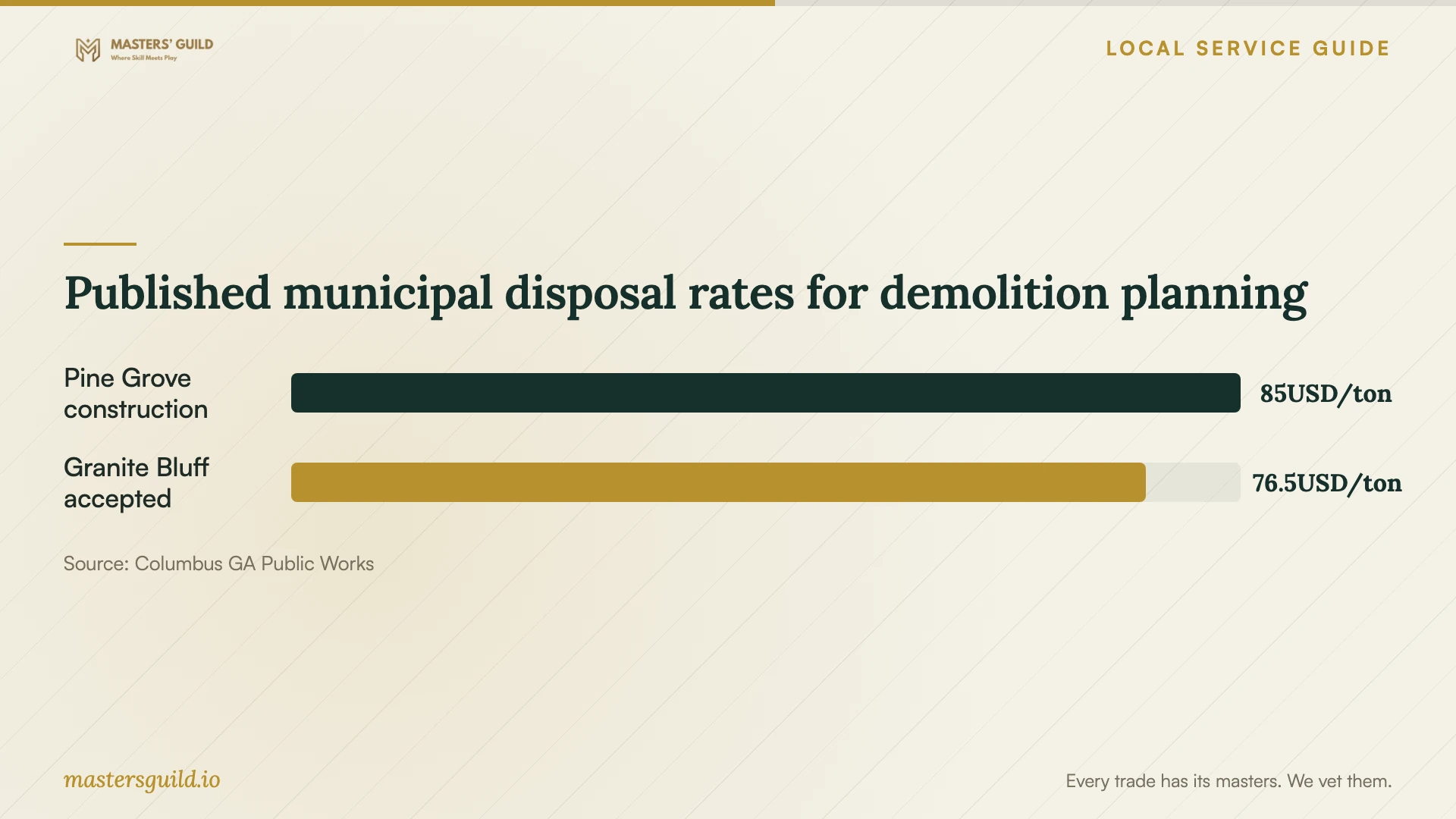
Pine Grove publishes a construction-waste disposal charge of $85 per ton. Use that figure to discuss the disposal component of the proposal. Have the installer distinguish loading, transport, and disposal charges so you can understand the hauling price without treating the landfill rate as a complete project estimate. [3]
Prepare for access and handover
Agree on a schedule for demolition, preparation, setting, finishing, and return to use. Have the installer base waiting periods on the selected products. Plan temporary arrangements if the project affects your only bathroom. Assign appliance and fixture moving, reconnection, material storage, and protection for adjoining rooms.
Walk through the room with the installer at handover. Compare the layout, edges, transitions, and cleanup with your agreement. Collect care instructions, warranty information, and leftover tile. Record unfinished items and an agreed return date before closing out the work.
Published municipal disposal rates for demolition planning
Local details that affect your job
Choose the correct application route
Since January 1, 2026, Columbus has limited in-person permit and plan submissions. Its notice includes residential alteration, electrical, gas, plumbing, and mechanical permits among the categories it accepts in person. The city requires other submissions, including new residential and commercial plans, through its online portal. Determine your application category with Inspections & Code at (706)-225-4126 before preparing paperwork. [1]
Prepare your own landfill trip
Pine Grove Municipal Landfill is at 7900 Pine Grove Way and accepts waste from Muscogee County residents. Residents must present valid identification or a water bill; contractors must show proof of the county job location. The city lists weekday hours of 8:00 AM to 5:00 PM and asks customers to arrive 30 minutes before closing for normal drop-offs or at least 90 minutes before closing for large loads. Separate waste before departure because the landfill prohibits mixed loads and onsite separation. [3]
Match the agreement to your project
| Project | Resolve before hiring | Record in the agreement |
|---|---|---|
| Dry-area backsplash | Wall preparation and visible edge treatment | Layout, protection, materials, and cleanup |
| Floor replacement | Substrate assessment and adjoining-room transitions | Demolition, preparation, transitions, and return-to-use timing |
| Shower remodel | Waterproofing products and checks before covering work | Assembly, fixture handling, review stages, and warranty |
| Remodel with other alterations | City permit guidance for the complete scope | Application and inspection responsibilities |
| Demolition with hauling | Disposal destination, separate loads, and job-location paperwork | Loading, transport, disposal charges, and final cleanup |
Your hiring checklist
- Photograph the work area and record tile, pattern, grout, and edge preferences.
- Compare written preparation scopes after site visits.
- Review the proposed shower waterproofing or floor substrate work.
- Obtain city guidance for the complete remodel before scheduling.
- Assign permits, inspections, debris removal, and cleanup in the agreement.
- Set a written approval process for hidden-damage repairs and added charges.
- Plan fixture handling, room access, waiting periods, and handover.
Frequently Asked Questions
Does tile replacement require a permit?
The city's Inspections & Code page does not specify a tile-replacement requirement or exemption. Describe the complete remodel to the department, including any plumbing, electrical, or structural changes, before work begins. [1]
Can I put removed tile and demolition debris at the curb?
Columbus excludes construction and demolition material from curbside collection and directs it to Pine Grove Landfill. Include removal arrangements in your project agreement. [2]
What paperwork do I need for Pine Grove?
Residents must present valid identification or a water bill. Contractors working in Muscogee County must show the job location through a work order, invoice, or other proof. Bring separated loads; the landfill prohibits mixed loads and separation at the site. [3]
Do landfill fees tell me what installation will cost?
The published rates cover disposal at the named facilities. They do not establish a tile installation or hauling price. Compare project quotes that identify preparation, materials, labor, loading, transport, and disposal. [3]
Sources and scope
This guide combines the sources below with practical planning guidance. Figures apply to the stated geography and period; request a written quote for your property.