
Local service guide
Electrical Repairs in Columbus, GA: Hiring Guide
For Electrical Repairs in Columbus, GA, choose a Georgia electrical contractor whose license covers your installation, agree on the diagnostic charge, and confirm permit requirements for the proposed work with Columbus Inspections and Code. For storm-damaged service equipment, ask your utility for current repair and restoration instructions before scheduling around a return of power. [1] [3]
Describe the problem before choosing a repair
Give the contractor a symptom list rather than a guessed repair. Identify the affected outlets, switches, lights, or rooms. Describe when you noticed the problem and which appliances you were using. Tell the contractor whether you want diagnosis alone or permission to complete specified repairs within your spending limit.
Request a written proposal that separates the diagnostic charge, labor, proposed parts, and work outside the initial visit. Ask whether the contractor credits the diagnostic charge toward an approved repair. Include responsibility for permit applications, applicable fees, inspections, and utility coordination where relevant.
Compare proposals using the same symptom description. Have each contractor explain the recommended repair, exclusions, and follow-up terms if the symptom returns. Agree on how they will obtain your approval if their findings change the scope. Avoid authorizing an open-ended repair before you understand the findings and price.
Match the contractor’s license to the installation
Georgia restricts statewide Class I electrical contractor licenses to single-phase installations that do not exceed 200 amperes at the service drop or service lateral. Class II electrical contractor licenses are unrestricted. For a service upgrade, ask the contractor to identify the existing and proposed installation and explain which license class covers the work. [3]
Request the responsible license holder’s name, license number, insurance documentation, and an explanation of who will supervise the job. Have the contractor assess the installation covered by the state rule; do not choose a license class from the rating on an individual branch-circuit breaker. [3]
Discuss how the contractor will explain the diagnosis and document the completed repair. Ask about experience with a comparable problem. Georgia’s applicant experience requirements describe qualifications for a license; they do not establish a particular contractor’s repair history or the quality of a proposed repair. [3]
Confirm the permit process before setting a date
Columbus’s Permits and Forms page lists an electrical permit application and a request for construction power. The supplied page does not specify exemptions for individual repairs. Describe the proposed work to city staff rather than assuming that a small repair needs no permit. [1]
For electrical work within a larger construction project, discuss both the electrical application and the project’s plan submission with staff. Under the city’s policy effective January 1, 2026, electrical permits retain an in-person submission option, while new residential and commercial plans require the online portal. [1]
Before agreeing on a start date, have the contractor explain any approval or inspection steps and identify who will arrange them. Ask which appointments require you to be home. Keep application and completion records with the invoice so you can refer to the agreed scope later.
Plan storm-damaged service repairs with your utility
In its October 4, 2024 guidance about restoration after a major storm, Georgia Power describes the service entrance as the connection between its lines and the home’s electrical wires, usually near the meter. It identifies a bent mast pipe, damaged or missing weatherhead, service entrance pulled from the house, and meter base pulled from the house as conditions that prevent safe restoration. [2]
That storm guidance says an electrician must repair the damaged service entrance and that Georgia Power cannot perform those repairs. It describes notification after the repair followed by utility scheduling of reconnection. Treat this as dated storm guidance: confirm the current repair, inspection, notification, and restoration instructions with the utility serving your home. [2]
Describe visible damage when arranging the assessment. Take photographs only from a safe position without opening equipment or touching wiring. Leave damaged service components alone. Ask the electrician and utility who will coordinate the work, and avoid planning household needs around a reconnection time until the utility confirms it.
Prepare access and keep a record of the repair
Clear access to the work area and arrange for pets to stay elsewhere. Gather previous repair invoices and existing circuit labels. Tell the contractor if anyone depends on powered equipment, then discuss how you will manage a planned interruption before work begins.
At completion, ask the contractor to explain what they found, what they repaired, and any remaining work they recommend. Request an invoice that identifies the completed scope and parts. Keep any permit or inspection records, warranty terms, and instructions for reporting a returning symptom.
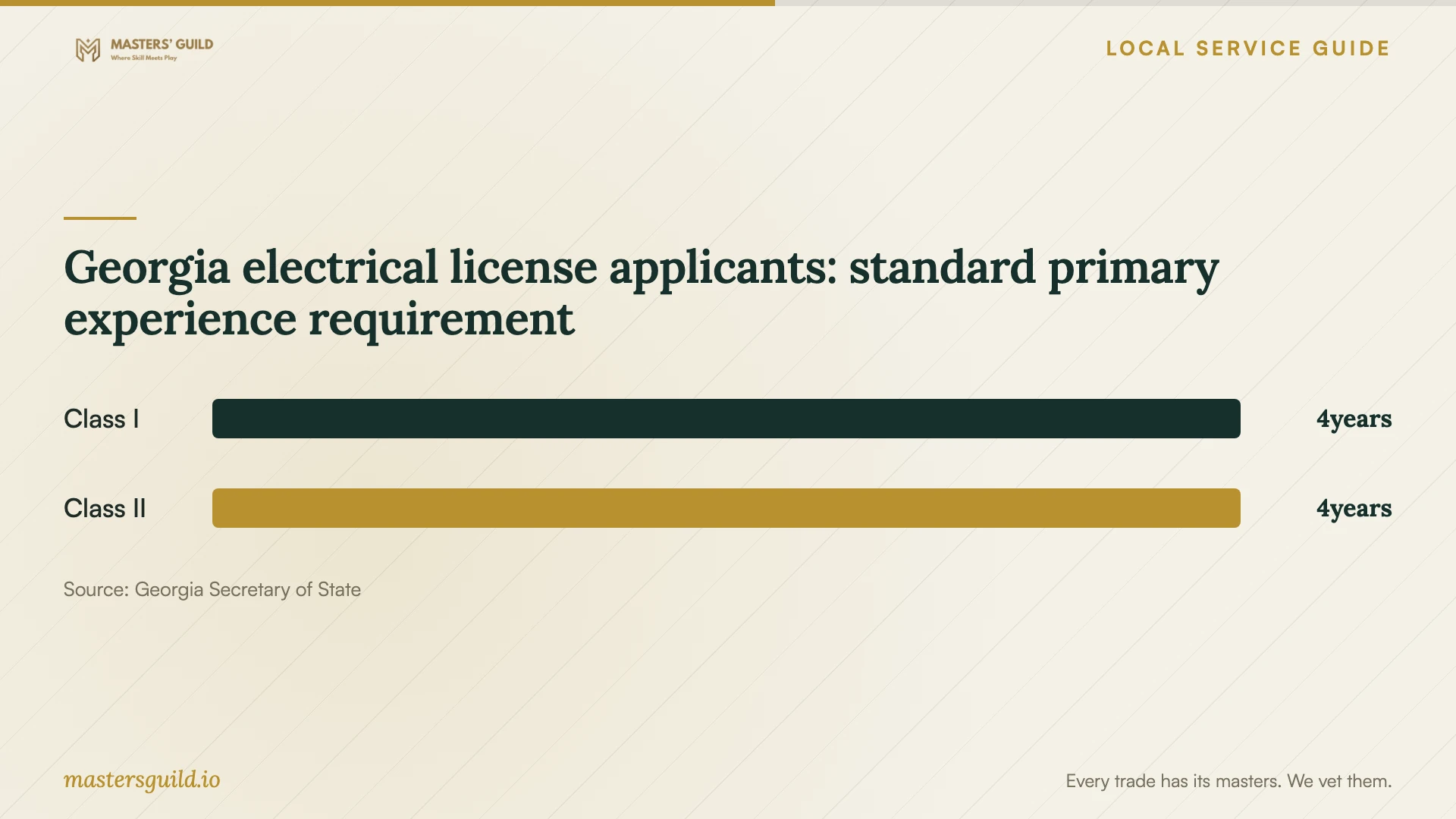
Georgia electrical license applicants: standard primary experience requirement
Local details that affect your job
Use the permit department’s office address
Columbus Inspections and Code lists 706-225-4126 and an office at 1111 1st Avenue, 3rd Floor. Its published hours are 8:00 AM to 5:00 PM, Monday through Friday. For an in-person electrical permit submission, use this department address and confirm what documents staff need for your scope. [1]
Separate storm repairs from utility restoration
For a Columbus home served by Georgia Power, its October 4, 2024 major-storm guidance explains why repairing detached or damaged service equipment can require an electrician before power restoration. The article describes repair, utility notification, and scheduled reconnection in that storm context. Ask Georgia Power to confirm today’s instructions for your damage and outage; the article does not establish a current general-purpose referral contact or routine reconnection procedure. [2]
Choose a starting point for the work
| Situation | Starting point | Information to provide or confirm |
|---|---|---|
| An outlet, switch, or circuit needs diagnosis | Arrange an electrical troubleshooting visit | Affected devices, symptoms, diagnostic charge, and authorization limit |
| You are unsure whether the repair needs a permit | Discuss the scope with Columbus Inspections and Code | The contractor’s description of the proposed work |
| Electrical work accompanies new residential construction | Discuss both submissions with city staff | New residential plans require the online portal; electrical permits retain an in-person option |
| A service upgrade may exceed Class I limits | Ask the contractor to explain the appropriate license class | Class I covers single-phase installations up to 200 amperes at the service drop or lateral |
| A Georgia Power home has storm-damaged service equipment | Arrange an electrician’s assessment and confirm current utility instructions | The October 4, 2024 storm guidance describes electrician repair before restoration |
Your hiring checklist
- Write down the affected devices, rooms, symptoms, and circumstances.
- Agree on the diagnostic charge and a repair authorization limit.
- Request the responsible contractor’s license and insurance documentation.
- Ask city staff about the proposed scope and submission requirements.
- Photograph visible damage only from a safe position without touching equipment.
- Clear access and plan for anyone who depends on powered equipment.
- For storm-related service damage, confirm current instructions with your utility.
- Keep the findings, final invoice, and completion records.
Frequently Asked Questions
Does a small electrical repair need a Columbus permit?
The city’s Permits and Forms page lists an electrical permit application but does not specify individual-repair exemptions. Give staff the proposed scope so they can clarify the requirement and submission process before you schedule work. [1]
How should I budget for troubleshooting?
Get the diagnostic charge before booking and ask what it includes. Agree on whether the contractor may complete repairs during that visit and the amount you authorize. Request a revised price before approving additional work.
Will Georgia Power repair a meter base pulled from the house after a storm?
Georgia Power’s October 4, 2024 major-storm guidance identifies a detached meter base as damage that prevents safe restoration. In that guidance, the utility assigns service-entrance repair to an electrician and says it cannot perform the repair. Confirm current instructions with the utility before arranging restoration. [2]
Does the four-year licensing requirement show a contractor’s actual experience?
It describes the standard primary-experience baseline for Georgia electrical license applicants. The rule also permits credits and an alternative experience pathway. Ask the contractor about their own work history and experience with your repair rather than treating the baseline as proof of individual tenure. [3]
Sources and scope
This guide combines the sources below with practical planning guidance. Figures apply to the stated geography and period; request a written quote for your property.