
Local service guide
Duct and Vent Cleaning in Columbus, GA
For Duct and Vent Cleaning in Columbus, GA, get three written estimates after contractors inspect and show you the contamination. EPA recommends cleaning as needed for substantial mold, pests, or excessive debris rather than on a fixed schedule. Agree on whole-system scope, dust containment, and completion checks before work starts. Separate proposed HVAC repairs from cleaning so you can check Georgia credentials and local permit requirements. [1] [2] [3]
Decide whether you need cleaning or diagnosis
Start with the problem you want to solve: debris blowing from supply registers, suspected growth inside the system, or evidence of pests. EPA identifies substantial visible mold on hard surfaces, vermin infestation, and excessive dust or debris as reasons to consider cleaning. Ask the inspector to show you the affected locations and explain the cause before proposing a treatment. [1]
A dusty return grille is normal because the system pulls dust-laden air through it. You can vacuum or remove and clean the grille. EPA does not recommend routine duct cleaning and says cleaning has not been shown to prevent health problems. Discuss unexplained symptoms with your doctor rather than treating a cleaning appointment as a medical solution. [1]
If the contractor suspects mold, ask how they identified it. EPA says an expert may need laboratory analysis to confirm growth. Correct leaks, drainage problems, or other underlying causes before cleaning. For wet or moldy insulated ducts, EPA recommends removing and replacing the affected material because cleaning cannot address it effectively. [1]
Get a quote you can compare
Ask each contractor to list supply and return ducts, registers, grilles, coils, drain pans, the blower, and the air-handler housing in the written scope. EPA advises homeowners who choose system cleaning to use a qualified provider who agrees to clean all components. Require the contractor to identify exclusions and explain who will handle any component outside their qualifications. [1]
Give each bidder the same description of your system and the same access information. Ask for a total price, any inspection charge, the expected time on site, and the conditions that could change the price. Have the contractor price repairs and optional treatments separately, with your approval required before additional work.
Ask where the vacuum exhaust will go. EPA recommends equipment that exhausts particles outdoors or HEPA vacuum equipment when the exhaust stays inside. The contractor should protect furnishings, use cleaning methods suited to the duct material, and seal and reinsulate access openings after the work. [1]
Reject sweeping health-benefit claims and claims of EPA certification for duct cleaning. EPA does not certify or approve duct-cleaning companies. Ask for references from customers with systems like yours and request proof of liability insurance. [1]
Separate cleaning from repairs and chemical treatments
Pause before approving duct replacement, equipment alterations, or other repairs discovered during the visit. Request photographs, a repair description, and a separate proposal. For work that constitutes conditioned-air contracting, Georgia requires businesses to display the qualifying licensee's registration number on proposals and invoices. The cited licensing rules do not establish a blanket requirement for cleaning-only work. [3]
Ask Columbus Inspections & Code to determine whether the proposed repair or alteration needs a permit. Describe the actual work rather than asking about duct cleaning in general. Decide who will submit any required application and arrange inspections before accepting the repair proposal. [2]
For a proposed biocide, ask to see the product label, the approved use, and evidence supporting its application. EPA's guidance says no biocides are registered for fiberglass duct board or fiberglass-lined ducts. EPA also advises against routine interior sealant treatments. Ask the contractor to explain physical cleaning and moisture correction before you consider chemical treatment. [1]
Plan access and check the finished work
Before the appointment, clear a path to registers and equipment. Tell the contractor about pets, fragile furnishings, and rooms you need to use. Ask how long they expect to stop heating or cooling and plan household activities around that interruption.
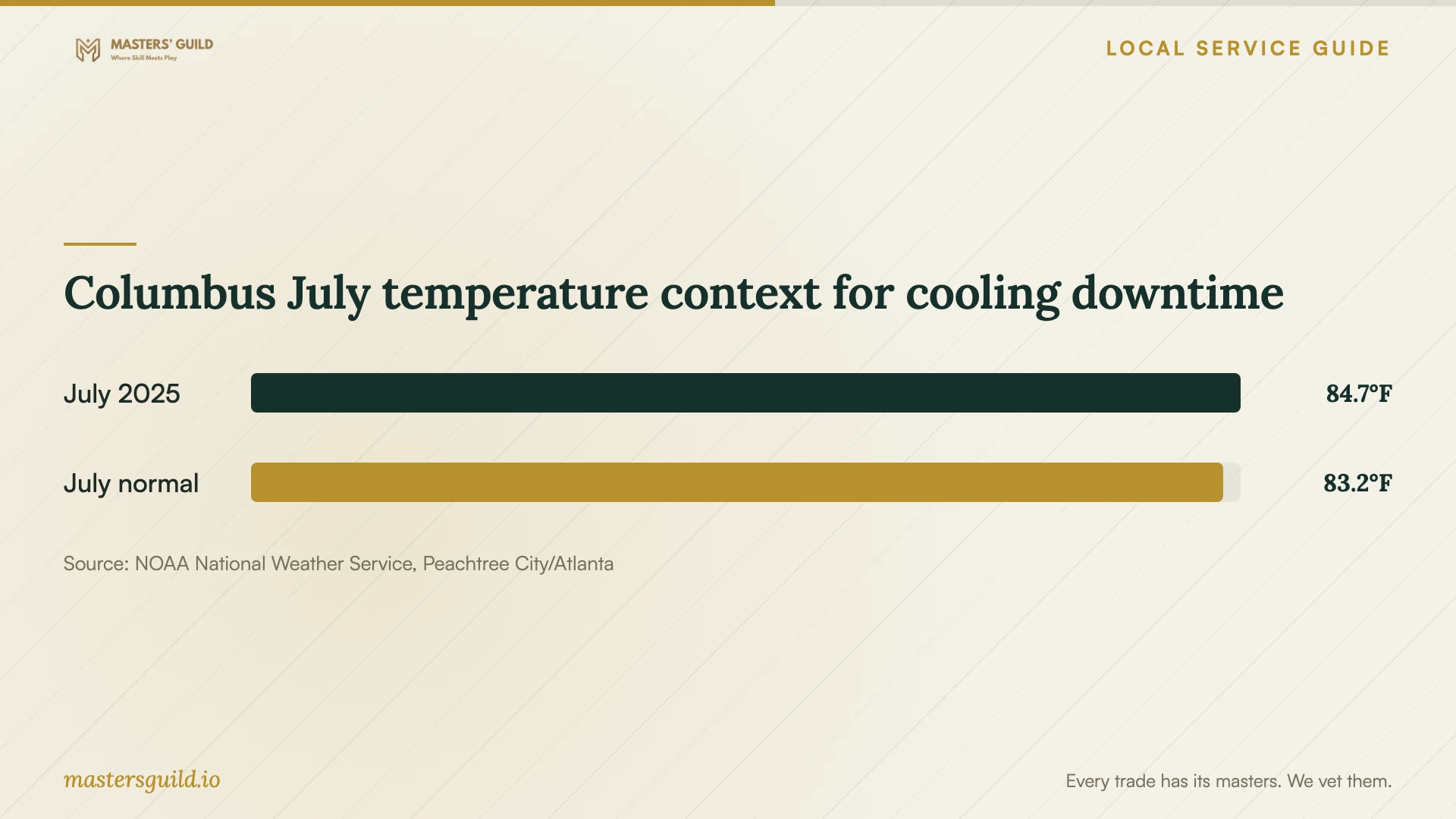
For summer appointments, consider the heat when agreeing on system downtime. NWS reported a Columbus mean temperature of 84.7°F in July 2025, compared with its listed July normal of 83.2°F. These historical figures provide scheduling context, not a forecast for your appointment or evidence that your ducts need cleaning. [4]
Before the crew leaves, ask to inspect the cleaned components or review photographs of inaccessible areas. EPA recommends a visual inspection and checking that registers are secure, access openings do not leak, and the system operates in heating and cooling modes. Ask the contractor to address deficiencies against the agreed scope. [1]
Columbus July temperature context for cooling downtime
Local details that affect your job
Columbus mechanical permit questions
Columbus Inspections & Code administers mechanical codes, permit applications, and inspections. Call 706-225-4126 with the proposed repair scope before authorizing alterations. Effective January 1, 2026, the department limits in-person submissions, but continues accepting mechanical permits in person. Its office is at 1111 1st Avenue, 3rd Floor, with hours of 8:00 AM to 5:00 PM Monday through Friday. Do not infer that cleaning alone needs a permit. [2]
Georgia credentials for added HVAC work
Georgia's conditioned-air contracting rules apply statewide, including Columbus. For work within that scope, ask for the qualifying licensee's number on the proposal and invoice, displayed with GA. REG. and a CN or CR prefix. Class I licenses cover systems up to 175,000 BTU of heating and 60,000 BTU of cooling; Class II licenses are unrestricted. Ask the contractor to explain which classification covers your proposed work. [3]
Choose your next step from the inspection findings
| Finding | Next step | Question to ask |
|---|---|---|
| Dust on the return grille alone | Clean the grille and assess the system before buying duct cleaning. | Can you show me substantial contamination beyond this grille? |
| Excessive debris or particles coming from supply registers | Consider cleaning and identify the underlying cause. | Which components will you clean, and how will you contain the debris? |
| Suspected mold or wet duct insulation | Confirm the finding, correct moisture, and assess replacement of affected insulation. | How did you identify the growth, and what caused the material to get wet? |
| Proposed mechanical repair or alteration | Obtain a separate scope and ask Columbus about permit requirements. | Who will handle credentials, applications, and inspections? |
Your hiring checklist
- Describe the symptoms and ask the inspector to show you the affected areas.
- Give bidders the same system description and access information.
- Request an itemized scope, total price, exclusions, and expected downtime.
- Ask how the crew will contain dust and protect the duct material.
- Separate repair proposals and chemical treatments from the cleaning agreement.
- Confirm who will handle any required permits and inspections for added work.
- Clear equipment access and plan for pets and household activities.
- Review the completed work with the contractor before they leave.
Frequently Asked Questions
How often should I have my ducts cleaned?
EPA recommends cleaning as needed rather than on a recurring schedule. Ask for evidence of substantial contamination. Keep up with filter changes, equipment maintenance, and moisture control regardless of whether you choose cleaning. [1]
Can duct cleaning reduce my energy bills?
EPA says some research suggests that cleaning dirty coils, fans, and heat exchangers may improve system efficiency. It finds little evidence that cleaning ducts alone improves efficiency. Ask which component needs attention and avoid accepting a promised bill reduction. [1]
Does the quote include dryer-vent cleaning?
Ask the contractor to name each vent or system included. If you want dryer-exhaust cleaning, have the contractor list that work and its price separately so you can compare offers without assuming it comes with HVAC duct cleaning.
Does Columbus require a permit for duct cleaning?
The city's published guidance does not specify whether cleaning alone requires a permit. It confirms that Inspections & Code administers mechanical permits. If the contractor proposes repairs or alterations, contact the department with that scope before approving the added work. [2]
Sources and scope
This guide combines the sources below with practical planning guidance. Figures apply to the stated geography and period; request a written quote for your property.