
Local service guide
Snow Removal in Columbia, SC: Hiring and Ice Planning
Arrange Snow Removal in Columbia, SC by asking for a written scope that covers your driveway, entrance steps, walking route, ice treatment and any return visit. Choose a provider who explains how road conditions affect arrival and what triggers service when freezing rain leaves ice without deep snow. South Carolina emergency officials describe freezing rain as ice forming on contact with roads and walkways, so include ice handling in your hiring questions. [3]
Choose service for the route you need to use
Start with the path from your door to your vehicle or pickup point. Tell the provider whether you need the whole driveway cleared or a smaller access route, and include steps, landings and gates in the request. Ask who will move snow from areas a plow cannot reach. Send photographs that show the driveway entrance and any tight turns.
Request an ice-specific service option. SCEMD distinguishes freezing rain, which coats surfaces with ice, from sleet, which falls as ice pellets. Ask how the provider would handle each condition at your property and whether they accept an ice-only call. Avoid accepting a snow-depth trigger as the sole service condition if your main concern is an icy entrance. [3]
For a short, level area, consider whether you can shovel without overexertion. SCEMD advises stretching before shoveling and taking breaks. Hire help if the work exceeds your ability, and tell the provider about any mobility needs before agreeing on the clearing scope. [3]
Compare property-specific written quotes
Get property-specific quotes for snow removal in Columbia. Compare the same work: clearing area, hand work, ice treatment, materials and follow-up. Ask whether the provider charges per visit, by time or under a storm agreement, and request a total or a spending limit before work starts.
Clarify what counts as one visit. Ask whether another pass during the same storm costs extra, whether the provider charges for treating ice without plowing, and whether there is a callout minimum. If you consider a seasonal agreement, ask about payment during a winter with no service, cancellation and priority relative to other customers.
Ask for proof of insurance covering the proposed work and identify who will perform it. Request the equipment plan for your surface, especially around pavers, gravel, edging or narrow steps. Have the provider name the ice-treatment product and explain its suitability for your surface and pets. SCEMD advises choosing products labeled pet-safe and avoiding rock salt around pets. [3]
Agree on dispatch and delay terms
Use a winter storm watch to contact your provider and confirm availability. SCEMD defines a watch as an increased risk whose occurrence, location or timing remains uncertain. Ask how the provider confirms a booking, what conditions trigger dispatch and how they notify you if travel becomes unsafe. [3]
Request an arrival window with a road-condition contingency. In its February 18, 2025 notice, SCDOT said crews would prepare interstate and primary routes before secondary roads, then monitor and de-ice during impacts. That notice describes a state response approach, not a clearance deadline for your street. Check the connecting road before assuming a cleared driveway will let you leave. [2]
Ask the provider to contact you before traveling if access changes. SCEMD advises driving only when necessary and directs residents to dial 511 for real-time road conditions. Agree on whether the provider will postpone, cancel or reschedule a visit when they cannot reach the property, including any charge for that outcome. [3]
Prepare the property and plan the follow-up
Before work, move vehicles as agreed and mark edges or obstacles that the operator needs to avoid. Choose a snow-storage location with the provider and ask them to preserve access to doors and gates. Photograph the surface before service, then request completion photographs if you will be away.
Include a follow-up decision in the booking: who checks the walking route, when you contact the provider again and what another treatment costs. Columbia's January 2026 winter guidance warned residents about black ice and overnight freezing. Treat that guidance as a reason to discuss a later check, not as a forecast for your service date. [1]
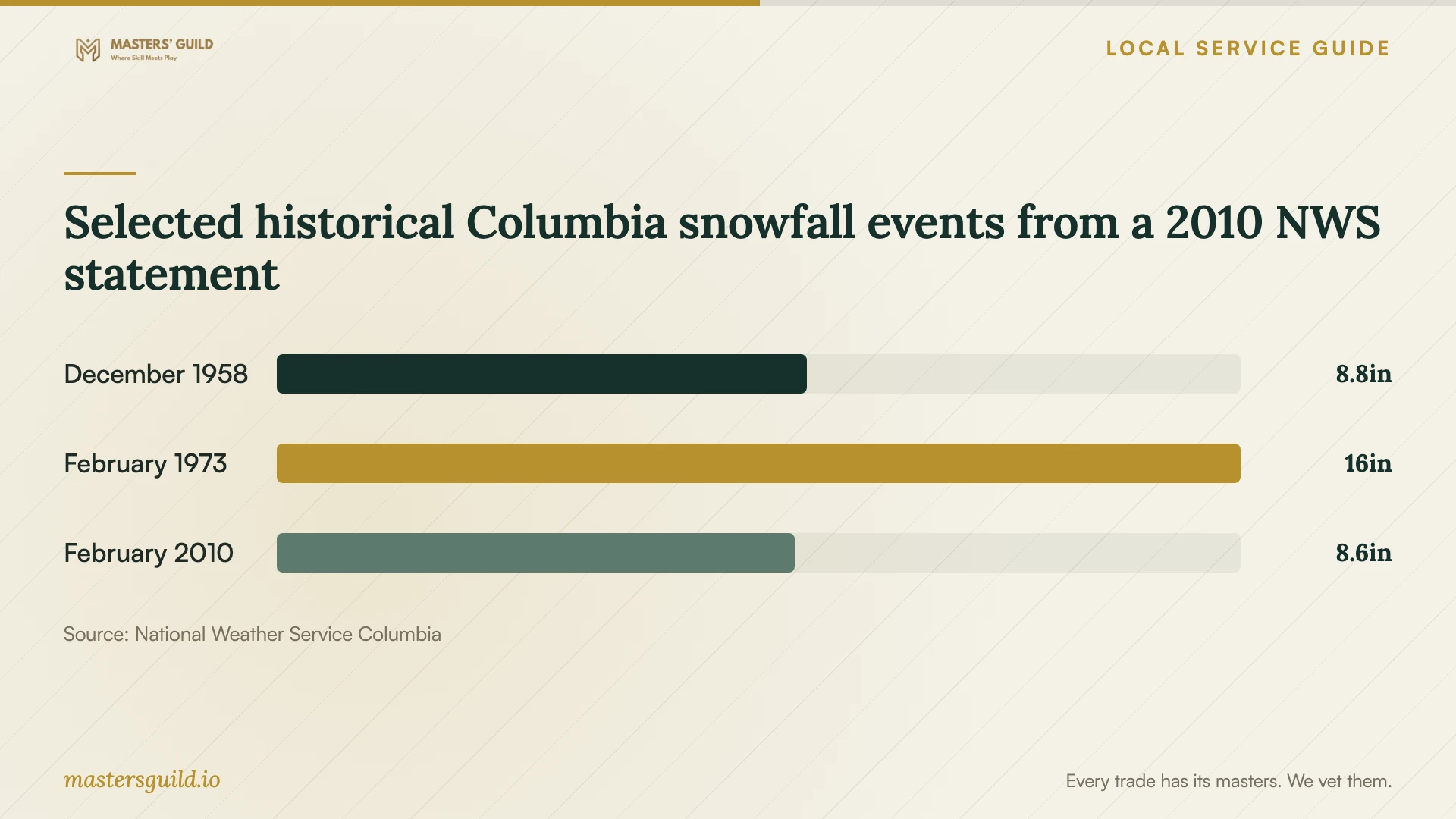
Use the historical snowfall chart to discuss the provider's limits for larger accumulations. The National Weather Service's February 2010 statement listed several substantial Columbia snow events, including 16.0 inches in February 1973. Ask how the provider changes equipment or schedules additional passes for a large storm. These past events do not predict this winter's snowfall or establish current service demand. [4]
Selected historical Columbia snowfall events from a 2010 NWS statement
Local details that affect your job
Separate private clearing from public-road access
SCDOT's February 2025 notice described preparing interstate and primary routes before secondary roads. SCEMD also warns that less-traveled roads can require caution for longer. Before booking an arrival tied to an appointment, check road conditions through 511 and ask the provider how they handle an inaccessible connecting street. [2] [3]
Report blocked roads and electrical hazards to the right contact
Columbia lists Customer Care at 803-545-3300 for non-emergency downed trees and blocked roads. Its winter guidance directs residents to call 911 for a downed power line and stay away. If either hazard obstructs your property, report it and tell the snow-removal provider before dispatch; do not ask the crew to work near the line. [1]
Match the booking to your access problem
| Your situation | Service to request | Terms to confirm |
|---|---|---|
| Snow across the driveway and entrance | Driveway clearing plus hand work at steps and landings | Clearing boundaries, snow placement and extra passes |
| Freezing rain coats the walking route | Ice assessment and treatment | Ice-only dispatch, product choice and follow-up charge |
| You need access by a particular time | A priority access route and arrival window | Road-condition check and delay notification |
| A downed line obstructs the work area | Emergency reporting before contractor dispatch | Call 911, stay away and alert the provider |
Your hiring checklist
- Send photographs and describe the driveway surface, slope, steps and access route.
- Mark the exact areas to clear and agree on where the crew will place snow.
- Confirm that the provider accepts ice-only calls and identify the treatment product.
- Request proof of insurance and an equipment plan for your surfaces.
- Get the visit price, material charges, extra-pass terms and follow-up price in writing.
- Agree on a service trigger, arrival window and unsafe-travel rescheduling terms.
- Move vehicles and mark obstacles before the agreed visit.
- Request completion photographs and decide who will check the route afterward.
Frequently Asked Questions
Should I book before snow starts?
Contact a provider while you can still agree on scope and availability. A winter storm watch means increased risk with uncertain occurrence, location or timing, according to SCEMD. Use it to confirm the booking process, then agree on the conditions that trigger a visit. [3]
Does driveway clearing include salt or ice treatment?
Ask the provider to list ice treatment and materials in the quote. Do not assume they come with clearing. If pets use the route, discuss the product before work; SCEMD advises choosing ice melt labeled pet-safe and avoiding rock salt around pets. [3]
Can I leave once the crew clears my driveway?
Check the connecting road before leaving. SCEMD advises driving only when necessary and notes that major roads receive attention first. Dial 511 for road conditions, and follow current official guidance rather than using the driveway's appearance as your travel decision. [3]
How do I compare a one-time visit with a seasonal agreement?
Compare the included areas, ice treatment, arrival terms and repeat visits. For a seasonal agreement, ask what you pay if no work occurs and how cancellation works. For a one-time visit, confirm the minimum charge and whether another pass or ice treatment costs extra.
Sources and scope
This guide combines the sources below with practical planning guidance. Figures apply to the stated geography and period; request a written quote for your property.