
Local service guide
Lighting Installation in Columbia, SC
For Lighting Installation in Columbia, hire a contractor with credentials appropriate to residential electrical work, agree on a fixture-by-fixture scope, and confirm permit responsibility before scheduling. South Carolina’s Residential Builders Commission lists a residential electrical license category. Columbia requires permits for regulated work and includes electrical work in its Building Trade Permit process. For a replacement at an existing light location, ask the Development Center whether your exact scope requires a permit; the City’s page does not settle that question for each fixture swap. [1] [4]
Define the installation before comparing quotes
Give each contractor the same list: room, fixture count, existing or new location, ceiling height, fixture model, and desired switch controls. Include photographs of the current lights and surrounding ceiling or wall. For pendants, mark your preferred position relative to the table or counter and ask the installer to confirm the hanging height before work begins.
Ask for separate prices for installation labor, fixtures, wiring, switch changes, mounting work, permit handling, and surface repairs. State who will supply bulbs and who will remove the old fixtures. If you supply the lights, send product instructions before accepting the quote and ask the contractor to review the mounting requirements.
The supplied official sources do not establish a Columbia installation price range or standard completion time. Use a written quote for your actual scope. Ask which conditions could trigger an extra charge and require your approval before the contractor adds work.
Check electrical credentials and job responsibility
South Carolina’s Residential Builders Commission distinguishes residential electrical licensing from general residential specialty registration. Its licensure page lists both categories and provides a Licensee Lookup entry. Ask for the contractor’s legal name and license number, then check the credential and current status through LLR before hiring. [4]
Ask who will perform the electrical work and which person holds the relevant credential. If a firm contracts with you, clarify its authorization as well: the Commission says a residential business certificate of authorization is required when a licensee does not own at least 51% of the business. [4]
Request proof of insurance and a written description of responsibility for electrical testing, cleanup, and any damage repairs. For new wiring, heavy fixtures, or uncertain mounting conditions, ask for an on-site assessment before agreeing to a fixed installation scope.
Settle permits before setting the work date
For an address inside the City of Columbia, the City says regulated work requires a permit. Its Building Trade Permit covers electrical and other trade work that typically does not require review by additional agencies. To obtain one, applicants submit a completed Residential Building Trade Permit application and required plans to the Development Center. [1]
Describe the proposed work to the Development Center at 803-545-3420: replacement at an existing box, relocation, added lights, switch changes, or new wiring. Ask which permit route applies and what plans or inspections you need. Record who will submit the application, pay fees, arrange any required inspections, and provide the completion paperwork. [1]
The City allows licensed contractors to apply and pay through its Access portal. Ask your contractor to include permit handling in the written scope if that is their responsibility. Confirm the authority serving your address before applying this city process to a home outside city limits. [1]
Check protected-property status before exterior changes
Consult City preservation staff before committing to exterior fixtures or mounting locations on a protected property. Columbia’s preservation staff administer Certificates of Design Approval for alterations to historic buildings and sites. Projects start with staff consultation; staff determine whether they can approve the work or must send it to the Historic Preservation Design Review Commission. [2]
Use the district page’s map resources to check your address. The City lists Cottontown/Bellevue and Elmwood Park as Architectural Conservation Districts, while Shandon has a Community Character overlay. The City describes Community Character review in terms of demolition and new construction on newly subdivided lots. A neighborhood name alone does not establish the review needed for your lighting project. [3]
Send staff a fixture image, dimensions, finish, proposed placement, and a photograph of the mounting surface. Ask whether the change needs approval before purchasing. Columbia’s residential project guidance says properties within designated Historic or Design Districts need a Certificate of Design Approval before permit issuance and directs design questions to Planning Staff at 803-545-3222. [1]
Choose brightness and controls before installation
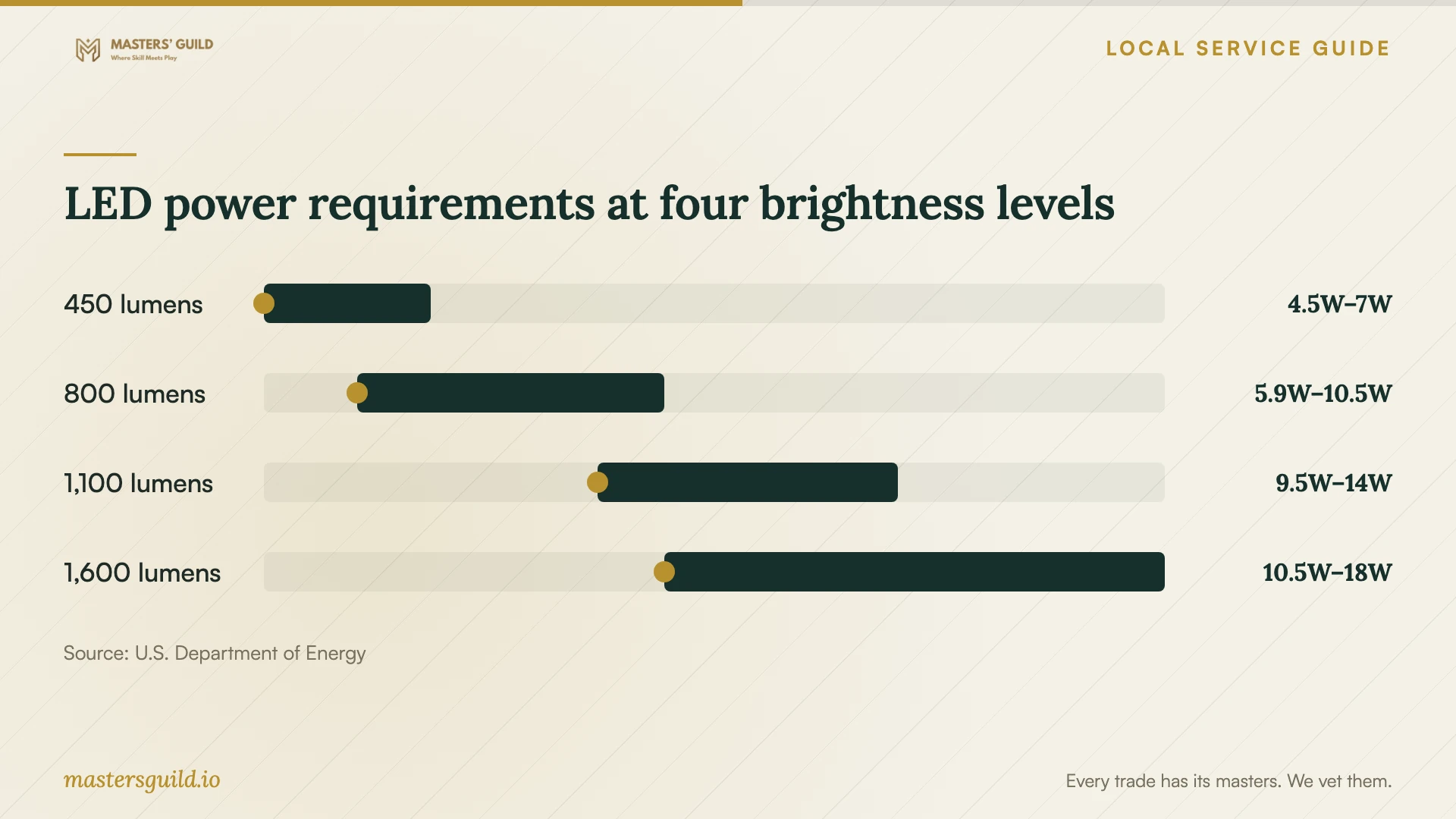
Compare brightness in lumens rather than selecting bulbs by wattage alone. The Department of Energy defines lumens as visible light output and watts as power input. Its national reference table compares LED and incandescent power requirements at matching lumen levels; the chart here reproduces the LED ranges. [5]
Check light appearance alongside brightness. DOE lists 2,700 K as warm and 3,000 K as soft, with homes among the applications for both. Ask to see a sample in the room before choosing bulbs for the whole space. Record your chosen color temperature in the fixture schedule. [5]
For dimming, DOE advises checking both the bulb’s dimming capability and compatibility with the dimming system. For fully enclosed fixtures, check the packaging or technical specifications for suitability because trapped heat can affect LED performance and life. Ask the installer to demonstrate the intended controls before you accept the work. [5]
LED power requirements at four brightness levels
Local details that affect your job
Columbia’s electrical trade application route
For regulated residential electrical work within city limits, submit the Residential Building Trade Permit application and required plans to the Development Center. Licensed contractors can use the Access portal to apply and pay. Call 803-545-3420 to confirm the requirements for your lighting scope before assigning an installation date. [1]
Design approval can precede a permit
Columbia says a property in a designated Historic or Design District requires a Certificate of Design Approval before permit issuance. For proposed exterior lighting, consult preservation staff first; they determine the staff or commission review route. Resolve that step before buying fixtures or authorizing mounting holes. [1] [2]
Check the address and overlay type
The City’s Preservation Districts page directs owners to its City Information Viewer map to check overlay status. Cottontown/Bellevue and Elmwood Park have conservation districts; Shandon has a Community Character Area with a different stated review scope. Check your parcel and ask staff which requirements apply instead of assuming nearby properties follow the same rules. [3]
Match your lighting project to the next step
| Project | Next step | Put in the written scope |
|---|---|---|
| Replace a light at an existing location | Ask the Development Center whether the exact scope requires a permit. | Fixture model, mounting assessment, removal, and testing. |
| Add or relocate lighting | Confirm the City’s electrical trade permit route and required plans. | Wiring route, switch work, permit responsibility, and surface repairs. |
| Change exterior lights on a protected property | Consult preservation staff about design approval before purchasing. | Approved fixture, finish, placement, and mounting details. |
| Add LED dimming | Check bulb dimming capability and compatibility with the control. | Bulb and dimmer models plus a demonstration at completion. |
| Install bulbs in an enclosed fixture | Check packaging or specifications for enclosed-fixture suitability. | Compatible bulb model and selected brightness. |
Your hiring checklist
- List each fixture location and identify replacements, relocations, and additions.
- Send fixture specifications, ceiling heights, and photographs with the quote request.
- Record the contractor’s legal name, electrical credential, and insurance information.
- Confirm the permitting authority and assign application and inspection responsibility.
- Check address-specific design review before purchasing exterior lights.
- Specify brightness, color temperature, and desired dimming controls.
- Agree on extra-work approval, surface repairs, cleanup, and completion paperwork.
Frequently Asked Questions
Does replacing one ceiling light require a Columbia permit?
The City says regulated work requires a permit and includes electrical work in its Building Trade Permit process. Its residential page does not give a fixture-swap-specific exemption. Describe the replacement to the Development Center at 803-545-3420 and confirm the requirement before work starts. [1]
Which credential should I ask an installer to show?
Ask for a credential appropriate to residential electrical work and verify it through LLR. The Residential Builders Commission lists residential electrical licensing separately from general specialty registration. Ask which person holds the electrical credential and who will perform your installation. [4]
Should I buy porch lights before historic review?
Consult preservation staff first if your property has local protection. Columbia starts historic-project review with staff consultation, and staff determine the approval route. Send the proposed fixture and placement details before purchasing so you can resolve any design questions. [2]
Can I keep my existing dimmer with new LED bulbs?
Check the exact bulb and dimmer combination before deciding. DOE advises confirming that bulbs support dimming and that LEDs are compatible with the dimming system. Ask the contractor to identify the proposed models in the quote and test the controls at completion. [5]
Sources and scope
This guide combines the sources below with practical planning guidance. Figures apply to the stated geography and period; request a written quote for your property.