
Local service guide
Heavy lifting in Columbia, SC: Hiring and Access
Arrange heavy lifting in Columbia, SC by telling the provider which items need moving, where they must go, and whether you need transportation. Request a quote after the provider reviews the access route. If you hire a household-goods carrier for transport within South Carolina, verify its PSC/ORS certificate. Confirm street access with the Parking Division before relying on a loading zone. [1] [2] [3]
Define the job before choosing a crew
List each item, its starting location, and its final placement. Include dimensions and a manufacturer-listed weight if you have one. Send photos that show the item, doorways, stair landings, and outdoor steps. Ask the provider to assess crew size and equipment from those details rather than choosing a crew yourself.
Specify whether you want furniture rearranged inside the home, a rental truck loaded, or belongings transported between addresses. Identify who supplies and drives the vehicle and who secures the load. ORS defines a Class E carrier through vehicle-based property transportation; its page does not settle requirements for a provider performing lifting-only work. [2]
For a piano, safe, stone tabletop, or other unusual item, request an item-specific assessment before accepting an offer. Explain any narrow landing or sharp turn. For appliances, assign disconnection and reconnection as separate tasks in the scope so neither you nor the crew assumes that the lifting booking includes installation.
Compare the complete quote
Ask for a written quote stating crew size, booked time, minimum charge, and charges for extra time, travel, stairs, equipment, or disassembly. Establish when billing begins and ends. Give competing providers the same description so you can compare what each offer includes.
ORS says a household-goods carrier's representative should inspect the goods and physical location, prepare an inventory, and assess the move before quoting. For a transport booking, request that review if the estimate leaves access assumptions unclear. You can also request the carrier's approved tariff and compare its rates and charges with the estimate. [3]
Agree on how you will approve extra work if an item cannot pass through the planned doorway or the truck must park farther away. Ask how the provider charges for building-access delays and how cancellation or weather postponement affects payment. Keep the agreed exclusions with the quote.
Check coverage and record condition
Ask the carrier to explain coverage limits and additional coverage costs. ORS advises reviewing the insurance valuation block on the Bill of Lading before the move begins. Read it before signing and ask the carrier to explain the cargo coverage for your shipment. [3]
Photograph existing marks on furniture and the carrying route. Agree on protection for floors, doorframes, and stair rails. ORS advises the customer and carrier to note existing damage to goods before the move and says an inventory should accompany the move. [3]
Inspect your belongings after the move. ORS advises requesting and filing the carrier's insurance claim form immediately for damaged household goods. For dwelling damage, it directs consumers to request a claim form under the carrier's general liability policy. Ask a lifting-only provider to explain its own coverage and damage-reporting procedure. [3]
Prepare access and a weather contingency
Clear clutter and loose rugs from the route, keep children and pets away, and mark where each item belongs. Arrange elevator reservations or building entry with the property manager. Leave the crew room to assess the route before anyone starts carrying.
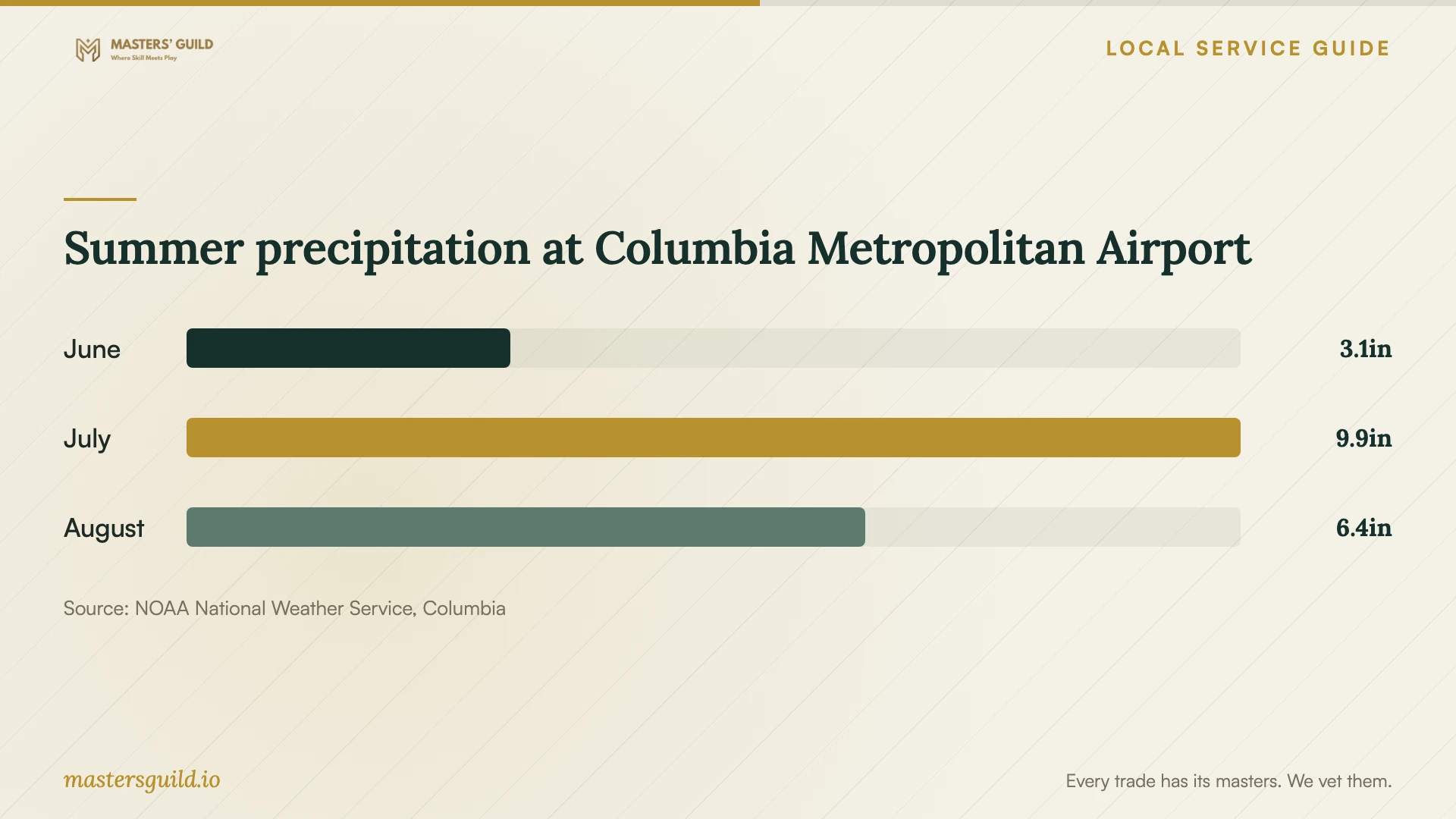
Discuss exposed loading and wet steps when setting postponement terms. NWS recorded 9.92 inches of precipitation at Columbia Metropolitan Airport in July 2024. That historical airport total supports planning for weather interruptions; it does not predict your move date. Check the forecast near the booking and agree who decides whether to pause outdoor work. [4]
Summer precipitation at Columbia Metropolitan Airport
Local details that affect your job
Confirm loading-zone eligibility for residential work
Columbia's reproduced section 12-51 limits loading-zone use to merchandise pickup or delivery serving a business within 30 minutes and includes an annual vehicle-permit requirement. Section 12-45 also contains day and hour restrictions and a separate 15-minute occupancy provision subject to posting. The city warns that these reproductions may be incomplete. Do not treat either a permit or a 30-minute stay as authorization for a residential move. Give the Parking Division the exact location, vehicle, date, and time; confirm the arrangement and identify an alternative legal space before booking. [1]
Ask about residential permit-parking access
The city's reproduced section 12-108 exempts vehicles providing repairs, deliveries, or other services to a resident from the residential permit-parking division. That exemption concerns that division, not unrestricted street access. Section 12-109 says a parking permit does not authorize use of prohibited zones or violations of other parking laws. Ask the Parking Division how these provisions apply to the service vehicle at your address, and keep driveways and sidewalks clear. [1]
Verify the carrier for both addresses
South Carolina requires a Class E carrier to obtain a Certificate of PC&N from ORS after PSC approval. For-hire household-goods carriers operating exclusively within one municipality must obtain a Certificate of FWA instead. Give the provider both addresses so it can identify the transport scope. ORS advises asking for the PSC/ORS certificate number and calling the regulator to verify it. Its Columbia-area consumer inquiry number is 803-737-5230. These state requirements provide a separate planning check from municipal parking permission. [2] [3]
Choose the scope to request
| Your task | Request | Resolve before booking |
|---|---|---|
| Rearrange furniture at home | Lifting help for named items | Provider assessment of the route and final placement |
| Load your rental truck | Loading labor | Vehicle supply, driving, and responsibility for securing items |
| Transport household goods within South Carolina | Carrier assessment and estimate | Verify the PSC/ORS certificate and compare the approved tariff |
| Move a safe or piano | Item-specific handling assessment | Provider acceptance of the item, access, and equipment needs |
| Use a Columbia loading zone | Parking Division confirmation | Business-service eligibility, permit provisions, timing, and posted restrictions |
Your hiring checklist
- Prepare an item list with dimensions, available weights, and final placement.
- Send photos of stairs, narrow turns, and the outdoor carrying route.
- Assign vehicle supply, driving, load securing, and appliance connections.
- Compare written charges and agree on approval for extra work.
- Settle street access, building entry, and elevator arrangements.
- Record existing condition and retain the quote, inventory, and coverage documents.
Frequently Asked Questions
Does lifting-only help need a mover's certificate?
The supplied ORS guidance describes vehicle-based household-goods carriers and does not resolve lifting-only work. Explain the exact service when asking about requirements. If the provider will transport household goods within South Carolina, verify its PSC/ORS certificate with the regulator. [2] [3]
Can a moving truck use a downtown loading zone?
Confirm the exact arrangement with the Parking Division. The city's reproduced rules include merchandise service to a business, vehicle permits, time limits, and day, hour, and posting qualifications. The city warns that the text may be incomplete. A permit plus a 30-minute stay does not establish residential-moving permission. [1]
How can I check a carrier's complaint history?
ORS says consumers can call Consumer Services at 803-737-5230 in the Columbia area to check a moving company's complaint history. Ask about the specific carrier whose name and certificate appear on your estimate. [3]
Sources and scope
This guide combines the sources below with practical planning guidance. Figures apply to the stated geography and period; request a written quote for your property.