
Local service guide
Colorado Springs lawn mowing: Plan and compare
Arrange lawn mowing by agreeing on cutting height, a schedule that follows grass growth, and a written price covering the areas and cleanup you need. Include any bordering alley in the scope: Colorado Springs tells owners to maintain weeds and grasses below 9 inches and take responsibility from their property line to the middle of the alley. [1]
Compare quotes for the same work
Give each provider the same description: front and back lawn, side strips, any alley area, gate access, slopes, obstacles, and current grass height. Send photos that show the whole mowing area and access route. Ask the provider to separate an initial overgrowth cleanup from the recurring visit price.
Have the written quote name mowing, trimming around fences and beds, edging along paved boundaries, and clearing clippings from hard surfaces. Ask whether the crew returns clippings to the lawn, bags them, or removes them from the property. Confirm any charge for bagging or hauling before the first visit.
Compare the payment arrangement as well as the visit price. Ask whether you pay per completed visit or under a monthly or seasonal agreement, how the provider handles skipped cuts, and whether you must approve extra work. Use property-specific quotes to set your budget rather than treating an unrelated lawn’s price as your expected bill.
Choose frequency from growth
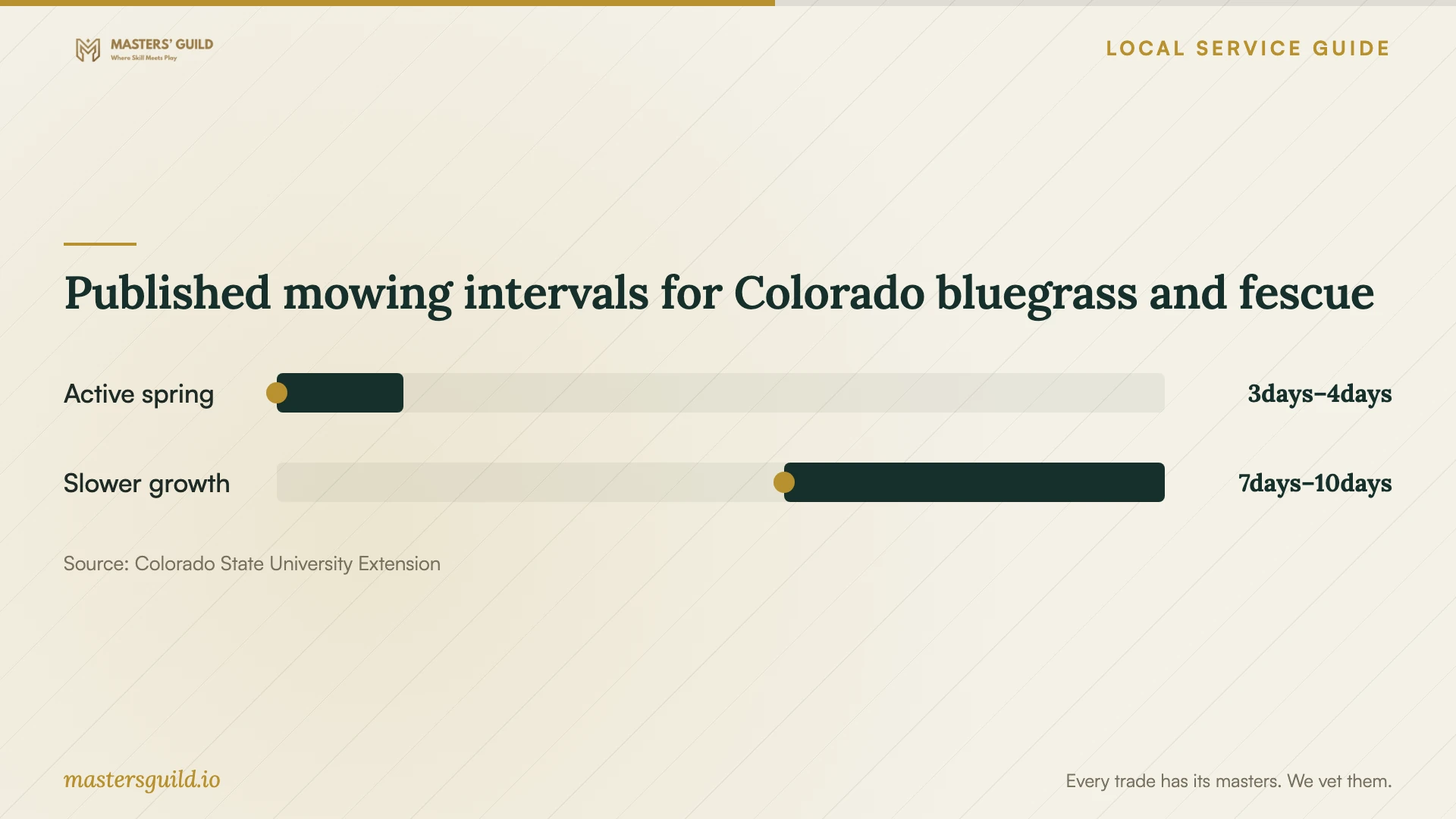
A fixed weekly or biweekly plan needs a way to adjust for growth. For bluegrass or fescue, Colorado State University Extension says the one-third rule may require cuts every three to four days during active spring growth, compared with every seven to ten days during slower growth caused by heat, drought, or cold. A biweekly interval exceeds that slower-growth example; ask the provider how they will decide whether to shorten the interval. [4]
Agree on a measured cutting height. Colorado Springs Utilities advises using the mower’s highest setting, while Extension gives a 2.5-to-3-inch recommendation. Ask the provider to explain the proposed height for your lawn and equipment rather than relying on a numbered mower setting. [3] [4]
For an overdue cut, ask about a staged approach. Extension recommends raising the mower height after a delay to avoid removing too much grass, then cutting again at the normal height a few days later. Confirm whether the follow-up cut has a separate charge. [4]
Set expectations for clippings and weather
Choose whether the crew should return clippings to the lawn. Extension says clippings return nutrients and organic matter to the soil and do not contribute to thatch buildup. It also tells mower operators to keep side discharge away from hard surfaces and avoid sweeping or blowing clippings into gutters or streets. [4]
Discuss wet grass and weather delays before committing to recurring service. Colorado Springs Utilities recommends mowing when grass blades are dry to prevent disease. Share your irrigation days and times, and agree on how the provider will notify you and reschedule a visit. [3]
Before the crew arrives, remove toys, hoses, and pet waste. Identify sprinkler heads, shallow edging, and areas you want the crew to leave untouched. Confirm gate access, where pets will stay, and how the provider will report accidental damage.
Plan autumn visits and separate add-ons
Use current growth to decide on autumn cuts rather than requesting a shorter final mow. Extension recommends maintaining a consistent height through the year and says there is no need to cut turf shorter in late summer or fall. Ask the provider to explain the stopping point for recurring visits and the process for restarting service. [4]
Keep irrigation work separate in the quote. Colorado Springs Utilities recommends reducing watering to once per week in October as weather cools and winterizing sprinkler systems in October. These are seasonal care recommendations. For ordinary sprinkler watering, the utility allows up to three days per week and requires watering before 10 a.m. or after 6 p.m. from May 1 through October 15. [2] [3]
Account for the utility’s exceptions when planning irrigation. It allows watering at any time with drip irrigation, a handheld hose with a shutoff nozzle, or another handheld watering container. Customers establishing grass or plants with sprinklers can apply for an establishment permit. Customers unable to follow the three-day schedule because of a large landscape, complex system, or other conditions can apply for a water allocation plan, which provides timing flexibility without additional water. [2]
If you also want aeration, seed, or fertilizer, request an itemized proposal with its own timing and preparation instructions. Identify who will adjust irrigation and whether the mowing schedule needs to change while new grass establishes. Do not assume the recurring mowing price includes those tasks.
Published mowing intervals for Colorado bluegrass and fescue
Local details that affect your job
Include the alley and check overgrowth
The City of Colorado Springs says weeds and grasses need to stay below 9 inches. If your property borders an alley, the city assigns you responsibility from the property line to the middle of the alley. Show that area during the quote visit and request a separate cleanup scope if it needs more than routine mowing. For an address outside city limits, confirm the applicable jurisdiction’s requirements. [1]
Coordinate mowing with Water Wise Rules
For ordinary sprinkler watering, Colorado Springs Utilities allows up to three days per week, with watering before 10 a.m. or after 6 p.m. from May 1 through October 15. The utility allows watering at any time with drip irrigation, a handheld hose with a shutoff nozzle, or another handheld watering container. Establishment permits and water allocation plans provide alternative arrangements for qualifying needs. The utility also prohibits pooling on hard surfaces and flow down gutters, and permits cleaning hard surfaces with water only for a public health and safety concern. Ask the crew to clear pavement clippings without routine hose washing. [2]
Discuss establishment watering before adding seed or sod
Colorado Springs Utilities lets customers apply for an establishment permit when they need sprinkler watering to establish new grass or plants. If your mowing proposal includes seed or sod, identify who will handle that application and confirm the watering arrangement before work starts. For a large landscape or complex irrigation system, discuss whether a water allocation plan fits your needs; the utility says that plan changes timing flexibility without allowing additional water. [2]
Choose the service arrangement that fits your lawn
| Situation | Arrangement to discuss | Point to confirm |
|---|---|---|
| Bluegrass or fescue in active spring growth | Flexible visits that may be every three to four days | Each cut removes no more than one-third of the height |
| Bluegrass or fescue during slower growth | Assess whether a seven-to-ten-day interval fits | Adjust the interval to actual growth |
| Overdue mowing | Raised first cut followed by another cut a few days later | Price and timing of the follow-up visit |
| Property bordering an alley | Include maintenance from your property line to the middle of the alley | Crew access and the exact area in the quote |
| New seed or sod as an add-on | Separate establishment and irrigation arrangements | Who applies for a utility establishment permit if needed |
Your hiring checklist
- Photograph each mowing area, access gate, and any alley strip.
- Describe current grass height, slopes, obstacles, and areas to leave untouched.
- Get separate prices for the first cleanup and recurring visits.
- Specify trimming, edging, clipping handling, and pavement cleanup.
- Agree on cutting height and a process for adjusting visit frequency.
- Share your irrigation method and schedule, including any approved alternative arrangement.
- Ask for proof of insurance and a process for reporting damage.
- Confirm billing, extra-work approval, weather delays, cancellation terms, and seasonal stopping arrangements.
Frequently Asked Questions
Should I choose weekly or biweekly mowing?
Choose an interval that lets the crew remove no more than one-third of the grass height per cut. Extension gives bluegrass and fescue examples of three to four days during active spring growth and seven to ten days during slower growth caused by heat, drought, or cold. Request a plan that allows changes rather than assuming biweekly service will fit throughout the season. [4]
Do I need the crew to bag grass clippings?
For routine mowing, Extension recommends returning clippings to the lawn to recycle nutrients and organic matter. It says clippings do not cause thatch buildup. If you want bagging, specify removal and disposal in the quote, and confirm the charge. [4]
How short should the provider cut the lawn before winter?
Extension recommends a consistent mowing height throughout the year, generally 2.5 to 3 inches, and says there is no need for a shorter fall cut. Ask the provider to maintain the agreed height and base remaining visits on growth. [4]
Does the mowing crew need to maintain my alley?
Colorado Springs assigns owners responsibility from their property line to the middle of a bordering alley. Include that area in your service agreement; confirm whether the provider will mow, trim, or perform a separate cleanup there. [1]
Sources and scope
This guide combines the sources below with practical planning guidance. Figures apply to the stated geography and period; request a written quote for your property.