
Local service guide
Concrete work in Colorado Springs: Hiring Guide
For concrete work in Colorado Springs, first establish whether your driveway, sidewalk, or curb project touches the City right-of-way. For that work, hire a contractor with the City's concrete license and confirm who will obtain the permit. Before hiring for damaged concrete adjacent to your property, ask the City about cost-share eligibility. For a private patio or slab, request an assessment and a written scope covering demolition, base preparation, drainage, finish, and return-to-use instructions. [1] [2] [3]
Identify the work area before choosing a contractor
Separate the private driveway or patio from any sidewalk, curb, gutter, or driveway portion in City right-of-way. The City requires a license and permit for constructing or repairing these items within its right-of-way. Ask the bidder to mark that boundary on the proposed work sketch. If the boundary remains unclear, confirm it with Right-of-Way Management before accepting the scope. [1]
For right-of-way work, request the contractor's City concrete license number and check its status with the City Clerk. The City requires a $5,000 surety bond and a certificate of commercial general liability insurance for $1,000,000 with the City listed as certificate holder. Ask for evidence of insurance covering your project as well; do not treat the license paperwork as a substitute for reviewing the contract. [1]
Ask for a repair diagnosis and a comparable quote
Show bidders the cracks, uneven joints, surface damage, and any places where water collects. Include photos and measurements, and describe how you use the surface. Ask each contractor to explain whether they propose filling cracks, leveling existing concrete, replacing individual sections, or removing and replacing the whole area. Request their reasoning and the limitations of the proposed repair.
Have each bidder state the area, slab thickness, excavation depth, base preparation, reinforcement proposal, joint layout, finish, and drainage plan. Ask them to identify demolition and disposal charges, equipment access, protection of nearby landscaping, and restoration after the work. For right-of-way concrete, require the contractor to identify a City-approved supplier and mix design, because the City permits only approved mixes from approved suppliers there. [2]
Use site-specific written quotes to set your budget. Ask for separate prices for optional finishes or extra replacement areas, and agree on how the contractor will price unforeseen conditions before work starts. Compare the total for the same scope, including permit responsibility and cleanup, rather than comparing a single unit price.
Check the City repair route before paying privately
For damaged concrete adjacent to your property, report the issue to Operations and Maintenance and ask whether the Concrete Cost Share Program applies. The City limits eligibility to High severity ratings. Under the program, the City arranges competitive bidding and its contractor completes the repair; the owner and City split the cost equally. Obtain eligibility confirmation before making a separate hiring commitment. [3]
Do not assume a report means a prompt repair. The City says its repair backlog may take several years to address and tells owners to report sidewalk hazards as soon as possible. It also states that owners retain legal liability concerning their sidewalks. If you enter the cost-share program and an adjacent pedestrian ramp has a compliance issue, the City says it will replace that ramp at no charge and split the remaining surrounding-concrete cost. [3]
Schedule permits, utility locates, and access
For established right-of-way concrete, the City directs contractors to its Remove/Replace Existing permit category when the work does not involve warranty or specified development permit requirements. The concrete permit includes traffic control, so the contractor does not need a separate traffic-control permit for that work. The City lists typical permit readiness for payment at 3 to 5 business days. Treat that as an approval allowance, then agree on the construction date. [2]
Before excavation, confirm who will premark the dig area, contact 811, and review utility responses. Colorado Springs Utilities instructs excavators to contact 811 three business days ahead and keep positive-response documentation onsite. If marks and responses disagree or marks are incomplete, the excavator must stop in the area of concern and request renotification. Utilities requires hand tools or soft digging within 18 inches of the exterior sides of a marked utility. [4]
Ask for a written sequence covering demolition, preparation, placement, inspections, and reopening. Agree on access to the garage and entry doors, where equipment will stand, and who will protect the new surface. Request project-specific curing and weather-protection instructions, plus separate dates for walking and driving on the concrete. Include the contractor's plan for weather delays and the process for reporting defects after completion.
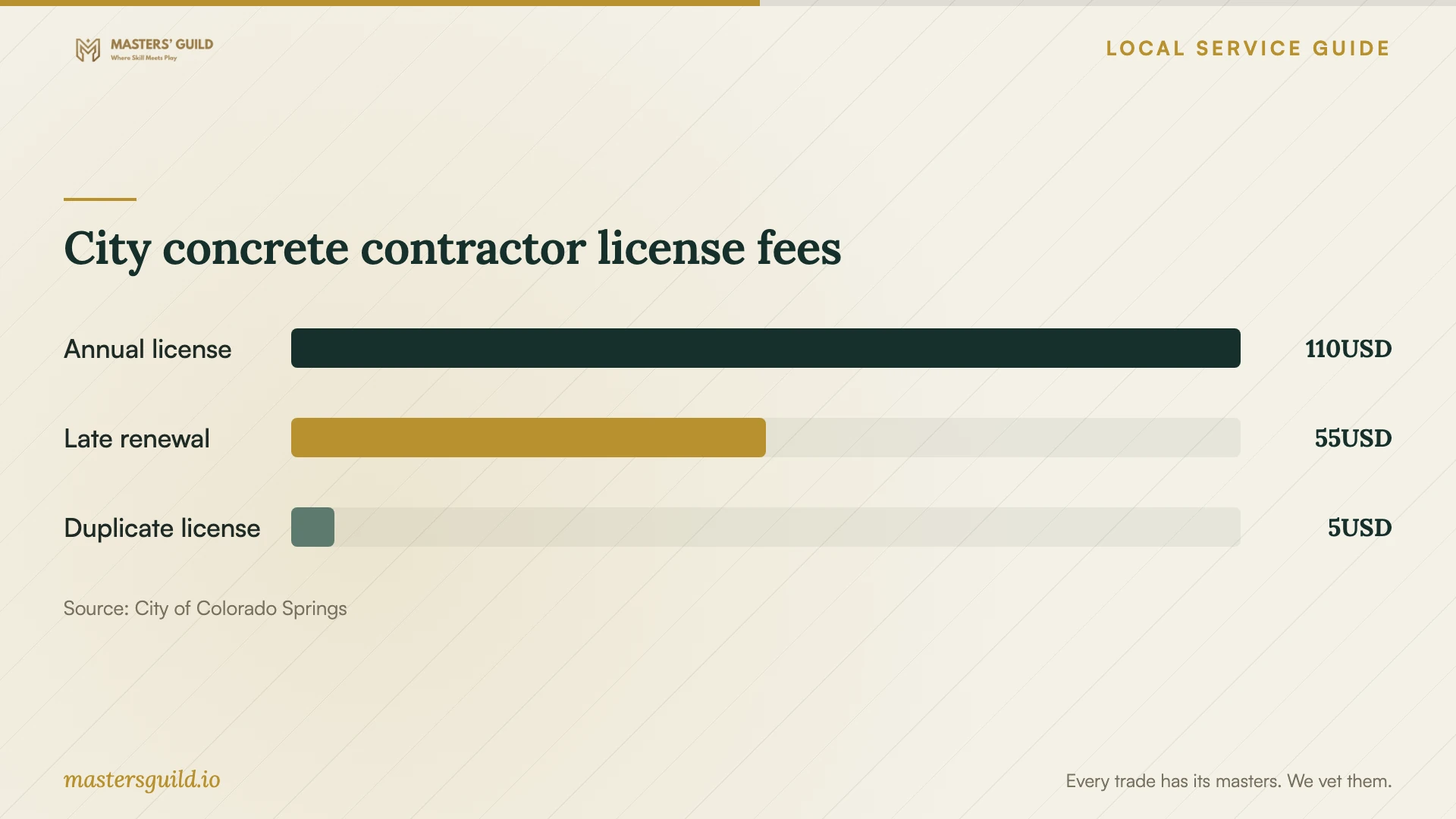
City concrete contractor license fees
Local details that affect your job
Right-of-way questions go to City Engineering
Confirm the boundary and permit route with Right-of-Way Management at 719-385-5977. The City handles concrete permitting through its online system and requires applicable inspections unless the inspector determines otherwise. Put permit payment and inspection scheduling in the contractor's written scope. [1] [2]
Ask for a severity assessment before choosing cost share
Report adjacent concrete disrepair at 719-385-5934 and ask the City to assess program eligibility. Only a High severity rating qualifies for cost share. The City's High criteria include 2 to 3 inches of vertical settlement, but let the City assign the rating rather than assuming your measurements establish eligibility. [3]
Include utility coordination in removal work
Utilities' locate guidance covers concrete installation, repair, and removal, and calls for finding the water stop box when it lies in the dig area. Ask the contractor to include this coordination in demolition planning rather than limiting the discussion to the new pour. [4]
Choose your first step by project location
| Project | First step | Include in the hiring discussion |
|---|---|---|
| Private patio or slab | Request an onsite assessment and confirm project-specific requirements. | Repair diagnosis, base preparation, drainage, finish, and access. |
| Driveway portion in City right-of-way | Confirm the boundary and contractor's City concrete license. | Concrete permit, approved mix, and inspections. |
| Damaged adjacent sidewalk or curb | Ask Operations and Maintenance for a severity assessment. | High-rated cost-share eligibility and City-arranged contractor. |
| Concrete removal involving excavation | Assign utility-locate coordination before digging. | 811 timing, positive responses, preserved marks, and stop-box location. |
Your hiring checklist
- Mark the proposed work area and confirm whether any portion lies in City right-of-way.
- Request the appropriate license number and project insurance documentation.
- Ask the City about adjacent-concrete repair eligibility before committing to a private repair.
- Get matching written scopes with quantities, preparation, drainage, finish, disposal, and exclusions.
- Assign responsibility for permits, inspections, utility locates, and any required standby appointments.
- Agree on access arrangements, weather delays, payment milestones, and written change approvals.
- Obtain curing instructions, reopening dates, and the contractor's defect-reporting process.
Frequently Asked Questions
Does a general contractor license cover the sidewalk work?
The City says general contractor licenses do not cover work in its right-of-way. For sidewalk construction or repair there, confirm the contractor has the City's concrete license and obtains the concrete permit. [1] [2]
Can I choose my contractor for the City's cost-share program?
The City describes a process in which it competitively bids the work and uses its contractor. Ask for program approval and arrangements before hiring a private contractor or expecting reimbursement. [3]
How much time should I allow before work starts?
For right-of-way permits, the City lists typical readiness for payment at 3 to 5 business days. Utilities instructs excavators to contact 811 three business days before digging. Ask the contractor to coordinate both steps and confirm readiness before setting demolition. [2] [4]
Should I choose leveling or replacement?
Ask bidders to inspect the damage and explain the cause before recommending a method. Request the proposed result, drainage implications, repair limitations, and warranty in writing. Compare both approaches where the contractor considers them suitable.
Sources and scope
This guide combines the sources below with practical planning guidance. Figures apply to the stated geography and period; request a written quote for your property.