
Local service guide
Tree cutting and arborist services in Cleveland, OH
Tree cutting in Cleveland starts with checking who handles the tree. The city accepts service requests for trees on tree lawns and the public right-of-way, but does not service private-property trees. For a private-yard job, request an arborist assessment and a written quote covering the proposed cutting, utility coordination, stump work and cleanup. [2]
Choose the right first contact
Use Cleveland’s Tree Issues service to request removal of a fallen tree or fallen or hanging branch on a tree lawn. The city also accepts trimming requests for trees needing attention, but excludes routine street-tree maintenance from that request category. Ask Urban Forestry to clarify responsibility if you cannot determine the tree’s location. [2]
For a private-yard tree, describe your concern before requesting a removal quote. Share photos of broken limbs, visible damage or branches over a structure. Ask the arborist to explain whether pruning, retention or removal suits the tree and what further investigation they recommend. Have them identify the tree and proposed work in writing.
Keep people away from a damaged tree while arranging help. Contact your electricity provider before cutting near wires. FirstEnergy warns against working on trees near power lines and excludes public safety hazards, outages and irregular service conditions from its routine tree-report form. [4]
Check approvals and qualifications
Cleveland requires a permit before planting, pruning, removing, excavating near or otherwise altering a public tree or public planting area. The city includes tree lawns, medians, parks and other City-owned or City-managed spaces in this guidance. Agree with the contractor on who will obtain approval before scheduling work. [1]
The city’s permit terms require licensed tree contractors for the listed public-property tree work. ISA Certified Arborists must perform public-tree pruning under current ANSI A300 standards. Contractors working on public trees must hold current workers’ compensation certification and at least $1 million in professional liability insurance. Apply these requirements to public work rather than treating them as a blanket private-yard rule. [1]
For private work, request current insurance documents and the assessing arborist’s name and certification details. Ask the contractor to identify the branches they propose to remove and explain the purpose. Cleveland prohibits topping, lion’s tailing and pollarding on public trees; ask bidders to describe their proposed pruning method rather than promising to cut the tree back. [1]
Compare quotes with the same scope
Use written quotes based on a site visit to set your budget. Give bidders the same tree photos and work request. Separate assessment, pruning or removal, stump work, hauling and restoration so you can see what each contractor includes. Ask them to identify exclusions and explain how you would approve any added work.
Walk through the proposed access route with the contractor. Discuss fences, paving, nearby plants and where equipment can stand. Record any agreed access arrangements, how the crew will protect surfaces and who will repair damage. Ask whether the quote includes equipment and utility coordination.
Specify stump depth, exposed-root treatment, grindings removal, backfill and the finished surface. For permitted public-property stump removal, Cleveland requires removal at least 8 inches below ground level and topsoil refill. The permittee must arrange underground utility locating through 811 before stump or root removal. Public-land tree removal must include stump removal. [1]
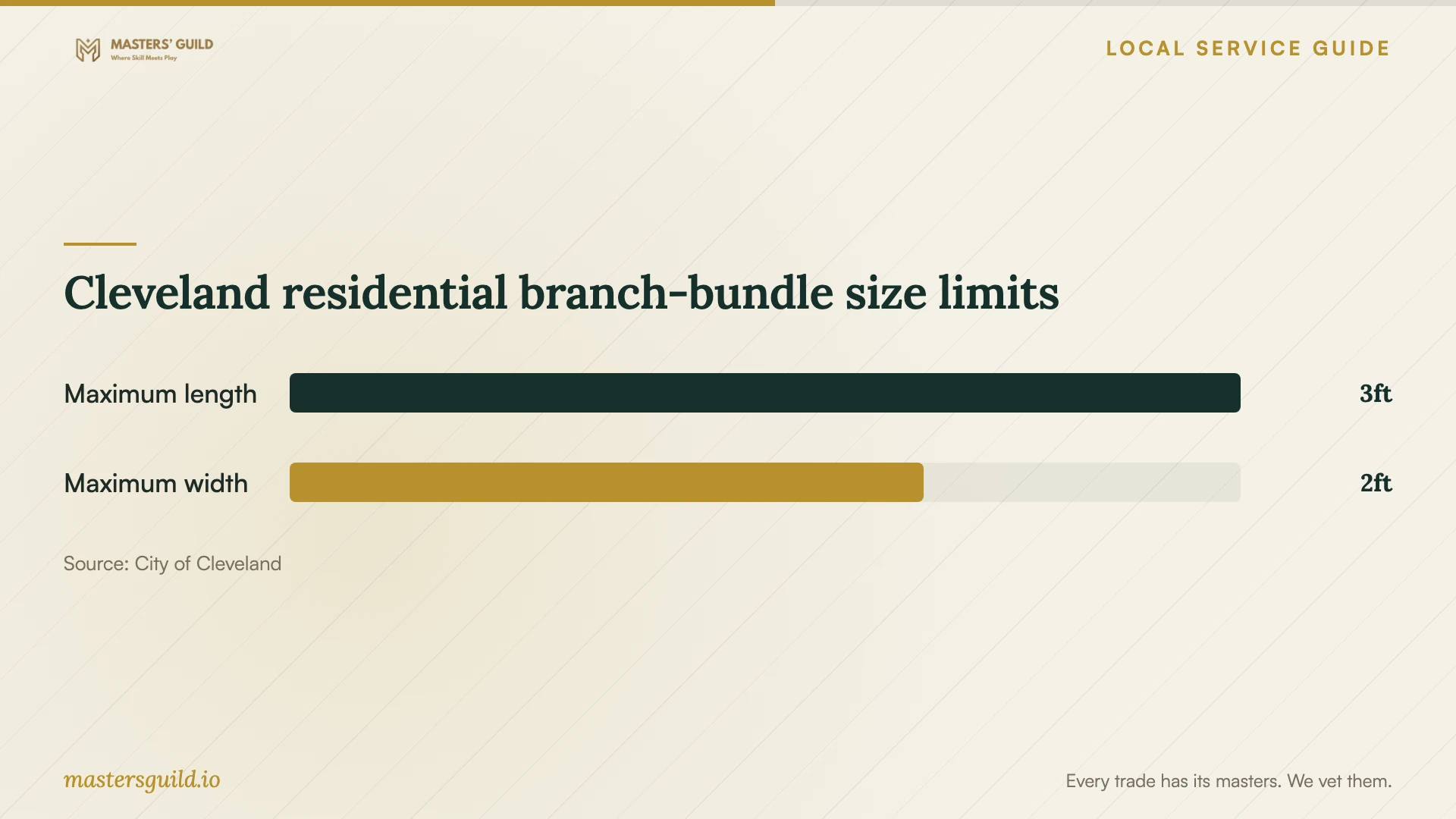
Agree on whether the crew will haul away logs and chips or leave them for you. Cleveland’s residential collection rules allow up to 20 branch bundles and 20 bags of yard waste per week. Each tied branch bundle must measure no more than 3 feet long and 2 feet wide. Include hauling or compliant bundling in the quote instead of assuming the city will collect a loose removal pile. [3]
Arrange timing and utility work
For public oak and elm trees, Cleveland’s permit terms specify pruning from November through March while the trees are dormant. For pruning outside that period, the terms require wound painting from April 1 to first frost. Ask the arborist to recommend timing for a private tree’s species and condition and explain whether the concern needs urgent attention. [1]
Agree on weather postponements and access requirements before the crew arrives. Ask who will contact you if conditions prevent work and how you will arrange a replacement date. Keep the work area available under the access arrangements you approved.
Check your electricity bill to identify your provider. For customers served by FirstEnergy, the utility says removing a tree between a utility pole and the home requires service disconnection, may involve service fees and leaves the actual removal to the homeowner. Ask the utility for instructions about your tree, then coordinate those instructions with the contractor. [4]
Cleveland residential branch-bundle size limits
Local details that affect your job
Use the current tree-work application
On its permit page retrieved October 13, 2026, Urban Forestry directed applicants to the linked Tree Work Permit Form while it developed its Accela application process. Check the city’s current application instructions and obtain the required approval before work starts. [1]
Flag removal connected to development
Cleveland requires Tree Preservation Plan review for development projects on one or more acres, apartment, townhome or condominium projects of four or more units, and other applicable Chapter 341 projects. Urban Forestry must approve the plan before the related Building Permit can issue. Tell the contractor if your removal forms part of a development project. [1]
Settle utility cleanup responsibilities
FirstEnergy’s normal maintenance includes branch chipping and raking, but the utility leaves wood over 4 inches in diameter for the homeowner’s use or disposal. During storm work, it removes limbs from wires without cleaning up the debris. If FirstEnergy serves your home, inspect what remains before requesting a private cleanup quote. [4]
Choose your next step
| Situation | First step | Detail to settle |
|---|---|---|
| Fallen tree or hanging branch on a tree lawn | Use Cleveland’s Tree Issues service | Confirm the location qualifies for city service |
| Planned pruning of a public tree | Seek Urban Forestry approval | Arrange an ISA Certified Arborist and required pruning standards |
| Private-yard tree with uncertain condition | Request an arborist assessment | Ask for the reasons behind retention, pruning or removal |
| Tree near FirstEnergy wires | Contact FirstEnergy before cutting | Determine utility involvement, disconnection and any fees |
| Branches left for residential pickup | Arrange tied bundles or hauling | Keep bundles within 3 feet long and 2 feet wide; observe the 20-bundle weekly limit |
Your hiring checklist
- Confirm the tree’s location and responsibility before approving cutting.
- Share photos, your concern, the access route and nearby structures.
- Ask for the assessing arborist’s credentials and written recommendation.
- Request current insurance documents and assign responsibility for approvals.
- Coordinate wire-related work with your electricity provider.
- Specify stump depth, grindings, hauling, backfill and restoration.
- Agree on postponements, payment terms and approval of added work.
Frequently Asked Questions
Do I need a permit to remove a private-yard tree?
Cleveland’s Urban Forestry guidance requires permits for public trees and addresses preservation review for certain private-property development removals. Ask Urban Forestry whether your tree’s location and your project require review before authorizing removal. [1]
Will Cleveland remove a tree on private property?
The city’s Tree Issues page excludes private-property trees. Its service requests cover trees on tree lawns or the public right-of-way. Arrange a private arborist assessment for a tree in your yard. [2]
Does tree removal include the stump and cleanup?
Define both in your written quote. Cleveland requires stump removal with public-land tree removal. For private work, specify the treatment of logs, branches, chips, grindings and the remaining hole, plus any surface restoration you want. [1]
Can I use FirstEnergy’s tree form for a tree fallen on wires?
FirstEnergy identifies trees fallen on power lines as a public safety hazard and excludes hazards from its routine tree form. Keep away from the tree and wires and contact your electricity provider through its emergency reporting channel. [4]
Sources and scope
This guide combines the sources below with practical planning guidance. Figures apply to the stated geography and period; request a written quote for your property.