
Local service guide
Translation Services for Cleveland Court Matters
For Translation Services connected to a Cleveland Municipal Court matter, start by separating hearing assistance from written document work. The court publishes an interpreter request number, 216-664-3952. Use that route to arrange language assistance for your proceeding, and ask how to handle any documents you want to submit. Before hiring a document translator, obtain the recipient’s instructions and agree on the scope, delivery date, and corrections. [3]
Define the help you need for your court matter
Write down the communication tasks you need help with: following a hearing, speaking during a proceeding, understanding an exchange at the Clerk’s office, or preparing a translated document. Describe each task when arranging assistance. Ask who will handle it and whether you need a separate booking or document order.
Cleveland Municipal Court’s history page describes interpreting for small claims cases, driving privileges hearings, wedding ceremonies, probation referrals, psychiatric evaluations, and matters in the Clerk’s office. For a homeowner preparing receipts, estimates, or correspondence for a small claims matter, ask separate questions about hearing assistance and the written material you intend to present. [1]
Keep your document order specific. Identify the source and target languages, intended recipient, and files you need back. If you want help understanding a document for your own preparation, say so. If you intend to submit the translation, give the translator the receiving office’s instructions before accepting a quote.
Prepare for the interpreter request
Have your case number, hearing date, language, and communication needs in front of you when you contact the court through the published route below. Ask how staff will confirm the arrangement, whether they need further information, and whom you should contact if your hearing changes. Keep a note of the response with your case paperwork.
The court’s history page says it provides other languages, including American Sign Language, upon request. It also states that a defendant cannot use a friend or relative to interpret in court proceedings because of conflicts of interest. If you planned to rely on someone you know for that role, arrange the court’s assistance before the proceeding. [1]
Describe any difficulty hearing, seeing, or participating in the planned communication format. Ask staff to explain the arrangement you should expect. Avoid treating an unanswered message or your own private booking as confirmation that the court has arranged assistance.
Understand the credential you are checking
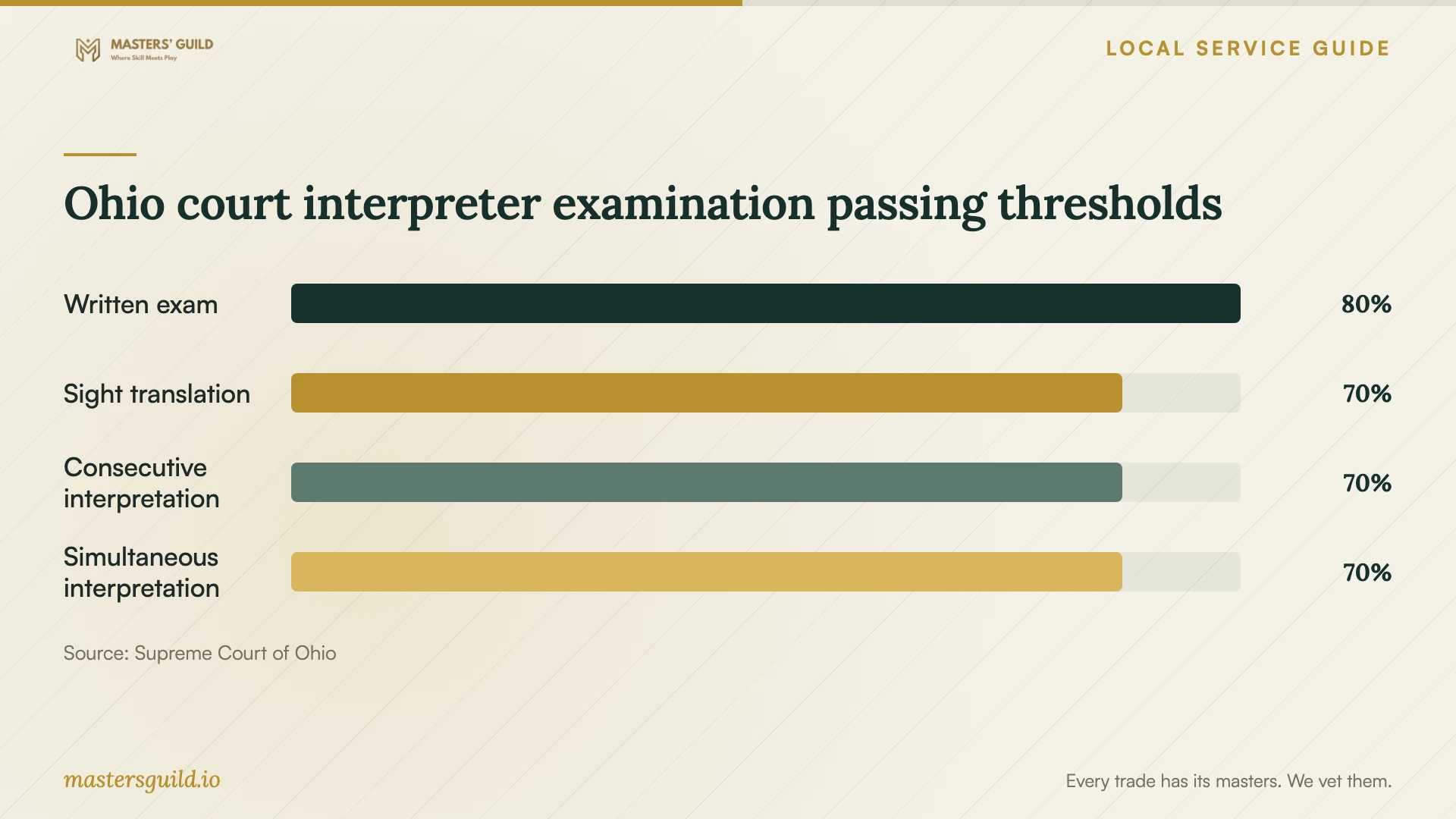
The Supreme Court of Ohio describes an examination-based certification route with written and oral exams. The written exam covers general English proficiency, court terminology, and interpreter ethics. The oral exam covers sight translation, consecutive interpretation, and simultaneous interpretation. The chart below presents the published passing thresholds for that route. [2]
The same page describes a provisionally qualified category, separate sign-language credential provisions, and reciprocity applications for certified and registered court interpreters. Ask a proposed interpreter to identify their exact credential and language rather than accepting a broad description such as certified language professional. [2]
For written documents, ask a different set of questions: who will translate the material, who will review it, and how they will resolve unclear handwriting or terminology. Request an explanation of the document review process alongside any court interpreting credentials the provider presents.
Scope and review a written translation order
Prepare readable copies of the complete material, including attachments, stamps, and handwritten notes. Supply the spellings you use for names and identify passages you cannot read. Ask the translator to flag uncertainty rather than guess. Keep the original files so you can compare them with the finished translation.
Ask the recipient whether it expects a translator’s statement, a specified credential, notarization, paper copies, or a particular electronic format. These are questions to resolve for your own submission, not requirements established by the court pages cited here. Send the recipient’s response with your quote request.
Request a total quote that identifies translation, formatting, review, and any requested accompanying statement. Ask how the provider charges for changes you make after work starts. Agree on a review date and final delivery date, and ask who can access your files and how the provider handles storage and deletion.
Before submitting the finished work, compare names, dates, amounts, and attachments with your originals. Check that you received the agreed files and accompanying material. Send discrepancies to the translator for correction and retain the final version alongside the source document.
Ohio court interpreter examination passing thresholds
Local details that affect your job
Cleveland Municipal Court request route
The court’s How Do I page publishes 216-664-3952 for interpreter requests. This is the local starting point for arranging assistance with that court. Ask staff to confirm the process for your case and whether your written documents require a separate step. [3]
Ohio roster and remote court assistance
The Supreme Court of Ohio links to a roster of interpreters and states that roster interpreters can assist courts by telephone and video. This statewide resource applies to planning court assistance in Cleveland. Check a proposed interpreter’s roster entry and ask the handling court whether remote participation fits your proceeding before making a private booking. [2]
Match the task to the arrangement
| Task | Planning choice | Question to resolve |
|---|---|---|
| Following or speaking in a municipal court proceeding | Use the court’s interpreter request process | How will staff confirm assistance for this case? |
| Submitting translated receipts or correspondence | Scope a separate written translation order | What does the receiving office expect? |
| Considering a private court interpreter | Use Ohio’s roster as a credential-checking resource | What is the person’s exact credential and language? |
| Considering telephone or video assistance | Discuss the format with the handling court | Will this arrangement fit the proceeding and your communication needs? |
Your hiring checklist
- List the hearing, office communication, and written document tasks you need help with.
- Keep your case details and notes from arrangement conversations together.
- Prepare complete, readable source documents and approved name spellings.
- Attach the recipient’s written submission instructions to the translation order.
- Agree on the total price, review date, final delivery, and correction terms.
- Check names, dates, amounts, attachments, and accompanying statements before submission.
Frequently Asked Questions
Does requesting a hearing interpreter cover my written documents?
Ask the court to address the written documents as a separate question. The cited municipal pages describe interpreter assistance and a request route; they do not establish a written translation ordering process. Obtain instructions for your intended submission before paying for document work. [1] [3]
Does Ohio’s examination process assess written translation work?
The credentialing page describes a court interpreting examination route. Its oral components include sight translation, consecutive interpretation, and simultaneous interpretation. For a written document order, also ask about the provider’s document experience, review process, and handling of unclear source text. [2]
Can I get a reliable translation price from these sources?
These court pages do not publish written translation prices. Request a quote for your actual files and instructions. Compare the included work, delivery commitment, and correction terms before choosing a provider. [1] [2] [3]
Sources and scope
This guide combines the sources below with practical planning guidance. Figures apply to the stated geography and period; request a written quote for your property.