
Local service guide
Pressure washing in Cleveland: plan and hire
Arrange pressure washing in Cleveland by comparing written quotes for the same surfaces and requiring a cleaning method, protection plan and cleanup scope. Resolve deteriorating-paint concerns before authorizing work, and seek preservation guidance for historic brick or stone. Cleveland provides address-based rental lead-safe records; EPA requires containment when pressure washing falls within its Lead Renovation, Repair, and Painting Rule. [1] [2] [3]
Compare quotes for a defined scope
Send providers photos of the whole area and close-ups of stains, peeling paint and visible damage. List each surface you want cleaned, approximate dimensions, access restrictions and the available outdoor water connection. Ask for a site visit if the provider cannot identify the material or assess its condition from your photos.
Request separate descriptions of preparation, cleaning, stain treatment, protection and cleanup. Have the provider identify exclusions, including repairs, paint removal and sealing. Ask who moves furniture and planters, whether the price includes wastewater handling, and what happens if the approved treatment leaves discoloration.
Compare property-specific written offers before setting your budget. Request insurance documentation and ask how the provider would handle damage. Agree that additional treatment requires your approval, with its method and price in writing.
Resolve paint concerns before work starts
Cleveland’s Department of Public Health warns that buildings constructed before 1978 may contain lead paint. The city identifies older windows, doors, railings and porches among surfaces to examine. Ask whether cleaning would disturb paint and seek an assessment before authorizing work around deteriorating coatings. [1]
EPA permits pressure washing under its Lead Renovation, Repair, and Painting Rule, subject to containment requirements. For work covered by that rule, the firm must prevent dust and debris, including debris in wastewater, from leaving the work area. It must maintain containment and preserve emergency exit access. EPA directs firms to consult the local water treatment authority about wastewater disposal. [2]
Ask the provider to explain whether your proposed work falls within the rule and describe its containment and disposal arrangements. Pause the paint-related portion if the provider cannot explain its approach. Keep the scope for other surfaces separate so you can decide which work to authorize.
Approve a test before cleaning historic masonry
Ask a qualified preservation professional to assess historic brick or stone before selecting a washing method. GSA’s reference guidance calls for identifying materials, conditions and previous treatments, then testing the gentlest effective method. GSA requires professional judgment about whether its procedures suit a particular building. [3]
Request an inconspicuous test area and review it before approving larger-scale cleaning. GSA includes surrounding-area protection and cleaning-effluent collection in its testing guidance. Ask the provider to describe products, application, rinsing and protection around openings in the written proposal. [3]
Agree on the appearance you will accept after the test. Ask the specialist to explain remaining stains and whether further treatment would suit the material. Keep photographs and the approved method with your maintenance records, then inspect the completed area with the provider.
Set weather limits and prepare access
Use the appointment forecast to choose the work window. The National Weather Service Cleveland table shows declining normal mean low temperatures from September through December. Treat that seasonal pattern as a reason to discuss overnight conditions and postponement, rather than as a forecast for your property. [4]
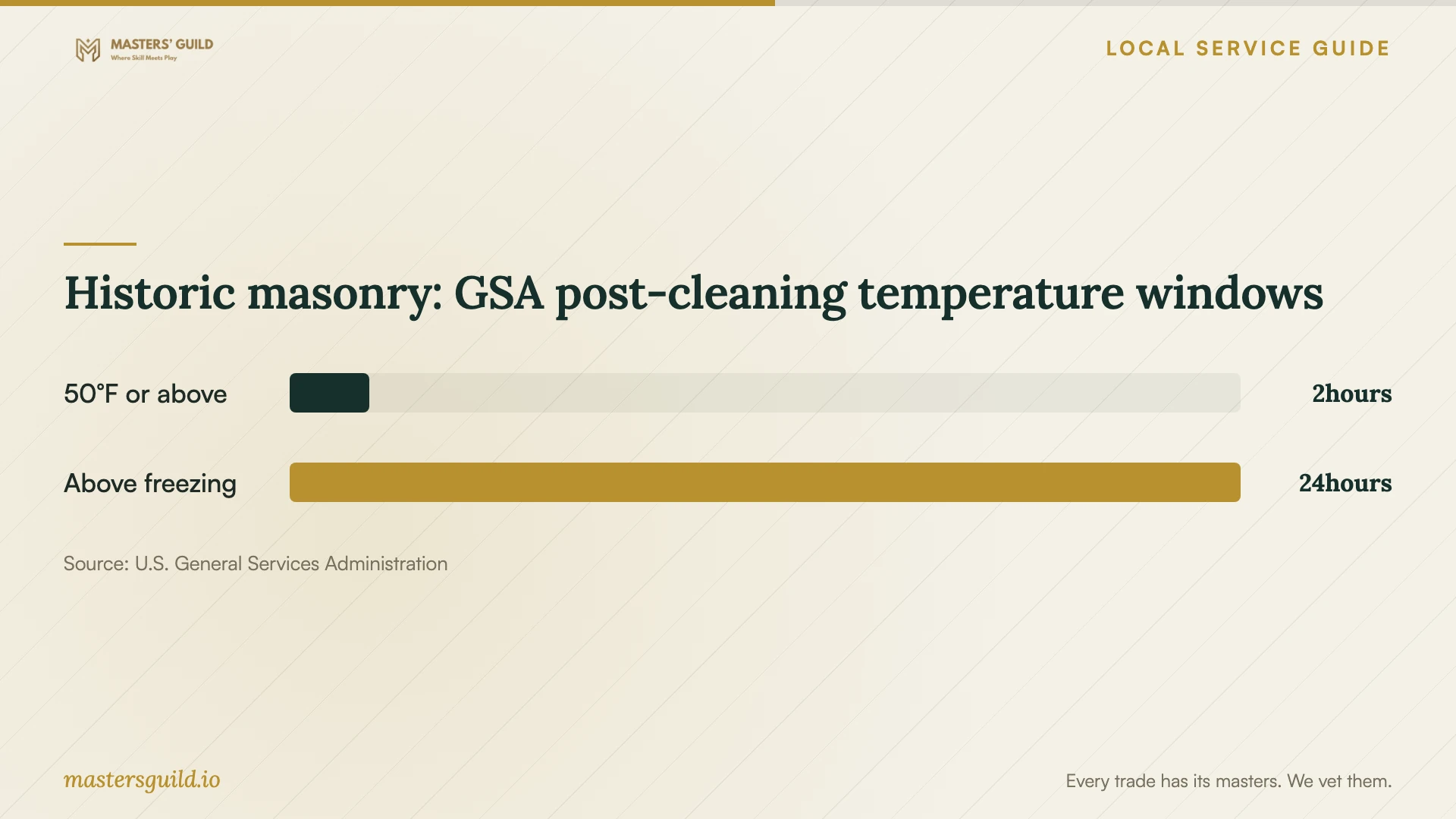
GSA’s historic-masonry reference specifies a minimum of 50 degrees Fahrenheit for at least two hours after completion and above-freezing temperatures for at least 24 hours afterward. It also says not to begin when rain, snow or below-freezing temperatures are expected within the next 24 hours. These are selected conditions from a project-specific reference; ask the preservation professional to establish the complete limits for your building. [3]
Before arrival, confirm who clears the work area and protects adjacent materials. Show the crew existing damage and any openings you want assessed. Agree on a route you can use during the job, the final scope and the cleanup inspection. Keep children and pets away from the agreed work area.
Historic masonry: GSA post-cleaning temperature windows
Local details that affect your job
Check the rental address before arranging painted-surface work
On Cleveland’s What to Know About Lead in a Home page, find the section about checking a Lead Risk Assessment and follow its Lead Safe Certificates link to the city’s Open Data Portal. The city describes an address search covering certification, assessments with required work and hazard sources, and noncompliance. Review the record with the property owner and washing provider before approving work around deteriorating paint. Cleveland requires pre-1978 rentals to obtain certification or an exemption; owner-occupied properties do not need certification. [1]
Plan a late-year appointment with an overnight weather check
The Cleveland CLE normals table shows lower normal mean lows in each month from September through December. For a late-year historic-masonry appointment, ask the specialist to review the forecast through the day after cleaning and document cancellation criteria. Apply the specialist’s project limits to the actual forecast. Station normals cannot establish conditions at your home or confirm a suitable appointment window. [4] [3]
Choose the next step before booking
| Situation | Next step | Confirm before approval |
|---|---|---|
| Unpainted paving | Request a material-specific quote | Cleaning method, stain treatment, protection and cleanup |
| Deteriorating paint on an older home | Resolve lead concerns | Assessment, RRP applicability and containment approach |
| Pre-1978 Cleveland rental | Check city lead-safe records by address | Certification or exemption and any hazard assessment |
| Historic brick or stone | Seek preservation-professional guidance | Test area, gentlest effective method and effluent collection |
| Late-year historic-masonry appointment | Agree on forecast-based postponement | Complete project limits, including conditions after cleaning |
Your hiring checklist
- Send matching photos, dimensions and surface lists to each provider.
- Identify painted areas and resolve concerns before authorizing paint-disturbing work.
- Check the city’s address-based lead-safe records if the property is an older rental.
- Request preservation guidance and a test area for historic brick or stone.
- Get preparation, cleaning, exclusions and cleanup in writing.
- Ask the provider to explain containment and wastewater disposal arrangements.
- Confirm insurance documentation, additional-work approval and weather postponement terms.
- Inspect the agreed surfaces and cleanup with the provider.
Frequently Asked Questions
How much should I budget for pressure washing?
Get written quotes for your property using the same dimensions, photos and scope. Compare preparation, treatment, protection and cleanup as well as the total price. Request separate prices for repairs, sealing or additional stain treatment, and agree on how the provider will obtain approval for extra work.
Does an owner-occupied home need Cleveland lead-safe certification?
Cleveland says owner-occupied properties do not need certification. The city also warns that pre-1978 buildings may contain lead paint. Resolve concerns about deteriorating paint before arranging cleaning that could disturb it, even if the rental certification requirement does not apply to your home. [1]
Can a provider pressure wash lead-painted surfaces?
EPA does not prohibit pressure washing under its RRP Rule. For covered work, the firm must meet containment requirements, including preventing debris in wastewater from leaving the work area. Ask the provider to explain applicability, containment and disposal before authorizing the job. [2]
Can I book historic masonry cleaning late in the year?
Ask a preservation professional to approve the work window using the actual forecast. GSA’s reference includes temperature conditions after completion and postponement for expected rain, snow or below-freezing temperatures. Agree on the complete project limits and rescheduling terms before booking. [3]
Sources and scope
This guide combines the sources below with practical planning guidance. Figures apply to the stated geography and period; request a written quote for your property.