
Local service guide
Tree Cutting in Cincinnati: Arborists and Job Planning
Arrange Tree Cutting in Cincinnati by identifying public-tree or utility involvement before booking a private crew, then obtain a site-specific written quote. Report split or hanging public trees in the right of way through 311Cincy. Duke Energy's April 2024 guidance allows only qualified line-clearance contractors to work closer than 10 feet from overhead power lines; higher voltages require greater clearances. For a private tree, ask the estimator to explain the assessment, proposed cuts, access plan, and finished condition. [1] [2]
Decide what you want the arborist to assess
Describe the problem before choosing a treatment: a damaged limb, branches over a roof, a tree you suspect is declining, or space needed for a project. If you hope to retain the tree, request an assessment and ask the arborist to explain the options before you authorize removal.
Identify each tree on a photograph or site sketch. For pruning, ask the estimator to describe the branches they propose to cut and the intended result. For removal, explain how you want to use the ground afterward so the estimator can describe the work needed to reach that condition.
Ask who will assess the tree and who will supervise the crew. Verify any arborist credential the provider claims and request current insurance documentation for the proposed work. Ask how the provider will handle an unexpected condition discovered after the crew starts.
Resolve overhead-line safety before scheduling
Duke Energy's April 2024 safety bulletin tells workers without line-clearance qualifications to keep themselves, tools, equipment, and vehicles at least 10 feet from overhead lines carrying up to 50 kV. Greater voltages require greater distances. Duke directs contractors to contact the utility before work to verify voltage and determine the required clearance. [2]
If the proposed work requires entering the mandated clearance distance, Duke directs contractors to arrange safety measures with the utility in advance. Tell the estimator about wires, including lines running from poles to buildings, and ask who will coordinate those arrangements before you agree on a work date. [2]
If a tree, limb, tool, or equipment contacts a power line, stop work. Duke directs people to avoid touching the line or anything it touches, keep others away, and contact 911 and the utility. Wait for utility personnel to say the area is safe before anyone resumes work. [2]
Compare the scope and finished condition
Request a site-specific price using the same description for each estimator. Have each provider identify the trees, proposed work, equipment access, cleanup responsibilities, and exclusions. Agree on how you will approve and price changes rather than leaving that discussion until work starts.
Walk the access route with the estimator. Point out gates, fences, garden beds, parked vehicles, and surfaces you want protected. Discuss equipment placement and where the crew plans to lower branches. Obtain any necessary neighbor permission before booking access across another property.
Describe the finish you expect: wood retained in a named location, brush hauled away, stump treatment, grindings removed or retained, and the ground left ready for your intended use. Ask the provider to price optional work apart from the agreed tree work so you can compare proposals without guessing what each total includes.
Prepare for collection and weather changes
Cincinnati DPS manages yard-waste collection every other week, beginning in April and continuing until January, on recycling day. Residents must prepare yard waste in paper bags or a container labeled Yard Waste and keep it out of the green recycling cart. Confirm debris eligibility and your address's collection date with DPS before deciding to leave material for pickup. [3]
Discuss wet-ground access and the contractor's rescheduling process. Ask who will notify you of a changed date and whether equipment placement needs another review after rain. Clear the agreed access route and arrange a way to keep children and pets away from the work area.
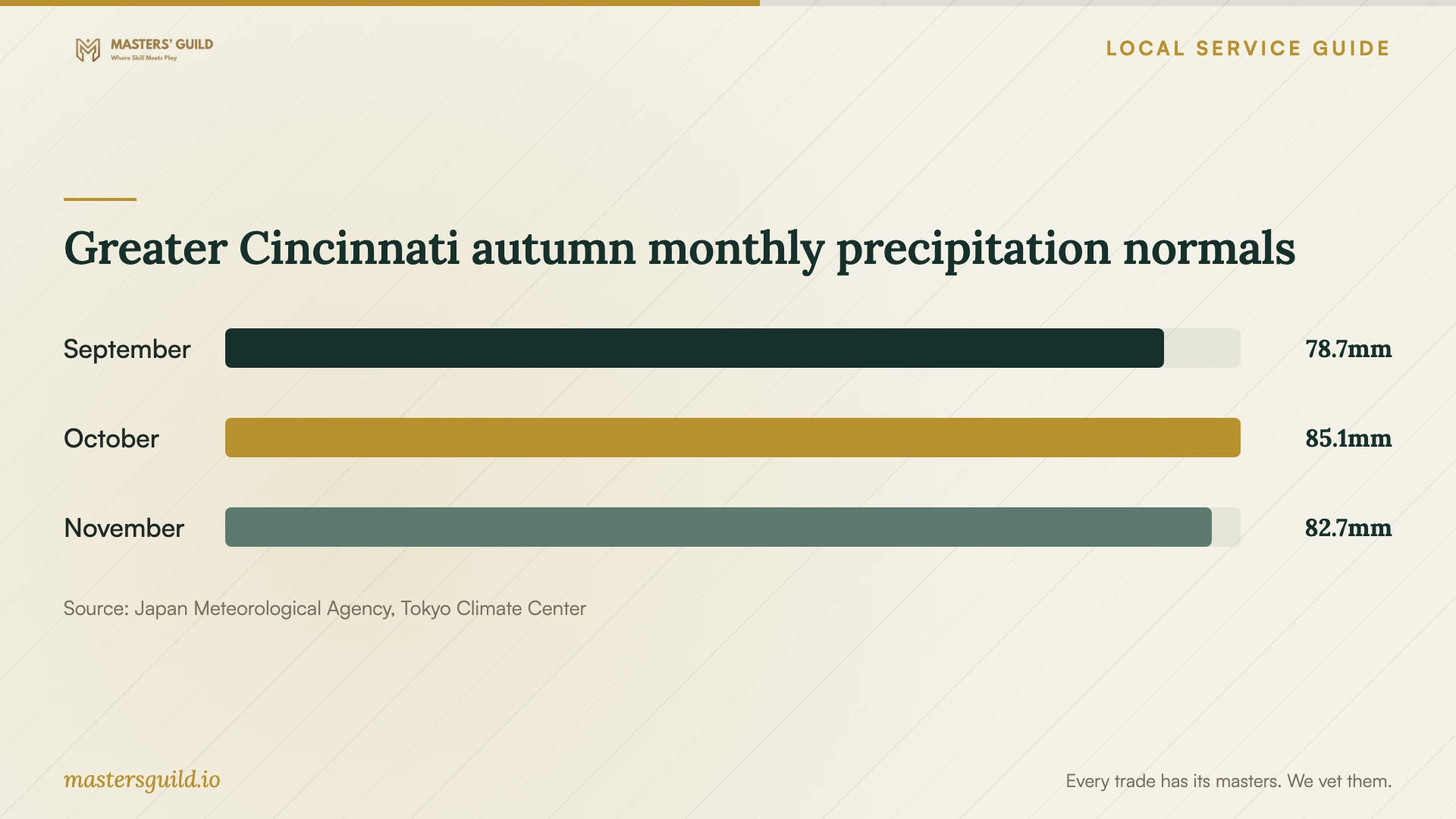
The regional precipitation chart uses published monthly normals for the Greater Cincinnati station. Use it as background for discussing weather contingencies. It does not predict rainfall at your property or determine when your particular tree needs pruning. [4]
Greater Cincinnati autumn monthly precipitation normals
Local details that affect your job
Public-tree response and private cleanup
Report a split or hanging public tree in the right of way through 311 or 513-765-1212. Cincinnati describes the usual tree lawn as the space between the sidewalk and street. Urban Forestry excludes private streets and interstates or state highways, except Norwood Lateral or 6th Street. Staff prioritize storm responses. If a private tree affects the street, Forestry may cut back a limb or hanger and place material on the owner's property. Confirm what cleanup remains before hiring a private crew. Call 911 for a serious life-safety issue. [1]
Kentucky and Ohio utility coordination
Duke Energy's April 2024 bulletin lists 800-544-6900 for Kentucky/Ohio planning and safety arrangements, and 800-543-5599 for electrical emergencies alongside 911. Treat these as contacts published in that bulletin, and confirm the planning contact with Duke before scheduling work near lines. Ask your estimator to name the person responsible for utility coordination. [2]
Collection timing affects the cleanup plan
Cincinnati collects yard waste on the same day as recycling, every other week from April until January. Before choosing municipal pickup for eligible pruning debris, confirm the next collection date and accepted materials with DPS. Agree on where the crew will leave prepared material so you can manage it until collection. [3]
Choose your next step
| Situation | Next step | Point to resolve |
|---|---|---|
| Split or hanging public tree in the right of way | Report it to 311Cincy; use 911 for a serious life-safety issue. | Confirm Urban Forestry's response scope before arranging private work. |
| Proposed work closer than 10 feet to overhead lines | Arrange utility coordination in advance. | Duke's April 2024 guidance limits this work to qualified line-clearance contractors; higher voltages require greater distances. |
| Private tree you hope to retain | Request an assessment before authorizing cuts. | Ask the arborist to explain the proposed treatment and alternatives. |
| Pruning debris intended for city pickup | Confirm eligibility and collection timing with DPS. | Use paper bags or a labeled Yard Waste container, outside the green recycling cart. |
| Removal followed by replanting or another project | Describe your intended use of the ground. | Agree on stump treatment and the finished condition in writing. |
Your hiring checklist
- Mark each tree in a photograph and describe your desired result.
- Resolve public-tree responsibility and utility coordination before booking.
- Verify claimed credentials and request current insurance documentation.
- Walk the access route and obtain any neighbor permission.
- Record the agreed finished condition and disposal responsibilities.
- Review price, exclusions, change approval, payment terms, and rescheduling.
- Clear the agreed access route and plan to keep children and pets away.
Frequently Asked Questions
Will the city clear my whole yard after a private tree falls into the street?
Confirm the response scope with Urban Forestry. Cincinnati says Forestry may cut back material from a private tree and place it on the owner's property. Arrange any remaining private cleanup after you know what the city will handle. [1]
Does an arborist credential qualify someone to work close to power lines?
Ask about line-clearance qualifications. Duke Energy's April 2024 bulletin says only qualified line-clearance tree-trimming contractors may work closer than 10 feet from overhead lines. Workers without that qualification must maintain at least 10 feet for lines up to 50 kV, with greater distances for higher voltages. Confirm voltage, clearance, and advance safety arrangements with Duke. [2]
How should I compare two different recommendations?
Ask each estimator to explain the problem they observed, the result they propose, and why they chose pruning or removal. Compare those explanations alongside the written scope. If you remain uncertain, request another assessment before authorizing irreversible cuts.
Sources and scope
This guide combines the sources below with practical planning guidance. Figures apply to the stated geography and period; request a written quote for your property.