
Local service guide
Translation Services in Cincinnati: Hiring Guide
Arrange Translation Services in Cincinnati by identifying who will receive your documents, obtaining that office’s requirements, and asking a provider for a written quote against those requirements. Specify the language pair, document set, delivery date and certification wording. For University of Cincinnati international transfer admissions, plan for translation, foreign credential evaluation and official transcript delivery as separate tasks. [1]
Define the assignment before requesting quotes
Tell the provider whether you need someone to translate written records or interpret a conversation, appointment or hearing. For documents, name the receiving institution and purpose. For spoken assistance, describe the setting, language and dialect, appointment length, and whether you need attendance in person or by remote connection.
Prepare one complete document set for quoting. Include reverse sides, stamps, handwritten notes and attachments. Ask the provider to identify unreadable passages before you approve the assignment. Supply your preferred spelling of names and flag differences between records so the translator can explain how they will handle them.
Plan UC transcript work as separate steps
UC’s international transfer admissions office requires a course-by-course foreign credential evaluation for each college or university attended outside the United States. Applicants must obtain the evaluation from a service on the NACES member website. UC also requires a certified translation company to translate transcripts that are not in English. [1]
UC accepts unofficial transcripts for the initial application review, but applicants cannot enroll until the university receives official transcripts. UC considers transcripts sent by the issuing institution official and documents sent by the applicant unofficial. Arrange the institution’s delivery alongside the translation order. [1]
Before paying, ask the evaluator which documents it needs and how it accepts translations. Give the translator those instructions and UC’s requirements together. UC also asks applicants whose prerequisite courses were taken outside the United States to provide course descriptions or syllabi, translated into English if needed. Include those materials in your scope when they apply. [1]
Match certification to the receiving authority
EOIR’s immigration court manual requires documents in English or accompanied by a certified English translation. The translator must type and sign the certification and attach it to the foreign-language document. The certification must state the translator’s competence and the translation’s accuracy, and include the translator’s address and telephone number. A certification covering multiple documents must identify them. [3]
An English affidavit or declaration signed by someone who is not fluent in English requires an additional certificate of interpretation under EOIR’s guidance. That certificate must confirm that the person heard the document in a language they understand and understood it before signing, along with the interpreter’s competence and accuracy statements. Discuss this step with the person preparing the filing. [3]
These requirements concern immigration court filings. For another receiving office, obtain its own instructions. Ask whether it requires notarization, paper copies or a particular certification format before buying those additions. [3]
Check qualifications for spoken court assistance
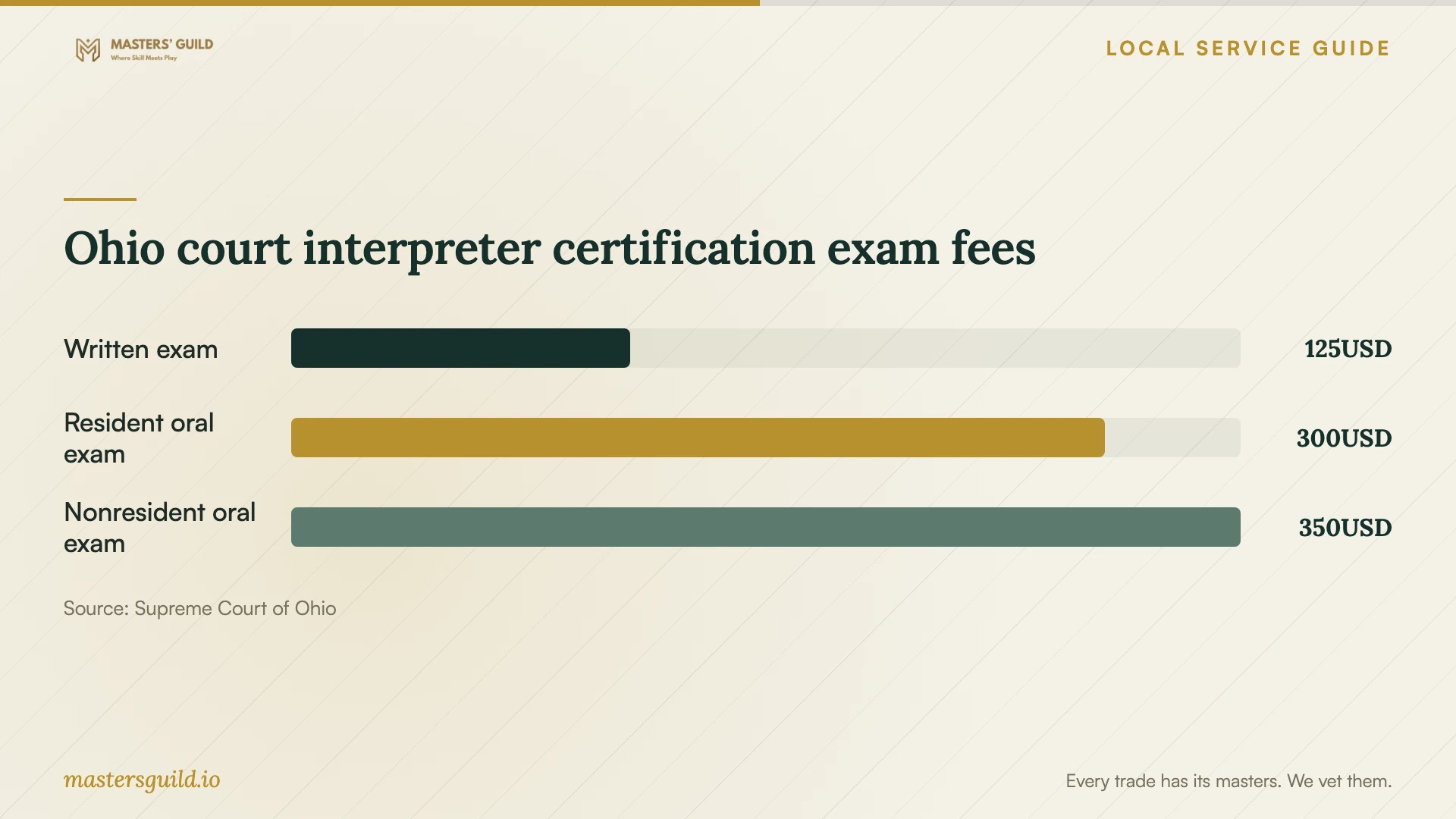
The Supreme Court of Ohio requires candidates for its foreign-language court interpreter certification to pass written and oral examinations. It also provides a reciprocity application route for candidates with specified credentials from other states or entities. For an Ohio court matter, ask the court how it arranges interpreters and which qualifications it requires before making a private booking. [2]
Ask a proposed interpreter to identify their credential, language and relevant assignment experience. Describe the hearing or meeting rather than requesting generic language help. Confirm who will coordinate with the court, the attendance format and the procedure if the appointment changes.
Compare scope, delivery and correction terms
Request a total quote for the same document set from each provider. Ask each to state the billing unit and list certification, formatting, notarization if requested, shipping and rush work as separate items. For an interpreting booking, request the minimum booking period, travel charges and cancellation terms.
Set a delivery date that leaves you time to review names, dates, document numbers and missing pages. Ask who checks the translation, how you request corrections, and whether the quoted price includes those corrections. Confirm whether you will receive a signed PDF, paper copies or editable files.
Ask how the provider receives sensitive records, who can access them and when it deletes retained copies. Send the receiving office’s instructions through the same agreed channel. Keep the approved scope, quote and final document set together for your records.
Ohio court interpreter certification exam fees
Local details that affect your job
UC applicants must coordinate the issuing institution
For international transfer admission, UC treats applicant-sent transcripts as unofficial even when the applicant supplies a translation. Ask your former institution to send official transcripts to UC and coordinate the separate NACES evaluation and English translation before ordering duplicate work. [1]
Ohio court work warrants a credential check
Ohio has a court interpreter credentialing program with written and oral examinations and a reciprocity route. If your assignment involves an Ohio court, ask the court about its interpreter arrangements first, then ask any proposed interpreter to identify their court credential and language. [2]
Choose the service for your assignment
| Your assignment | What to arrange | Before approving |
|---|---|---|
| UC international transfer with foreign university records | NACES member course-by-course evaluation; certified-company English translation if needed | Coordinate official transcripts from the issuing institution |
| Foreign-language immigration court documents | English translation with EOIR-compliant signed certification | Check competence and accuracy statements, contact details and document identification |
| English declaration for a signer who is not fluent in English in immigration court | Interpretation before signing and a certificate of interpretation | Discuss the certificate with the person preparing the filing |
| Spoken assistance for an Ohio court matter | Ask the court about interpreter arrangements and required qualifications | Check the proposed interpreter’s court credential and language |
Your hiring checklist
- Obtain the receiving office’s translation and delivery instructions.
- Specify the source language, target language and purpose.
- Prepare readable copies of the complete document set.
- Flag inconsistent names, dates and unreadable handwriting.
- Request an itemized total quote and a firm delivery date.
- Confirm certification wording and any requested notarization.
- Agree on review, correction and sensitive-document handling.
- Coordinate institution-sent transcripts or court arrangements where applicable.
Frequently Asked Questions
Does a transcript translation complete my UC transfer application?
UC requires a course-by-course NACES member evaluation for foreign university study as well as a certified-company translation for non-English transcripts. UC also requires official transcripts before enrollment. Ask the evaluator and admissions office to confirm your document and delivery plan. [1]
Must I notarize a translation for immigration court?
The cited EOIR translation provision specifies a typed, signed certification with competence and accuracy statements and translator contact details. It does not list notarization as a requirement in that provision. Confirm any separate instructions for your particular filing before ordering notarization. [3]
Can I use one certification for several immigration court documents?
EOIR permits a certification covering multiple documents, but the certification must specify those documents. Ask the translator to identify the complete set and include the required statements, signature, address and telephone number. [3]
How should I compare prices?
Give each provider the same files and requirements. Compare the total price, included certification, delivery format, completion date and correction terms. Ask providers to explain their billing unit and any extra charges before you approve the work.
Sources and scope
This guide combines the sources below with practical planning guidance. Figures apply to the stated geography and period; request a written quote for your property.