
Local service guide
Special Item Transport in Cincinnati: Plan Your Move
Arrange Special Item Transport in Cincinnati by choosing a crew that explains its handling plan for your item, provides a written scope, and reviews access at both addresses before booking. Settle delivery placement and setup responsibilities before accepting the price. If you need reserved curb space, follow Cincinnati’s permit and police-district process for temporary parking restrictions. [1] [2]
Choose a crew for the item and carrying route
Prepare one job description for all candidates. Include the make or model, dimensions, documented weight if available, condition photographs and intended destination room. Show the route at both addresses, including narrow openings, stair landings, turns and the proposed truck position. Ask for a site review if the crew cannot resolve access from that information.
Ask item-specific questions. For a piano, request the preparation and reassembly plan. For a pool table, specify whether you want transport, assembly and leveling. For a safe, discuss its empty weight and any removal or replacement of anchors. Ask who will handle detachable parts and what equipment the crew proposes.
Have the candidate explain how it will protect the item, floors and doorframes along your route. Agree on a stopping point if the crew discovers that the planned route will not work. Avoid approving an improvised route or added work without understanding the revised scope and charge.
Compare prices for the completed job
Request a written total or charging method that identifies packing, crating, carrying, disassembly and setup as included work or separate charges. Ask how the crew charges for waiting or changed access, and name the person who can approve additional work. Compare the price for the item in its agreed final position.
Request written damage coverage terms, including limits, exclusions and the claim procedure. Describe the item’s value and ask how those terms apply to it and to damage inside your home. Keep this answer with the quote. If another technician must complete setup, identify that appointment and its cost before choosing the transport crew.
Resolve curb access before agreeing to arrival
Cincinnati’s DOTE resource page directs non-event loading and unloading at homes or businesses to the police temporary parking restriction process. Police require a valid DOTE permit or issued CPD event permit with the request. Apply at the police district responsible for the loading address and provide the dates, start and end times, parking-area type, and addresses or meter numbers. [1] [2]
Police generally permit temporary restrictions where parking is already legal. They prohibit restriction signs in no-parking zones, including bus stops and taxi stands. Parking during restricted rush hours, 6am–9am or 3pm–6pm, requires express authorization on the valid DOTE permit or approved CPD event application. Have the crew identify a suitable loading position before you set its arrival time. [1]
Assign the curb-access work to a named person. Coordinate it with building access, elevators and the person meeting the crew. Ask what the crew will do if the planned space remains occupied, including whether a different truck position changes the carrying route or quoted work.
Agree on weather handling and delivery acceptance
Ask how the crew will cover the item between the building and truck, where it will stage components, and who decides to pause loading. For a temperature-sensitive item, obtain handling guidance from its manufacturer or a qualified technician and share it with the crew.
At the Greater Cincinnati weather station, January 2026’s monthly mean daily minimum temperature was −7.8°C, and July’s monthly mean daily maximum was 30.0°C. For a winter or summer move, ask how the crew will limit outdoor waiting and whether the item needs a temperature-controlled transport arrangement. These station observations describe past monthly conditions; use the forecast and item-specific guidance for your moving date. [3]
Meet the crew at delivery and inspect the item against the pickup record. Check the agreed placement and setup before signing completion paperwork. Record damage or unfinished work with the crew, keep the delivery documents, and use the agreed claim procedure if needed.
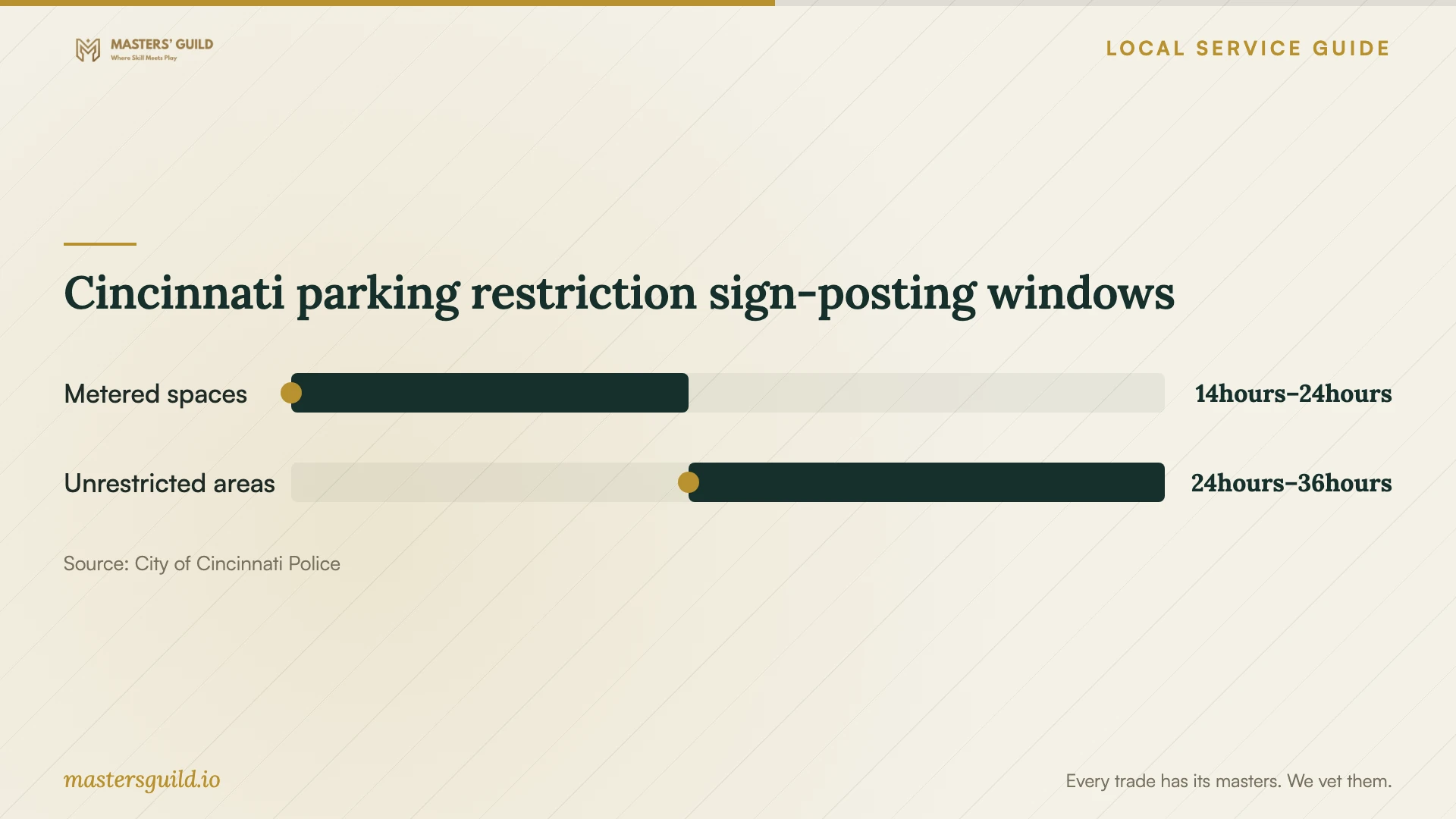
Cincinnati parking restriction sign-posting windows
Local details that affect your job
Posting and notification control enforcement timing
For otherwise unrestricted parking areas, police require approval and sign posting 24–36 hours before the restriction. For metered spaces, the posting window is 14–24 hours. The minimum advance-notice period starts when the district desk officer receives your notification. Police cannot enforce the restriction until the required 14 or 24 hours have elapsed. Schedule both posting and notification within the applicable window. [1]
Streetcar alignment includes more than the tracks
DOTE requires Trackway Access Authorization and a valid right-of-way permit for work within the streetcar alignment. The city defines that alignment to include contiguous public right of way from property line to property line, potentially including sidewalks and curbs. If your proposed loading work involves that area, ask DOTE to resolve the required approvals at 513-352-3463 before committing to the loading position. [2]
Someone must maintain and remove the parking signs
Police require restriction signs no farther than 40 feet apart and signs with dates and times alongside meter bags. The applicant must monitor the signs and bags; missing signs or bags can prevent enforcement. After completion, the applicant must remove and destroy them. Assign this task to someone who can remain at the loading address if you leave for delivery. [1]
Choose the next step for your loading position
| Proposed access | Next step | Timing or responsibility |
|---|---|---|
| Private off-street space | Ask the crew to review the truck position and carrying route. | Resolve building access and final placement before booking. |
| Reserved metered spaces | Obtain the prerequisite permit and district approval; post signs and meter bags 14–24 hours ahead. | Notify the district desk officer after posting. Police cannot enforce until 14 hours after notification. |
| Reserved otherwise unrestricted parking | Obtain the prerequisite permit and district approval; post signs 24–36 hours ahead. | Notify the district desk officer after posting. Police cannot enforce until 24 hours after notification. |
| Work within the streetcar alignment | Ask DOTE to resolve Trackway Access Authorization and right-of-way permit requirements. | Confirm approvals before committing to that loading position. |
Your hiring checklist
- Prepare one item and access description for all candidates.
- Resolve the handling plan and any uncertain carrying route.
- Confirm the completed setup, price assumptions and coverage terms in writing.
- Assign curb arrangements and coordinate building access.
- Name the people meeting the crew and approving changes.
- Agree on outdoor protection, weather delays and waiting charges.
- Inspect delivery and retain the condition record and paperwork.
Frequently Asked Questions
How should I budget for the move?
Obtain an item-specific written quote using the dimensions, documented weight and access details for both addresses. Ask for the price of the completed job, including any separately arranged setup, and a clear method for calculating changes. Confirm waiting charges and who can approve additional work before booking.
Can I reserve curb space with my own signs?
Follow the city’s approval process. Police require the prerequisite permit, district approval, correct posting and notification. After notification, the required advance-notice hours must elapse before police can enforce the restriction. [1]
Does every move need temporary parking restrictions?
DOTE offers the process for non-event loading and unloading when you need temporary parking restrictions. First agree on the proposed truck position with the crew. If you need reserved street space, resolve the permit and district requirements before scheduling arrival. [1] [2]
What should I do if the crew cannot complete the route?
Ask the crew to stop and explain the alternative, additional work and revised charge. Use the change-approval arrangement in your written scope. Resolve any new access or setup questions before authorizing the crew to continue.
Sources and scope
This guide combines the sources below with practical planning guidance. Figures apply to the stated geography and period; request a written quote for your property.