
Local service guide
mold removal in Cincinnati, OH: Hiring and Planning
For mold removal in Cincinnati, hire a professional experienced in cleaning and repairing buildings damaged by sewage or other contaminated water if that caused the damage. For other mold cleanup, EPA recommends checking the contractor's mold-cleanup experience and references. Ask for a written scope covering cleanup, moisture correction and rebuilding. Report sewer backups promptly and coordinate services with MSD, whose April 2024 announcement describes assistance for eligible properties. Address necessary contamination cleanup and moisture control while awaiting eligibility. [1] [4]
Choose who should handle the damage
Use the affected area and water source to plan the assessment. EPA says a patch smaller than about 10 square feet may suit homeowner cleanup in most cases. For extensive water damage or growth beyond that size, EPA directs readers to broader remediation guidance. For sewage or other contaminated water, hire a professional experienced in cleaning and repairing buildings damaged by contaminated water. Consult a health professional before cleanup if you have health concerns. [4]
Tell the assessor which surfaces show growth, when you first noticed it and whether it returned after cleaning. Include any suspected HVAC contamination. EPA advises against running the system when you know or suspect mold contamination because it could spread mold throughout the building. [4]
Ask what the assessor can inspect without opening walls and what remains inaccessible. Agree on approval and pricing before anyone expands demolition. Photograph the affected areas and record the work you authorize.
Coordinate sewage cleanup without delaying action
MSD's April 2, 2024 announcement says it investigates sewer-backup reports to determine assistance eligibility. It describes professional cleaning at no charge to eligible owners and tenants, plus reimbursement for eligible damage caused by the MSD public sewer. It assigns cleanup and repair responsibility to owners when a private issue causes the intrusion. Confirm the program's current availability and your property's eligibility with MSD. [1]
Report the backup promptly while arranging necessary contamination cleanup and moisture control. Ask MSD and any contractor you hire to identify overlapping tasks, so you understand who will perform each part. EPA urges quick action on mold and prompt correction of water problems. Plan necessary cleanup while MSD considers assistance. [1] [4]
MSD's cleanup procedure describes moisture measurements and lists of belongings to save or discard. Review those lists before signing. Its contractors may extract water, remove damaged flooring and wall materials, and clean, dry and disinfect wet surfaces. Ask how they will protect belongings you want to retain. [2]
Compare the work included in each quote
Request itemized prices for assessment, cleaning, material removal, drying, moisture-source repair and reconstruction. Ask bidders to name the rooms and surfaces included, explain how they will handle belongings and state what discoveries could trigger additional charges. Compare the same scope across offers.
EPA recommends choosing a contractor with mold-cleanup experience and checking references. Ask which EPA or professional remediation guidelines the crew follows. Request training and insurance documentation, and identify the supervisor and any subcontractors before accepting the quote. For sewage damage, check the crew's experience cleaning and repairing buildings affected by contaminated water. [4]
Discuss disposal before agreeing to surface treatment. EPA says moldy porous materials such as carpet and ceiling tiles may require disposal because complete mold removal can prove difficult or impossible. EPA also advises fixing water problems and drying items, then cleaning and drying moldy surfaces before painting or caulking. [4]
Ask each bidder to explain its completion criteria and the records it will provide. Request photographs, an account of removed materials, any moisture readings the crew takes and a written list of remaining repairs. Have the contractor explain any guarantee and its limits.
Plan construction and access before work starts
Discuss demolition, rebuilding and water-source repairs with the building department. Cincinnati's older residential guide describes permits for major repairs and structural, plumbing, mechanical or electrical changes, plus contractor registration before construction. The city marks the application section OLD and references 2011 and 2013 codes. Confirm today's requirements for your address and proposed work with Buildings & Inspections. [3]
Name the person responsible for repairing the water source and the person responsible for replacing removed finishes. Agree on their sequence and on access to the work area. Ask whether you need to move belongings or arrange another place to stay during the proposed work.
For its sewage-cleanup procedure, MSD describes drying equipment operating continuously for two to three days, with technicians returning to measure moisture. That duration covers the utility's described drying stage and does not estimate your mold project's duration. Arrange access for checks and follow its instruction to leave the equipment running. [2]
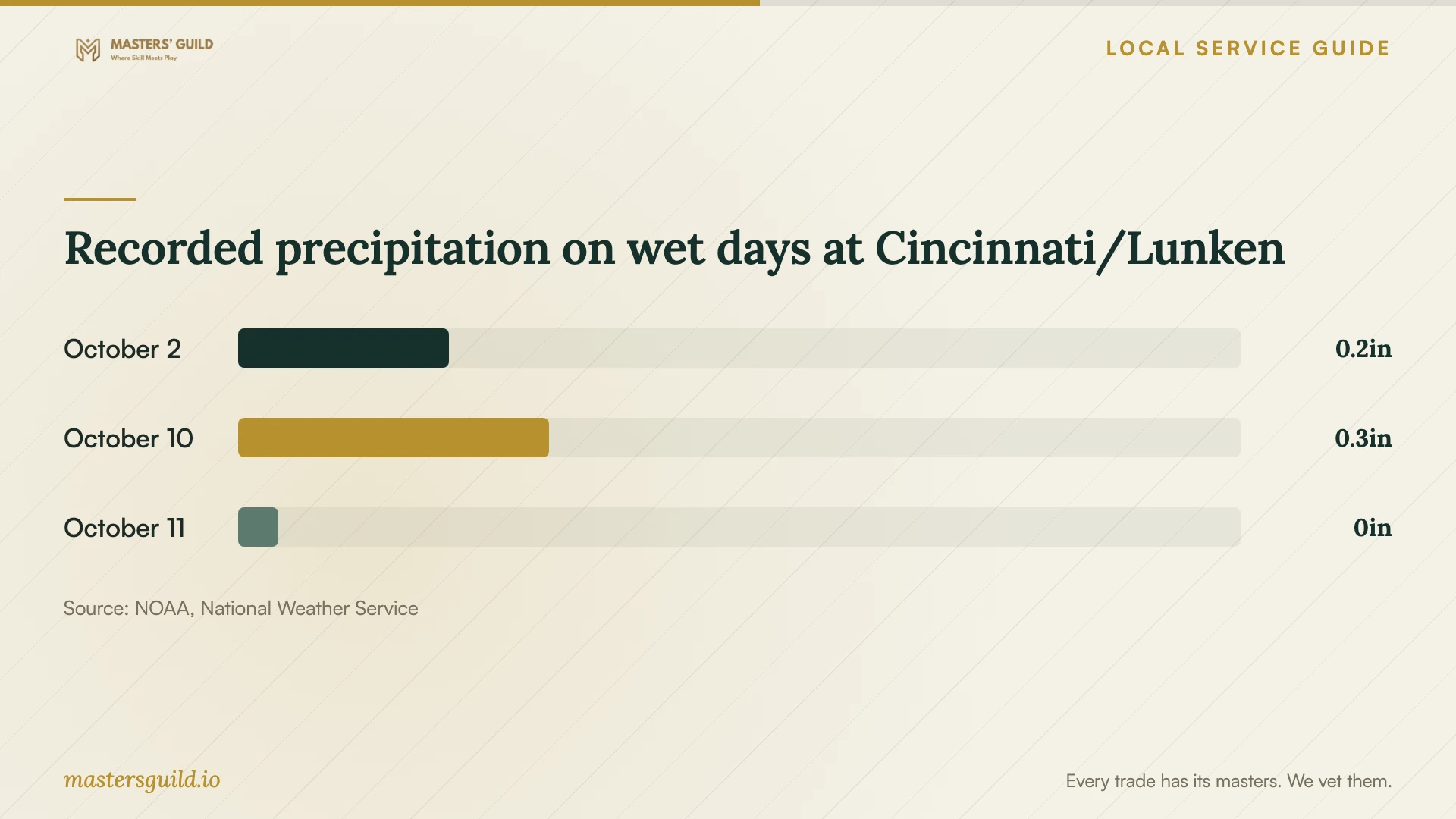
Recorded precipitation on wet days at Cincinnati/Lunken
Local details that affect your job
MSD assistance has a defined scope
MSD's April 2, 2024 announcement lists 24/7 sewer-backup reporting at (513) 352-4900. Report promptly and confirm current assistance while coordinating necessary cleanup. Its procedure excludes dedicated mold remediation and hazardous-waste removal, including asbestos floor tile, paints and solvents. Ask the assessor to identify those exclusions before you authorize removal. [1] [2]
Confirm jurisdiction and construction rules
The city's older residential guide directs owners to verify whether their address lies within Cincinnati before planning permit applications. Use that jurisdiction check when arranging rebuilding or building-system repairs. Ask the responsible building department for current permit and contractor-registration requirements. The older guide does not establish their currency in October 2026. [3]
Choose the next step for your situation
| Situation | Next step | Question to resolve |
|---|---|---|
| Patch smaller than about 10 square feet | Consider homeowner cleanup under EPA guidance and its exceptions. | Does contaminated water or a health concern change the plan? |
| Sewage backup | Report promptly, coordinate MSD assistance and hire a professional experienced in cleaning and repairing contaminated-water-damaged buildings. | Who handles necessary cleanup while eligibility remains unresolved? |
| Mold remains after MSD cleanup | Arrange a mold-remediation assessment; MSD excludes dedicated mold remediation. | Which materials and surfaces still need attention? |
| Suspected HVAC contamination | Do not run the system; seek guidance before further action. | Who will assess the affected system? |
| Rebuilding or building-system repairs | Confirm jurisdiction and current construction rules; the city guide is dated. | Who obtains any required approvals? |
Your hiring checklist
- Record affected rooms, surfaces and known water events.
- Report a sewage backup promptly and coordinate assistance while arranging necessary cleanup.
- Check mold-cleanup references and, for sewage damage, contaminated-water cleanup and repair experience.
- Compare itemized scopes for remediation, water-source repairs and rebuilding.
- Approve disposal decisions and additional demolition in writing.
- Confirm the property's jurisdiction and current construction requirements.
- Arrange access for drying checks and request handover records.
Frequently Asked Questions
Will MSD remove mold after a sewer backup?
MSD's procedure excludes dedicated mold and mildew remediation. Crews may remove some growth while removing damaged materials, but MSD provides no mold-removal or control warranty. Ask your assessor to identify any remaining remediation work. [2]
Can I paint over mold once the leak stops?
EPA advises cleaning the mold and drying the surface before painting or caulking. Include those steps before finish repairs, and ask the contractor how it will confirm that the surface is ready. [4]
Does mold removal require a Cincinnati permit?
The older city guide does not establish a blanket permit requirement for mold cleaning. It describes requirements for major repairs and specified construction changes. Explain your demolition, rebuilding and moisture repairs to the responsible building department and confirm current requirements before authorizing that work. [3]
Sources and scope
This guide combines the sources below with practical planning guidance. Figures apply to the stated geography and period; request a written quote for your property.