
Local service guide
Business Plan Consulting in Cincinnati, OH
Arrange Business Plan Consulting around the decision you need to make: opening a business, seeking financing, or planning expansion. Request a written scope covering research, financial assumptions, editable files, revisions, fees, and your deadline. For a Hamilton County business, explore Alloy’s one-on-one coaching, which includes business-plan development, before deciding which tasks to commission. [1]
Define the decision and the consulting scope
Write a brief naming your business, intended customers, planning purpose, and deadline. For a financing submission, obtain the recipient’s requirements and share them with each consultant. For internal planning, identify the decision you want to test, such as signing a lease, adding an employee, or introducing a service.
Alloy’s Hamilton County assistance includes business-plan development and business analysis. Ask whether its coaching can help you review a concept or existing draft, then use that discussion to identify the work you want a private consultant to complete. Confirm the program’s scope rather than assuming coaching includes a finished document or financial model. [1]
Separate research, analysis, and writing in the proposal. Name who will gather competitor information, supply operating figures, build the spreadsheet, and approve assumptions. Specify the narrative plan and editable financial files you want. Request a redacted sample, then ask the consultant to explain how its author supported the sales forecast and expense estimates.
Explore Hamilton County coaching before buying a full package
Alloy’s Small Business Assistance Program provides one-on-one coaching for Hamilton County businesses. Its listed assistance covers business-plan development, business analysis, training, connections to services, and financial connections. A business outside Hamilton County should confirm whether the program can assist it. [1]
Describe the question you need to resolve when discussing coaching: whether your startup assumptions hold together, which figures you still need, or how to organize an expansion plan. Ask what you will receive, what you must prepare, and when a coach can meet. Give any subsequent consultant your completed work and a list of remaining questions.
Check the premises before approving the opening forecast
For premises inside Cincinnati, check the proposed use against the property’s base zoning district and any overlay districts. The City requires zoning compliance before issuing building permits and applies zoning rules even when no building permit is required. Its zoning verification application lets you request a determination about your proposed use. [3]
Ask the consultant to identify any unconfirmed site assumptions in the plan. Supply lease terms, fit-out quotes, equipment costs, and the opening date you want to test. Request a scenario for a later opening, with your chosen delay and expense assumptions stated. Keep the proposed address provisional until you resolve the relevant approvals.
Build a contracting strategy around actual eligibility
Cincinnati’s Department of Economic Inclusion administers five business certification types with different ownership, location, operating-history, and financial requirements. The City lists procurement benefits and permits ELBE and SLBE firms to participate in designated sheltered markets. Review the relevant program before including those opportunities in your plan. [2]
Ask the consultant to distinguish your eligibility assumptions, application tasks, and prospective sales. Record which requirements you have documented and which need confirmation. For each projected contract, explain your expected bid timing, capacity, and basis for the revenue estimate. Avoid treating certification benefits as committed orders.
Agree on fees and inspect the financial handover
Obtain fees and turnaround times in writing. Request an itemized scope for research, drafting, financial modeling, meetings, and revisions. Agree on payment milestones and how the consultant will charge for changes such as a different location, funding amount, or customer segment. Set review points before the final handover.
Cincinnati requires zoning compliance for premises and sets separate eligibility conditions for its business certifications. In a plan that depends on either, ask the consultant to label the status of each check beside the related opening date or revenue assumption. This keeps a local requirement connected to the financial decision you must approve. [2] [3]
At handover, ask the consultant to walk you through sales volume, pricing, payroll, cash needs, and funding gaps in the editable model. Change one assumption together and inspect the resulting figures. Request source notes for market claims and a list of unresolved questions, with a person responsible for each answer. Keep your approval of assumptions separate from approval of the document’s wording.
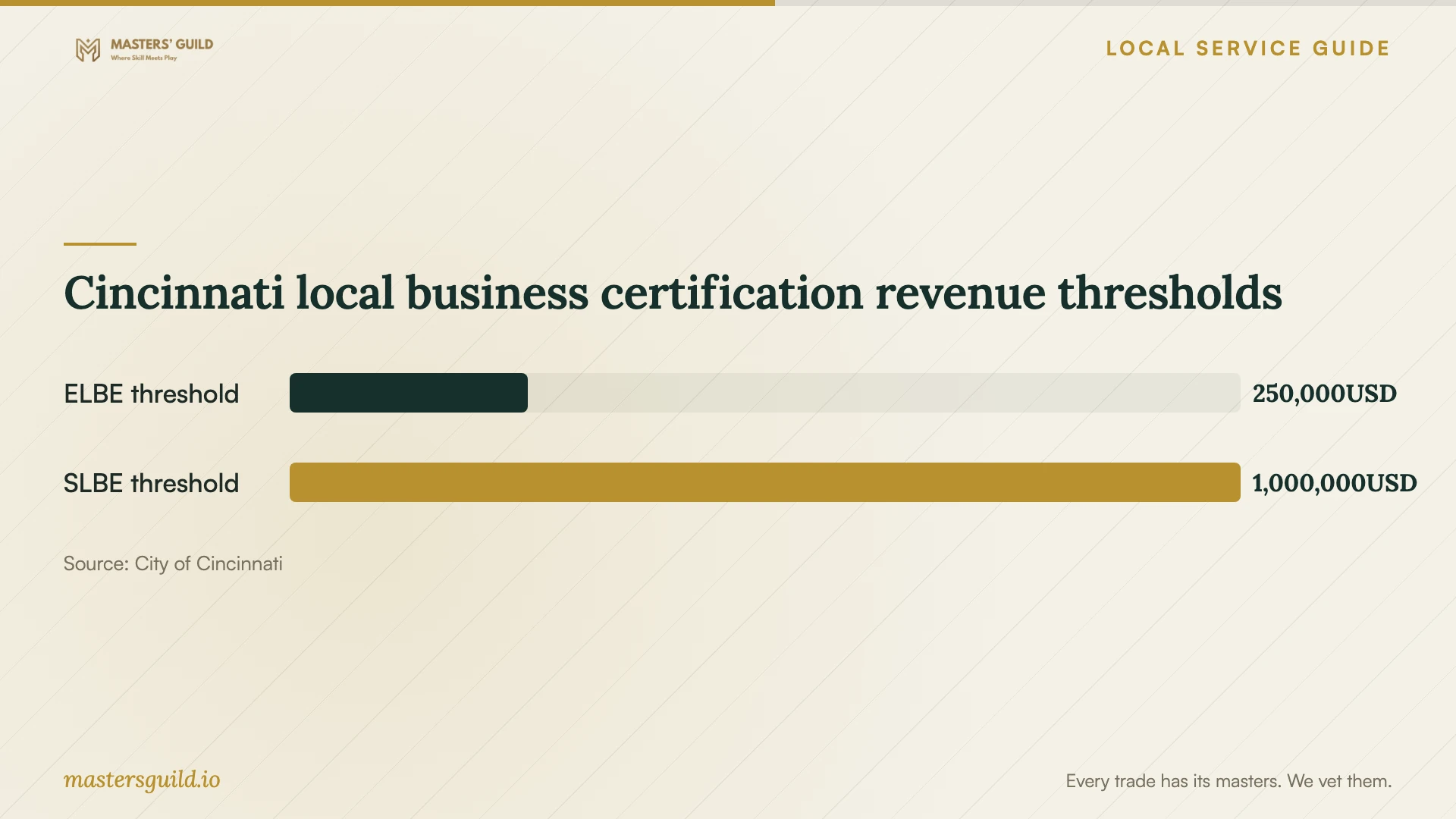
Cincinnati local business certification revenue thresholds
Local details that affect your job
County coaching can help you narrow the paid scope
Alloy lists business-plan development and business analysis within its one-on-one small-business coaching for Hamilton County. Ask which parts of your planning work a coach can address before purchasing a drafting package. Confirm eligibility, availability, charges, and deliverables; the stated service area does not establish eligibility throughout the wider metropolitan area. [1]
Request a zoning determination for your proposed site
Cincinnati directs applicants to submit a zoning verification application to the Permit Center at 805 Central Ave., Suite 500, Cincinnati, Ohio 45202. Zoning staff answer process questions at 513-352-2430. Provide your intended use and address, then ask your consultant to record unresolved site questions before you approve location-dependent spending. [3]
Check certification timing before forecasting opportunities
An SLBE applicant must have its principal place of business within Cincinnati city limits for at least one year before applying. ELBE applicants must have their principal place of business within city limits and have existed for less than five years, alongside other requirements. Ask the consultant to document the appropriate route before building a certification-dependent contracting forecast. [2]
Match the scope to your next decision
| Your situation | Suggested scope | Check before agreeing |
|---|---|---|
| You are testing a concept | Coaching and assumption review | Ask Alloy about its Hamilton County business-plan assistance and expected deliverables. |
| You have a financing submission | Narrative plan and editable financial model | Give the consultant the recipient’s requirements and agree on revisions. |
| You are choosing premises | Site-dependent budget and opening scenarios | Check Cincinnati zoning for the intended use and address. |
| You intend to pursue City contracts | Contracting strategy and eligibility review | Review certification requirements before forecasting related opportunities. |
| You have a draft and documented figures | Targeted review and model checks | Specify the gaps and request a quote for those tasks. |
Your hiring checklist
- Name your intended reader, planning decision, and submission deadline.
- Collect existing accounts, sales records, or documented startup assumptions.
- List the figures you can supply and the research you want the consultant to perform.
- Provide premises quotes and flag unresolved site approvals.
- Request a redacted sample and discuss the reasoning behind its forecasts.
- Agree on fees, editable deliverables, revision limits, and review milestones.
- Document certification eligibility if your forecast depends on City contracting opportunities.
- Inspect the model and assign responsibility for unresolved questions before accepting the plan.
Frequently Asked Questions
Should I commission a complete plan or a review?
List what you can supply and the decisions you still need help making. Request targeted review if you have a draft and documented figures. Specify a broader scope if you want market research, financial modeling, and narrative drafting. Ask who will approve the assumptions and which files you will receive.
Can I explore local assistance before hiring a consultant?
Alloy lists one-on-one coaching for Hamilton County small businesses, including business-plan development and financial connections. Confirm eligibility, availability, charges, and deliverables. Use that information to define any additional work you want to commission. [1]
Do I need to check zoning if I am not doing construction?
Cincinnati says zoning laws apply even when a building permit is not required. For premises within city limits, check your intended use against the property’s base and overlay districts. You can request a determination through the City’s zoning verification application. [3]
Can a new business assume it qualifies for City certification?
Review the specific program. MBE, WBE, SBE, and SLBE require at least one year in operation. ELBE has different criteria, including existence for less than five years. Check the full ownership, location, staffing, and financial requirements before relying on certification-dependent opportunities in your forecast. [2]
Sources and scope
This guide combines the sources below with practical planning guidance. Figures apply to the stated geography and period; request a written quote for your property.