
Local service guide
Senior Care in Chicago, IL: Hiring and Support
To arrange Senior Care in Chicago, write down the help your relative needs, check the agency’s Illinois license category, and request a written care plan and quote. Illinois defines home services as nonmedical assistance with daily activities, housekeeping, laundry and companionship. Before committing to private care, investigate the state Community Care Program and Chicago’s caregiver support and respite services. [1] [2] [3] [4]
Choose care around the tasks your relative needs
Start with a description of an ordinary day. Note help needed with dressing, bathing, meals, laundry, companionship and leaving the home. Record the person’s preferences, including language, routines and who may receive updates. Separate tasks family members will handle from those you want someone else to perform.
IDPH describes home services as nonmedical help intended to support someone living at home. Do not assume a home services license covers a proposed medical task. Ask the agency to identify the license category and staff qualifications for each task that concerns you; Illinois allows agencies to apply for separate home services, home nursing and home health licenses. [1] [2]
For a return home after a hospital stay, share the discharge instructions with the proposed provider and ask it to identify what it can undertake. Have the treating team clarify any instruction you cannot translate into a care task. Agree who will contact that team if the person’s needs change.
Check the agency before agreeing to a start date
Request the agency’s legal name, license number and license category. Use the directory linked from IDPH’s Home Services Agencies page to check the provider, and resolve any difference between the advertised name and licensed entity before signing. That page also links to the health care complaint process. [1]
Ask who employs and supervises the caregiver, how the agency checks staff backgrounds, and who handles a missed visit. Request evidence of insurance and a named contact for concerns. If the agency proposes a substitute, ask how that person will receive the care instructions and enter the home.
Confirm payment arrangements alongside the license check. IDPH lists private payment and private insurance as payer sources under the Home Services License. For Medicaid clients, it directs agencies to the Department on Aging’s Community Care Program or the Department of Human Services Division of Rehabilitation Services for approval. [2]
Compare quotes without assuming a local hourly price
Use a single task list and schedule when requesting quotes. Ask each agency to state the hourly or visit charge, minimum booking, weekend or holiday charges, overnight arrangement, transport expenses and cancellation terms. Request the total for your proposed week and identify which changes would alter it.
For overnight help, describe whether you expect the caregiver to remain awake and which tasks may occur. For transfer assistance, describe the person’s mobility and equipment, then ask the provider how it would staff the work. Have the agency put the agreed responsibilities in writing before the first visit.
Prepare the home and review the first visits
Agree on entry arrangements, emergency contacts and a way to record completed tasks. Explain stairs, building access and any restrictions on keys or visitor entry. Keep personal preferences alongside practical instructions so the caregiver knows how your relative wants help.
Arrange a review after the initial visits. Ask your relative whether the caregiver respects their choices, arrives as agreed and completes the planned work. Discuss missed tasks with the supervisor and record any revised schedule, responsibilities or price.
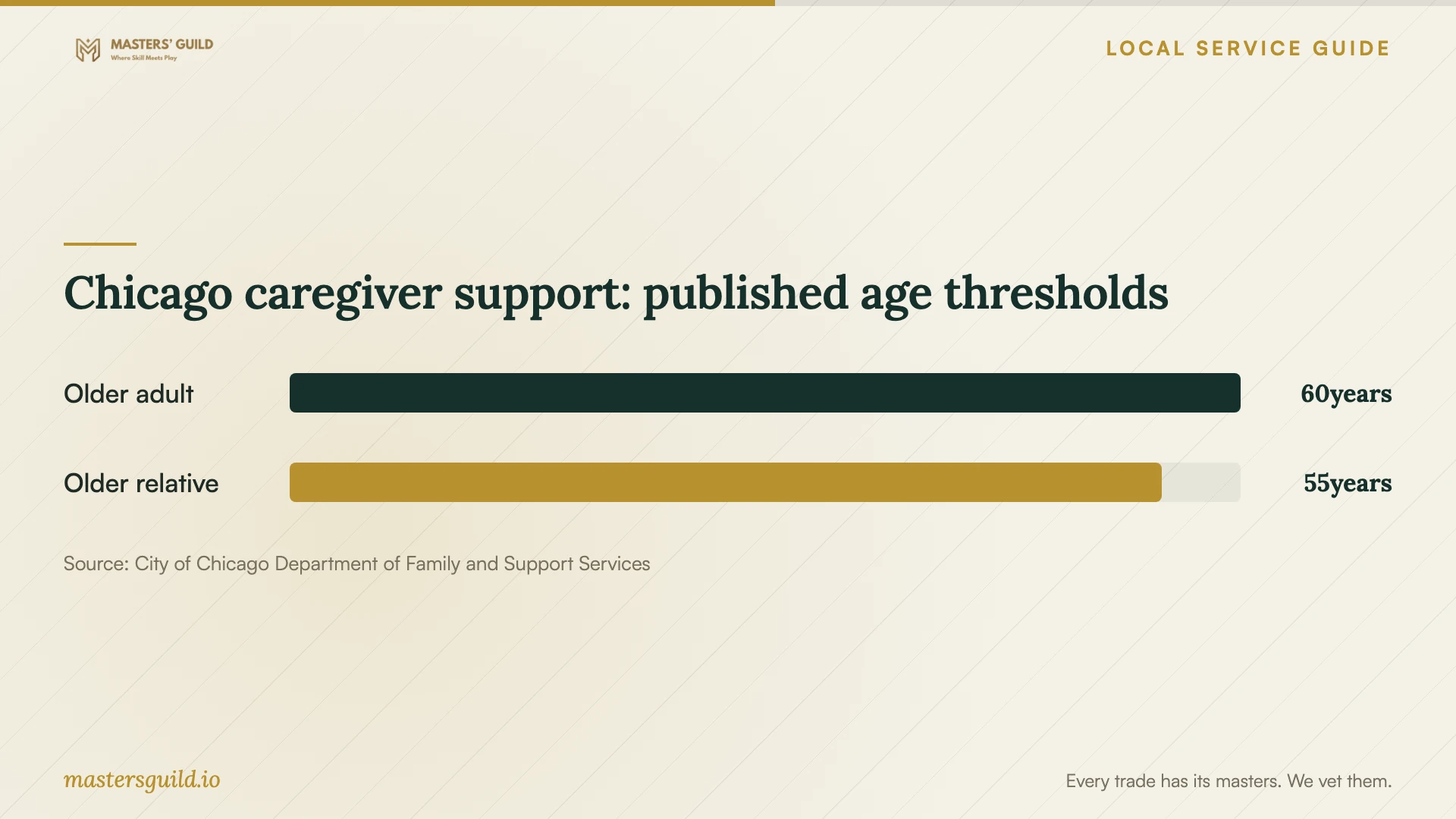
Chicago caregiver support: published age thresholds
Local details that affect your job
Illinois assistance starts with a care assessment
The statewide Community Care Program serves eligible Illinois residents age 60 or older who have an assessed need for long-term care. It lists a non-exempt asset limit of $17,500 and excludes the home, car and personal furnishings from that limit. Applicants must meet citizenship or eligible non-citizen requirements and apply for Medicaid, enrolling if eligible. Local Care Coordination Units coordinate access. For a Chicago household considering ongoing help, investigate an assessment before assuming the family must fund the entire schedule; age or assets alone do not establish eligibility. [3]
Chicago respite can address a temporary coverage gap
Chicago DFSS offers a TCARE caregiver screening and, when appropriate, referral for further assessment and support. Its respite program provides trained staff to care temporarily for a frail older adult during an emergency or planned time away. Care may take place at home or in an approved residential setting. Ask about eligibility, available dates and the proposed setting before relying on respite for a family absence. DFSS lists 312.743.0300 for its main phone and 311 for 24-hour assistance. [4]
Check service territory for an agency outside the city
An agency’s nearby office does not establish its approved service territory. IDPH requires agencies to obtain approval before caring for clients in a new county. When comparing a suburban agency with one based in Chicago, ask each to confirm approved coverage for the care recipient’s address before arranging the first visit. [2]
Match the immediate need to a care route
| Your situation | Route to investigate | Question to resolve |
|---|---|---|
| Help with daily activities and companionship | Illinois home services agency | Does its nonmedical care plan cover the requested tasks? |
| Possible need for nursing or medical tasks | Provider with the relevant separate license category | Which license and staff qualifications cover each task? |
| Ongoing help with possible public support | Illinois Community Care Program assessment | Does the person meet all eligibility and assessed-need requirements? |
| Temporary relief for a family caregiver | Chicago DFSS caregiver respite | Can the program cover the dates and setting you need? |
Your hiring checklist
- Write a task list with the care recipient’s preferences and proposed visit times.
- Request the agency’s legal name, license number and relevant license category.
- Ask the agency to confirm approved coverage for the care address.
- Request a written weekly total and all minimum booking or cancellation terms.
- Agree who supervises care and supplies cover for a missed visit.
- Investigate an assessment or caregiver support before finalizing private care hours.
- Prepare entry instructions, emergency contacts and a visit record.
Frequently Asked Questions
Does a home services agency provide medical care?
Illinois defines home services as nonmedical assistance. IDPH distinguishes home services, home nursing and home health license categories. Ask the provider which category covers the proposed work before agreeing to medical tasks. [1] [2]
Can my relative qualify for the Community Care Program while owning a home?
The program excludes the home, car and personal furnishings from its $17,500 non-exempt asset limit. The applicant must also meet age, residency, assessed-need and other eligibility requirements. Home ownership alone does not settle eligibility. [3]
Does Chicago offer support for dementia caregivers?
DFSS describes specialized dementia caregiver services, training and education. Its caregiver support eligibility includes people assisting someone of any age living with Alzheimer’s disease or a related dementia. The city offers a TCARE screening as a starting point. [4]
What should a written care quote include?
Request the agreed tasks, visit times, charges, minimum booking, cancellation terms and backup arrangements. Ask who can authorize extra hours and how the agency will document a change in care needs.
Sources and scope
This guide combines the sources below with practical planning guidance. Figures apply to the stated geography and period; request a written quote for your property.