
Local service guide
Photography and Videography in Chicago: Hiring Guide
Arrange Photography and Videography in Chicago by defining your business use, reviewing complete examples of comparable work, and getting a written quote that separates production, editing, usage rights and location costs. Confirm permission for your chosen backdrop before paying a deposit: the Chicago Park District requires permits for commercial photography and filming, while CTA directs professional projects through its film coordinator. Assign one person to handle approvals and agree on an alternative location. [1] [2]
Choose a provider around the finished work
Start with what you need to publish: staff portraits, product photographs, premises images, event coverage or an edited business video. Tell candidates where you will use the files, including your website, printed materials and paid advertising. For video, specify intended length, horizontal or vertical framing, captions and whether you need recorded interviews.
Ask to see a complete project with similar subjects and conditions. Review indoor lighting, skin tones, product detail and consistency across the photographs. Watch a finished video with sound on, then without sound to assess captions. For an interview project, ask how the provider will manage microphones, background noise and retakes.
Request a named lead photographer or filmmaker and identify any additional crew. Ask who edits the work and who handles a replacement if the lead cannot attend. Agree on approval stages, the number of revisions and the delivery deadline before you book.
Compare the complete quote
Give each candidate the same brief so you can compare scope. Ask for separate amounts for planning, shooting, editing, retouching, travel, location permissions and optional aerial work. Define whether coverage time includes setup and movement between locations. Request an overtime rate and a written process for approving extra work.
Agree on file quantities, formats, resolution and delivery method. Ask whether the quote includes print-ready images, web copies, captioned video and versions for different screen shapes. Put usage permissions in writing, including paid advertising, duration and whether you may provide files to a designer or agency. Ask about raw files if you need them.
For park-based business photography, the Park District lists a $890 commercial photography permit fee per location, per date, a $520 security deposit and an insurance requirement. Its page conflicts on the application charge: the pricing introduction says $35, while the application instructions say $45. Confirm the charge and deposit terms with the permit office before approving your location budget. [1]
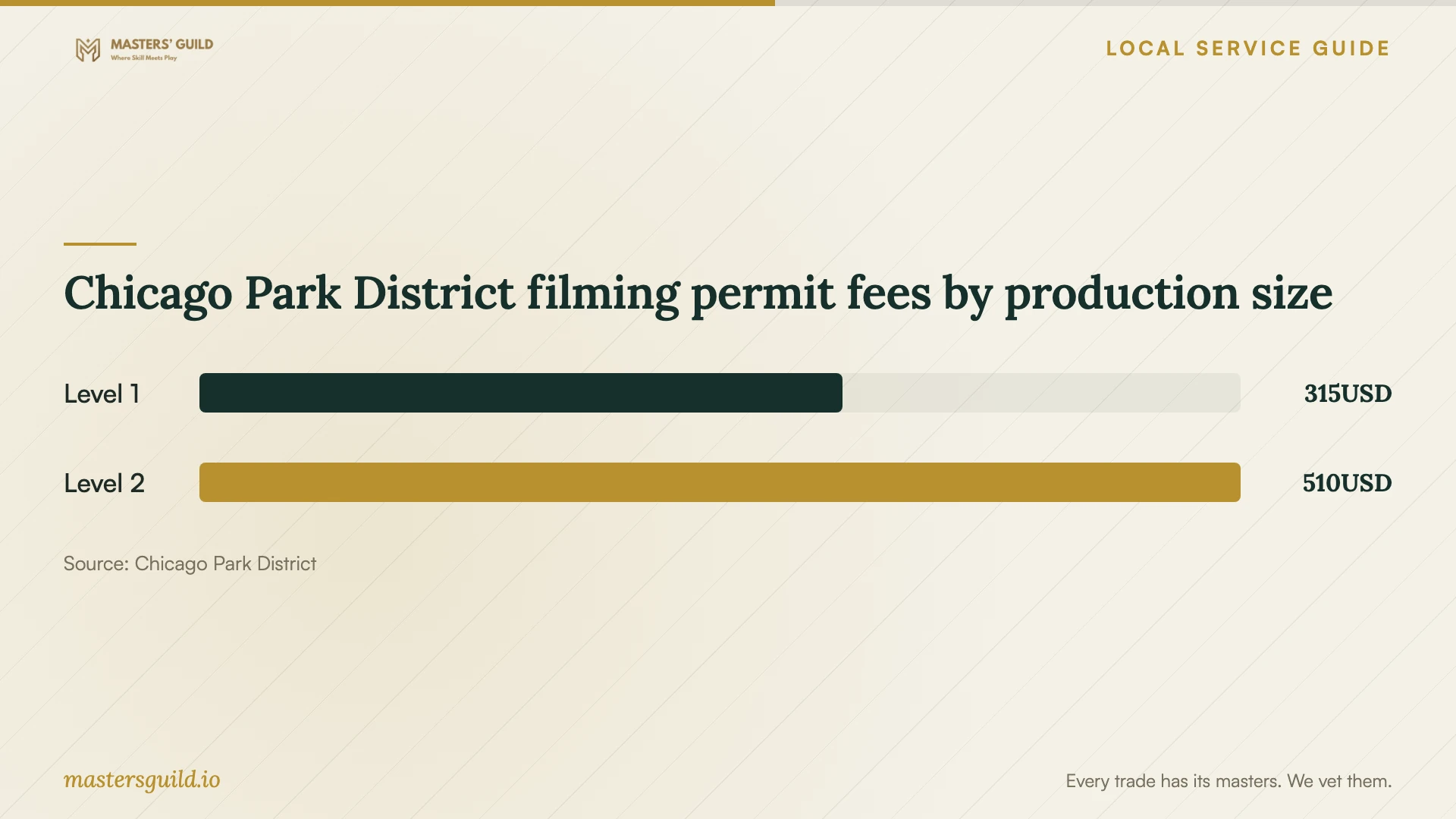
Treat the chart as a location-fee reference for filming. The Park District counts crew, talent, vendors and volunteers when defining filming levels. Ask your producer to confirm the applicable category, insurance and any indoor-location charges. These published fees do not establish what a photographer or filmmaker should charge for their work. [1]
Approve the backdrop before scheduling
For a shoot on park property, ask your provider to identify the permit category and who will submit the application. The Park District instructs applicants outside its listed non-commercial reservation process to pay the application fee, then submit a Media Permit Application using the receipt number. Keep the approved location, date and permitted activity with your production plan. [1]
Check who manages the site. The Park District directs applicants to contact Millennium Park, Maggie Daley Park, Lincoln Park Zoo, Alfred Caldwell Lily Pool and Olive Park through their separate managers. Choose your backup backdrop before booking so you can change plans if the preferred site cannot accommodate the shoot. [1]
For professional work on CTA, contact the film coordinator at least two weeks ahead and submit a letter of intent with a script, storyboard or concept. CTA requires a pre-production meeting and offers a written cost estimate on request. It warns that shorter-notice requests may face postponement. Ask the provider to own this coordination if transit footage forms part of your brief. [2]
Set conditions for aerial work and shoot day
Ask an aerial provider to identify the Part 107 remote pilot and check airspace requirements for the exact address, altitude and date. FAA guidance requires authorization for the controlled-airspace operations it describes. LAANC can provide near-real-time approval at pre-approved altitudes, but further-coordination requests require submission at least 72 hours before the requested start. FAA says FAADroneZone processing has historically taken up to eight weeks. [4]
Put a ground-based alternative in the agreement if aerial shots are optional. Specify how you will handle cancellation, rescheduling or a reduced scope if the operator cannot obtain approval or decides conditions do not support the flight. Avoid making a launch deadline depend on an unconfirmed aerial shot.
Before the crew arrives, prepare products, tidy visible areas and choose an interview space. Share a priority shot list and appoint one business representative to approve setups. Confirm arrival instructions, equipment access and the time staff can spend away from customers. For outdoor work, agree on a weather decision time and who will notify participants.
Chicago Park District filming permit fees by production size
Local details that affect your job
Park application fees need confirmation
The Chicago Park District lists $35 in its pricing introduction but tells applicants to pay a non-refundable $45 application fee in the application steps. Call the permit office at (312) 763-6710 to confirm the amount and category before paying. Ask your provider to separate that charge from the permit fee and security deposit. [1]
A handheld camera does not settle CTA approval
CTA allows the general public to take personal, non-commercial photographs and video with handheld cameras in public areas. It prohibits lighting, tripods, cables and other listed equipment except under professional contractual arrangements. For a business shoot, use CTA's professional process and allow at least two weeks for initial coordination. [2] [3]
Conservatory portraits require a second reservation
If you arrange a non-commercial portrait session at Garfield Park Conservatory or Lincoln Park Conservatory, the Park District requires an entry reservation for every participant in addition to the photography permit. Entry reservations open 30 days ahead, and participants must show both documents on arrival. Business shoots should confirm their commercial category rather than use this non-commercial reservation route. [1]
Choose the location process for your shoot
| Planned shoot | Approval or planning issue | Next step |
|---|---|---|
| Commercial park photography | Park District lists a $890 fee per location, per date, a $520 security deposit and required insurance. | Confirm the application fee and have the provider identify who handles approval. |
| Park filming with 1–5 participants | Filming Level 1 lists $315 per location, per date, plus a $200 security deposit and required insurance. | Count crew, talent, vendors and volunteers before confirming the permit category. |
| Professional CTA shoot | CTA asks for contact at least two weeks ahead, a production concept and a pre-production meeting. | Request a written estimate and agree on an alternative backdrop. |
| Aerial business footage | FAA authorization routes have different processing times; further-coordination LAANC requests need at least 72 hours. | Ask the operator to confirm the route for the exact location before committing to aerial deliverables. |
Your hiring checklist
- Write the intended business uses, shot list, video lengths and delivery deadline.
- Review a complete comparable project and confirm the named lead and backup arrangement.
- Compare quotes using identical coverage hours, file requirements and revision allowances.
- Assign responsibility for location applications, insurance paperwork and approval records.
- Confirm usage permissions, overtime rates, deposit terms and cancellation conditions in writing.
- Ask the aerial operator to confirm feasibility for the exact location and agree on substitute shots.
- Prepare products, staff availability, interview space and equipment access before shoot day.
Frequently Asked Questions
How much should I budget for the photographer or videographer?
Request project-specific quotes using the same scope and deliverables. The official sources here establish location fees and approval processes, not provider market rates. Ask candidates to separate production and editing from permits, deposits, travel and optional work so you can compare the total commitment.
Can we take business portraits on a CTA platform?
Discuss the plan with CTA's film coordinator at least two weeks ahead. CTA's public handheld-camera permission covers personal, non-commercial activity. Its policy directs professional and commercial projects through separate arrangements and restricts equipment such as tripods and lighting without a contractual agreement. [2] [3]
Does a park permit cover Millennium Park?
Contact Millennium Park's manager about your proposed shoot. The Chicago Park District identifies it as an independently managed location and directs applicants to call that location rather than assume its own permit process applies. [1]
Can a drone operator guarantee approval on short notice?
Ask the operator to check the proposed flight before promising footage. FAA describes near-real-time LAANC approval at pre-approved altitudes, but other requests require coordination or manual processing. Further-coordination requests need at least 72 hours, and FAADroneZone processing has historically taken up to eight weeks. [4]
Sources and scope
This guide combines the sources below with practical planning guidance. Figures apply to the stated geography and period; request a written quote for your property.