
Local service guide
Pest Control Services in Chicago: Hiring Guide
To arrange Pest Control Services in Chicago, choose an Illinois-licensed structural pest control business, check its insurance, and request a written plan covering inspection, treatment, preparation, and follow-up. Illinois requires a business to employ at least one certified technician before obtaining its license. For outdoor rat activity, consider city rodent assistance alongside a private inspection of your home. [1] [2]
Check the business and treatment supervisor
Illinois Department of Public Health regulates commercial structural pest control businesses. The department defines structural pests as pests associated with structures, including insects, spiders, rats, and mice. Its definition covers indoor work and some outdoor applications. Before issuing a business license, IDPH requires certified-technician staffing and documentation of the required insurance. [2]
Request the legal business name and license number, then use the state licensing page to reach its public business verification resource. Match the credential to the company on your estimate. Obtain an insurance certificate and identify the certified technician responsible for performing or overseeing your treatment. Confirm the person's role rather than assuming the salesperson will supervise the work. [2] [3]
Discuss whether the proposed work uses general-use or restricted-use pesticides. Illinois requires an individual using restricted-use pesticides to pass the General Standards Examination and the relevant subcategory examinations. A business may operate using only general-use pesticides. Check qualifications against the proposed work rather than requiring restricted-use certification for every job. [2]
Coordinate city rat assistance with work at your home
The 44th Ward's rodent-control guidance describes city investigations of reported rat sightings and alley conditions, replacement of damaged garbage carts, and rodenticide placement in rat burrows. If you live in that ward, report sightings in your alley, yard, or gangway to the ward office. Describe the location and any damaged cart or other condition you want staff to investigate. [1]
For a private estimate, request an inspection of the places where you have seen activity and have the contractor identify possible entry points. Separate trapping or baiting from sealing gaps, door repairs, and cleanup in the estimate. Establish who will complete each task and whether anyone needs permission to access a neighboring or shared area.
Keep your city service request with your private treatment plan. Give the contractor the location of reported outdoor activity and discuss how the proposed work relates to it. Confirm the city's planned scope before assuming that a report includes treatment inside your home or repairs to your building.
Request property-specific written estimates
Send each contractor the same description: what you saw, where you saw it, when you first noticed it, and which rooms or outdoor areas need inspection. Include clear photos if you can take them without disturbing a nest or handling a pest. If you cannot identify the pest, arrange identification before agreeing to treatment.
Have the contractor list inspection and treatment charges, included visits, and separate work. For rodents, discuss checking traps and removing captured animals. For suspected bed bugs, establish which rooms the contractor will inspect, what preparation you must complete, and how the technician will assess the result. For a nest, describe its height and access.
Request a written estimate for your property, with a total for the agreed scope and a clear explanation of possible extra charges. Before accepting an ongoing plan, review the payment schedule, cancellation terms, covered pests, and charges for additional visits. Obtain the conditions of any warranty in writing, including your responsibilities and the process for requesting a return visit.
Prepare the property and agree on follow-up
Get preparation instructions before the appointment. Establish what to move, what to leave in place, and whether people or pets must leave during treatment. Request product names and written return instructions for the proposed method. Tell the contractor about children, pets, aquariums, and access constraints so you can agree on a workable plan.
For a condo or shared building, ask your association or property manager who can authorize access to common areas and approve repairs. Describe activity beyond your unit and discuss whether the inspection should include those spaces. Arrange keys or an access contact before booking work that depends on a locked basement, service room, or shared yard.
Before the technician leaves, confirm the next inspection date, the signs you should record, and when to request a return visit. Keep the service report and note sightings by date and location. Establish which cleaning tasks you may perform after treatment and which areas you should leave undisturbed.
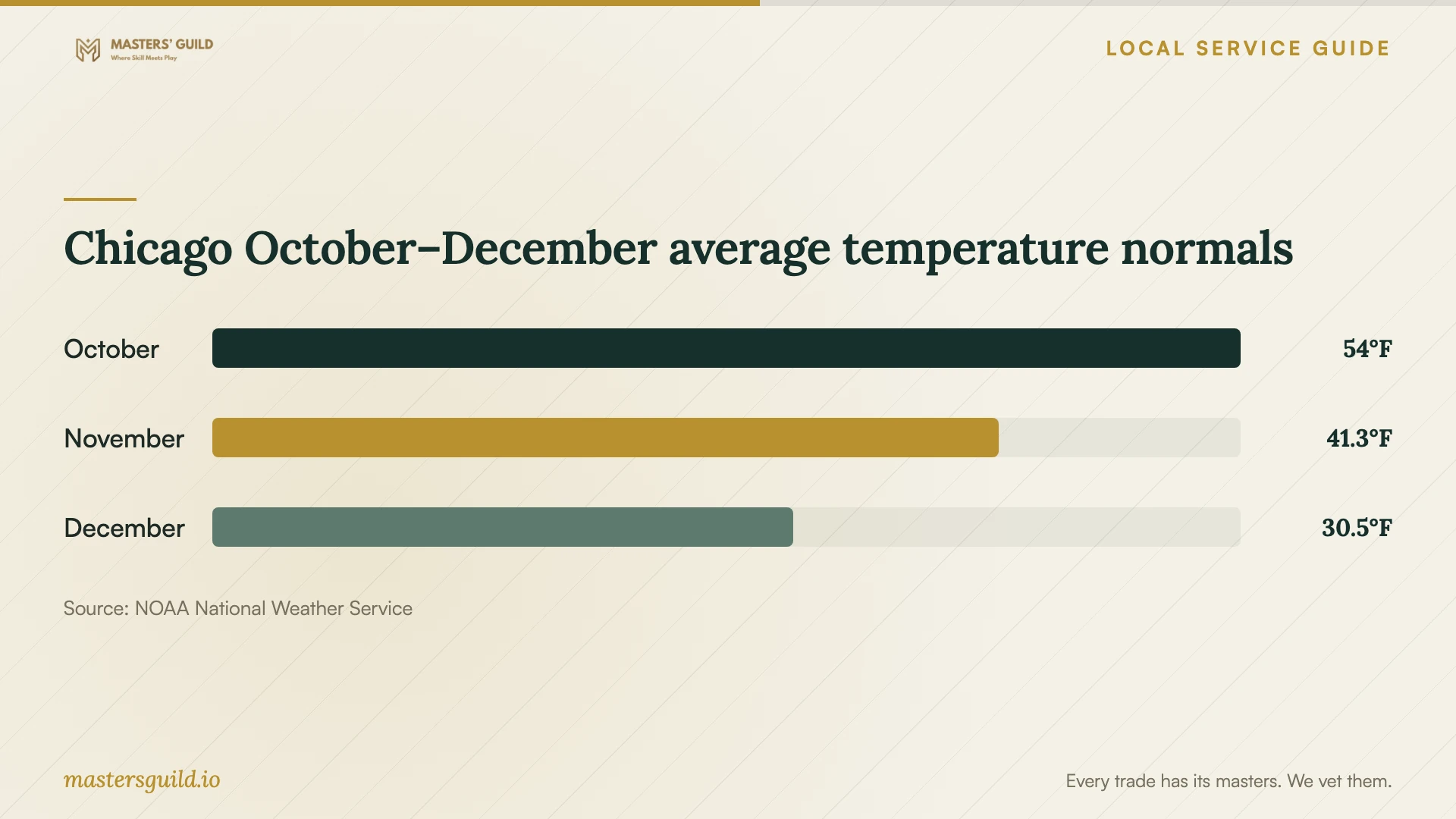
Chicago October–December average temperature normals
Local details that affect your job
Verify Illinois credentials before accepting the estimate
Illinois requires a commercial structural pest control business to employ at least one certified technician before obtaining its license and to document the required insurance. The state licensing catalog links to a public business verification resource. Check the company named on your quote, then identify who will perform or oversee your treatment. Treat business licensing and individual certification as separate checks. [2] [3]
44th Ward residents can report rats beyond the alley
The 44th Ward office invites reports of rodents in alleys, front or back yards, and gangways, as well as conditions that contribute to activity. Residents in that ward can call 773-525-6034. Include the exact location when reporting. If you live elsewhere, use your own ward contact rather than treating this office as a citywide reporting desk. [1]
Check garbage-cart eligibility before buying a replacement
The ward's guidance says the city supplies free garbage carts to single-family residences and apartment buildings with four units or fewer. It lists free replacement of missing or damaged carts through 311 or the ward office. If your property fits that description, request replacement and include the damaged cart in your report of outdoor rat activity. [1]
Choose the next step for your situation
| Situation | Next step | Question to settle |
|---|---|---|
| Rats in a 44th Ward alley, yard, or gangway | Report the location to the ward office; consider a private home inspection. | What city work is planned, and what work do you need at the building? |
| Missing or damaged city garbage cart at an eligible home | Request replacement through 311 or the ward office. | Does the property meet the single-family or four-unit-or-fewer eligibility description? |
| Suspected pest inside your home | Arrange identification and inspection with a licensed structural pest control business. | Which rooms and entry points will the contractor inspect? |
| Activity in shared building areas | Coordinate access and authorization with the property manager or association. | Who can approve treatment and repairs outside your unit? |
| Offer for ongoing service | Review the written scope and contract before choosing it. | Which pests, visits, extra charges, and cancellation terms does it cover? |
Your hiring checklist
- Record sighting dates, locations, and affected rooms; include photos if safe.
- Match the business name on the estimate to its Illinois credential.
- Request an insurance certificate and identify the certified technician responsible for treatment.
- Separate inspection, treatment, sealing, cleanup, and return visits in the estimate.
- Confirm access and repair authorization for shared areas.
- Get written preparation, pet precautions, and return instructions.
- Agree on follow-up dates, extra charges, and warranty conditions before treatment.
Frequently Asked Questions
Does each worker need to be the business's certified technician?
IDPH says a business must employ at least one certified technician to obtain a license. It describes certification as qualifying individuals to use or oversee pesticide application. Ask the business who will perform your work, who will oversee it, and how their qualifications match the proposed treatment. [2]
Can I request city help for rats on my property?
The 44th Ward guidance invites its residents to report rats in yards and gangways as well as alleys. It describes city rat investigations and burrow baiting. Confirm the response planned for your address and arrange any private inspection or building repairs as a separate scope. [1]
How much should I budget for treatment?
Request a property-specific written estimate after describing the pest and affected areas. Ask for the total covering inspection, treatment, included return visits, and any sealing or cleanup. Compare estimates for the same scope, and establish which findings could change the price before approving work.
Should I book exterior work before winter?
Ask the contractor whether the proposed exterior inspection or repairs depend on weather and access. At O'Hare, the 1991–2020 normal monthly average temperature falls from 54.0°F in October to 30.5°F in December. Those historical averages do not predict your appointment's weather or establish a pest-treatment deadline. [4]
Sources and scope
This guide combines the sources below with practical planning guidance. Figures apply to the stated geography and period; request a written quote for your property.