
Local service guide
Moving Services in Chicago: Hiring and Move-Day Planning
Choose Moving Services in Chicago by checking the mover’s Illinois household-goods license for a move within Illinois, comparing written estimates against the same inventory, and arranging loading access before you book. The Illinois Commerce Commission requires household-goods movers under its authority to hold a license and file their services and prices. Ask who will handle parking signs, confirm building access at both addresses, and read the mover’s liability terms before signing. [1]
Check the mover’s authority for your route
Start with the route, not the company’s advertised service area. For a household move that stays within Illinois, check the Illinois Commerce Commission’s household-goods licensing resources. The Commission requires covered movers to maintain valid insurance and tariffs on file, and its household-goods page provides a licensed-mover search. [1]
Ask for the company’s legal name and license number, then compare them with your estimate and moving paperwork. The ICC says intrastate household-goods carriers must display their ILCC number on their trucks even when they also conduct interstate operations. Treat a mismatch as something to resolve before the crew loads your belongings. [2]
If your destination lies outside Illinois, ask the company to explain its authority for that route and identify who will transport the shipment. Keep the booking company’s name, the carrier’s name, and the agreed pickup and delivery terms together in your records.
Compare the complete estimate
Ask each mover to quote the same furniture, boxes, packing work, and access conditions. Include both addresses, stair flights, elevator arrangements, and the proposed truck location. Request a walkthrough or video review if you cannot describe a large item or a tight entrance with confidence.
Illinois movers under ICC authority must file a tariff listing their services and prices. Ask which rates apply to your job and request an explanation of crew size, minimum charges, travel time, materials, and any proposed access charges. You can ask ICC staff to verify rates on file at 217-782-6448. [1] [2]
Do not assume the estimate caps your bill. In its household-goods FAQ, the ICC says final charges depend on actual moving time and that inventory or information changes can affect the estimate. It also says that when final charges exceed the estimate, the customer must pay only 110% of estimated charges at the end of the move and has 30 days to pay the remainder. That payment timing does not erase the balance. [2]
Ask the mover to put cancellation terms, deposit terms, accepted payment methods, and the process for approving extra work in writing. Compare the total scope before choosing a lower headline rate. Keep a copy of the inventory you supplied so you can explain any difference on moving day.
Arrange the loading route before booking
Walk the route from the proposed truck position to your door at both properties. Measure bulky furniture and the narrowest doorway or turn. Ask building management about elevator reservations, loading hours, protective coverings, and any insurance documentation it requests. Give the mover those requirements before agreeing to an arrival window.
Separate your building arrangements from your street arrangements. In the 44th Ward, the ward office provides complimentary, non-enforceable moving signs, while its guidance describes a CDOT option for enforceable signs obtained by eligible moving companies. Ask your mover which arrangement it proposes and confirm the procedure for the ward containing your address. [3]
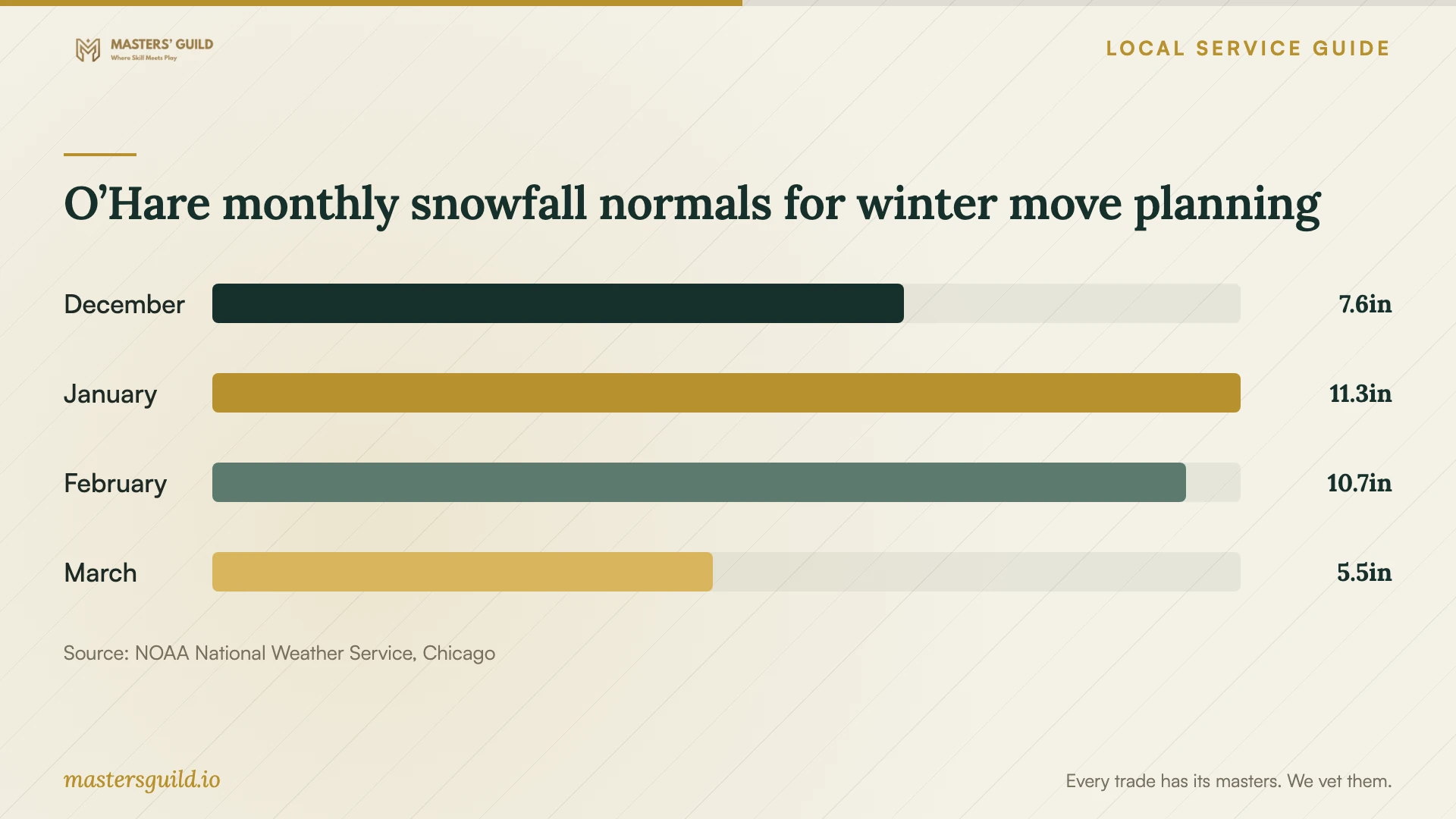
Prepare for weather along the outdoor loading route. At O’Hare, the National Weather Service’s 1991–2020 normals show 11.3 inches of January snowfall and 10.7 inches in February. For a winter move, decide who will clear the path and discuss floor protection and weather delays with the mover. Check the forecast near your moving date rather than treating climate averages as a prediction. [4]
Agree on protection and document the handoff
Ask the mover to explain its liability options in writing, including the amount payable for a damaged item and any charge for a higher declared value. The ICC distinguishes mover valuation from third-party insurance and says declared valuation can involve settlement at depreciated value. Do not assume the mover will pay the replacement price of your belongings. [2]
Identify high-value items before loading and check that the mover records them on the bill of lading. The ICC warns that movers are not liable for high-value items unless the paperwork notes them. Carry your jewelry, money, documents, and medication with you, as the Commission advises. [2]
Photograph furniture and fragile items before the crew starts. Keep your estimate, inventory, liability selection, and receipts together. At delivery, inspect what you can before signing and ask how to record damage or missing items and submit a claim. For complaints involving Illinois household-goods movers, the ICC Police investigates consumer allegations; keep a factual record of dates, charges, and correspondence. [2]
O’Hare monthly snowfall normals for winter move planning
Local details that affect your job
44th Ward signs require advance preparation
Residents of the 44th Ward can collect complimentary residential moving signs from the ward service office with proof of residency and photo ID. The office offers an eight-hour window of either 8:00 AM–4:00 PM or 9:00 AM–5:00 PM and limits reservations to one day at a time. Post the signs at least 48 hours in advance. These signs are non-enforceable, street-cleaning signs take precedence, and residential moving signs are not valid on commercial streets with pay-box parking. Confirm a legal loading plan before choosing the crew’s start time. [3]
Wrigley Field events can block truck access
The 44th Ward office says commercial trucks cannot enter the designated security perimeter bounded by Halsted, Racine, Belmont, and Irving Park beginning 90 minutes before any Wrigley Field event until one hour after it ends. If either address lies within that perimeter, check the event schedule and agree on an arrival window with your mover before booking. [3]
Confirm private space before choosing a container
The 44th Ward office states that moving pods cannot occupy the public way, including streets, sidewalks, curbs, parkways, and alleys. Its guidance permits placement on private property or in a privately owned parking space or driveway. Before choosing a container move, obtain the property owner’s agreement and confirm that your proposed placement follows the applicable requirements. [3]
Match your move to the preparation it needs
| Your situation | Decision before booking | Question for the mover |
|---|---|---|
| Household move within Illinois | Verify ICC household-goods licensing and filed rates. | Which license and tariff apply to this job? |
| 44th Ward curbside loading | Choose between non-enforceable ward signs and the CDOT option described for eligible movers. | Who arranges the signs and the backup loading plan? |
| Address inside the Wrigley event perimeter | Schedule around the published commercial-truck restriction. | Can your arrival window avoid the event restriction? |
| Moving container | Confirm a permitted private placement; the ward office prohibits pods on the public way. | Where will the container sit, and who approves that location? |
| High-value belongings | Review liability terms and record relevant items on the bill of lading. | How would you settle a claim for this item? |
Your hiring checklist
- Write down both addresses, the inventory, and the work you want the mover to perform.
- Match the mover’s legal name and license details with your paperwork.
- Request a written estimate that explains rates, minimums, materials, and extra-work approval.
- Confirm elevator access, loading hours, and building documentation at both properties.
- Assign responsibility for street arrangements and choose a backup loading location.
- Measure bulky items and photograph their condition before loading.
- Review liability terms and carry valuables and essential documents yourself.
- Keep signed paperwork and inspect belongings during the delivery handoff.
Frequently Asked Questions
How can I check an Illinois household mover?
Use the licensed-mover resources on the ICC household-goods page and compare the company’s legal name and license number with your estimate. The ICC requires covered movers to hold a household-goods license and maintain valid insurance and tariffs on file. [1]
Do free ward moving signs guarantee an open space?
The 44th Ward’s complimentary signs are non-enforceable. Its office requires posting at least 48 hours before the move and says street-cleaning signs take precedence. Ask your mover about the CDOT enforceable-sign option and prepare a backup loading plan. [3]
Can the final bill exceed my estimate?
Yes. The ICC’s household-goods FAQ says actual moving time determines final charges and that inventory changes can affect the estimate. It describes payment of 110% of estimated charges at move completion, with 30 days to pay the remainder when the final amount exceeds the estimate. [2]
Does the mover’s liability cover replacement value?
Do not assume replacement-value coverage. The ICC distinguishes valuation from third-party insurance and describes depreciated-value settlement for declared valuation. Ask for the written terms, identify high-value items on the bill of lading, and carry valuables yourself. [2]
Sources and scope
This guide combines the sources below with practical planning guidance. Figures apply to the stated geography and period; request a written quote for your property.