
Local service guide
Heavy Lifting in Chicago: Hiring and Access Planning
Arrange Heavy Lifting in Chicago by giving the crew an item list, photos, dimensions, and the full carrying route before you accept a quote. Confirm who supplies equipment and transportation, then coordinate building access and parking. For paid household-property transportation within Illinois, verify the mover’s ICC Household Goods License. The ICC’s transportation requirement does not establish a licensing requirement for carrying labor alone. [2]
Choose the service around the item and route
Start with the exact task: move a dresser upstairs, carry an appliance into a basement, load a rented truck, or transport furniture to another address. Ask the provider to confirm which tasks its quote covers. Include the starting room and final placement, rather than leaving the destination at the front door.
Send item dimensions and a manufacturer’s weight if you have one. Photograph the narrowest doorway, stair turns, landings, and exterior steps. Measure clear openings with the doors in their intended moving position. Ask the crew to review whether it needs disassembly, additional workers, or equipment before you reserve the time.
For a piano, safe, stone tabletop, or other item requiring special handling, request the provider’s written acceptance of that item and route. Ask how it will protect the item, floors, and railings. If the plan involves removing a railing or lifting through a window, pause the booking until the provider explains the method and you obtain the property owner’s approval.
Separate carrying labor from household transportation
The Illinois Commerce Commission requires businesses and individuals that transport household property for hire to obtain a Household Goods License and publish and file their services and prices in a tariff. For an Illinois household move that includes transportation, use the licensed-mover lookup linked from the ICC’s Household Goods Movers page and match the business name to your quote. [2]
The ICC also requires licensed movers to maintain valid insurance on file. Ask the provider to explain its coverage for your belongings and property, the claim process, and any limits or exclusions. For a carrying-only job, request proof of relevant insurance and written damage terms. The transportation rule does not establish that all lifting labor needs an ICC license. [2]
Assign responsibility for the truck, loading equipment, securing the load, driving, and unloading. If you supply a rental vehicle, ask the crew to confirm whether it accepts that arrangement. Keep appliance disconnection and reconnection as explicit, separate tasks; agree on who will perform them before anyone starts moving the appliance.
Compare quotes using the same scope
Budget from a written quote for your item and carrying route. Request the crew size, included tasks, booked time, and equipment. Ask whether the provider charges a fixed amount or hourly rate, when billed time starts and ends, and how it charges for additional time. Have it list any minimum booking, travel, stairs, parking, or special-item charges that apply.
Give each provider the same photos and access details. Ask how it handles an elevator delay, an unavailable loading space, or an item that cannot fit through the agreed route. Confirm whether the crew needs your approval before adding workers, time, or equipment. Keep its answers with the accepted quote.
Compare the total charges for your stated scope and ask each provider to identify exclusions. Include final placement, any agreed reassembly, and cleanup of protective materials in that scope. Before paying a deposit, review cancellation terms and agree on what happens if you or the crew must change the appointment.
Coordinate building access and the outdoor carry
Before choosing an arrival time, ask your building manager about moving hours, elevator reservations, loading entrances, insurance documents, and floor protection. Confirm elevator dimensions and capacity with management, then share those details with the crew. Arrange access at both addresses if the job includes a second location.
Check curb signs near the loading point before the move. The Fourth Ward Office describes street sweeping from April 1 through mid-November, with temporary parking restrictions posted at least 24 hours before scheduled sweeping. It also warns that emergency repairs can prompt immediate parking restrictions. Recheck the space before the vehicle arrives. [1]
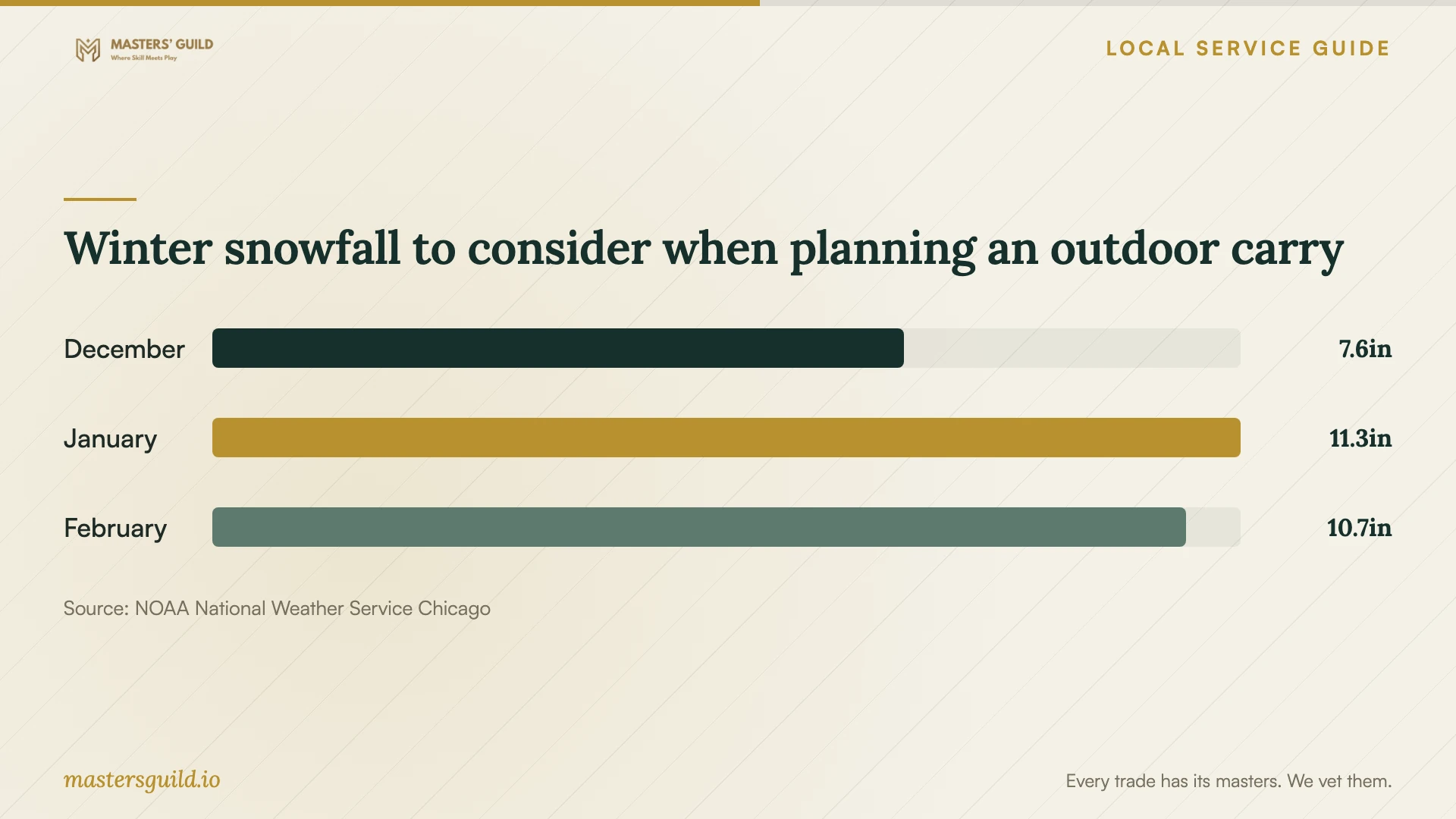
For an outdoor winter carry, inspect the steps, sidewalk, and alley before confirming access. NOAA’s O’Hare normals record January snowfall of 11.3 inches and February snowfall of 10.7 inches for 1991–2020. Check the forecast and conditions at your property, then agree with the crew on route clearance, another loading point, or rescheduling. [3]
Winter snowfall to consider when planning an outdoor carry
Local details that affect your job
Moving signs for a Fourth Ward destination
For a move to a Fourth Ward address, the ward office’s application instructions require your ID, the destination address, your phone number, and a moving window of no more than five hours. The office supplies signs valid for one day and accepts the requested details by email or through an office visit. Align your crew and building reservation with that window. If you are leaving the ward for an address outside it, confirm eligibility with the office before relying on this process. For another ward’s destination, ask that ward office about its arrangements. [1]
Arrange winter alley access before booking
The Fourth Ward Office states that Chicago does not plow public alleys. Before booking a rear-entry appliance or furniture carry after snow, inspect the alley and the path to the door. Agree with the property manager and crew on who will prepare access, or choose another loading point. Check the rear route before telling the crew it can use it. [1]
Match the booking to your job
| Your situation | Booking approach | Confirm before accepting |
|---|---|---|
| Furniture stays within the home | Request carrying labor for the exact route | Item acceptance, protection, equipment, and final placement |
| You supply a rented truck | Request loading or unloading labor | Who secures the load, supplies equipment, and drives |
| Provider transports household goods within Illinois | Verify its ICC Household Goods License | Business-name match, filed tariff, and coverage terms |
| Curbside move to a Fourth Ward address | Coordinate the ward’s moving signs with crew arrival | Destination-address application, one-day validity, maximum five-hour window, and building access |
| Winter move through a public alley | Inspect and arrange the loading route | Snow clearance or another loading point; Chicago does not plow public alleys |
Your hiring checklist
- List each item, its dimensions, known weight, starting location, and final placement.
- Send photos of doors, stair turns, landings, exterior steps, and the loading point.
- Ask the crew to confirm staffing, equipment, disassembly, and protection in writing.
- Assign the truck, driving, load securing, and appliance connection tasks.
- Confirm building permissions, elevator access, and the arrival window.
- Request all applicable charges and the process for approving extra work.
- Check parking signs and inspect the outdoor route before arrival.
- Photograph item and property condition before work, then inspect final placement with the crew.
Frequently Asked Questions
How many workers should I book?
Ask the provider to select staffing after reviewing the item and route. Send dimensions, known weight, stair photos, and carry distance. Have it confirm the crew size in writing, including how it will handle a route or item that differs from your description.
Does carrying-only help need the same license as a mover?
The ICC requirement covers transporting household property for hire. It does not establish the requirement for carrying labor alone. Describe whether the provider will transport your belongings; for household transportation within Illinois, verify its ICC Household Goods License. [2]
Can I get parking signs for a move to a Fourth Ward address?
The ward office’s instructions require ID, the Fourth Ward destination address, your phone number, and a moving window of no more than five hours. The signs are valid for one day. Confirm arrangements before coordinating crew arrival. If you are departing for an address outside the ward, ask the office whether you qualify. [1]
What should I do if the item will not fit?
Stop and ask the crew to explain the options before authorizing extra work. Discuss disassembly, a different entrance, or specialist handling. Confirm any added charge and obtain property approval before the crew removes building fixtures or changes the agreed route.
Sources and scope
This guide combines the sources below with practical planning guidance. Figures apply to the stated geography and period; request a written quote for your property.