
Local service guide
Chicago gardening: Hiring and Planning Guide
For gardening in Chicago, ask for a written scope that separates cleanup, planting, ongoing care, materials, and debris removal. Identify whether the work involves a private bed or a parkway before approving a planting plan. For a parkway pollinator garden, discuss the city registry paperwork; for pesticide treatments, check Illinois applicator and operator credentials before hiring. [1] [2]
Choose the work before comparing gardeners
Start with the result you want: reclaim an overgrown bed, maintain existing planting, or install a new garden. Photograph each area and mark plants you want to keep. Ask the gardener to identify uncertain plants with you before removing them. For a cleanup, agree on what the crew should remove, retain, prune, and leave for a later visit.
For planting work, request a plant list with quantities and sizes, a layout, and an explanation of how the gardener selected plants for your sun exposure and available space. Agree on substitutions before purchasing. Ask who will water after installation, how you should report problems, and whether the quote includes a follow-up visit.
For recurring care, describe tasks rather than asking for general garden maintenance. Specify hand weeding, edging, pruning, watering, litter pickup, and seasonal work as needed. Decide whether the gardener needs approval before removing a plant or adding a treatment. Confirm access through gates, use of your water supply, and where the crew can stage materials.
Compare the full quote
Ask for separate amounts for labor, plants, mulch or soil, delivery, and debris removal. For hourly work, clarify whether the rate covers one person or the crew, the minimum charge, and the spending limit that requires your approval. For a fixed price, attach the agreed task list and identify exclusions.
Give each bidder the same photos, approximate bed dimensions, access information, and disposal instructions. Ask whether the first cleanup has a separate price from later maintenance. Request proof of liability insurance and examples of comparable planting or maintenance work. For native beds, ask how the gardener distinguishes intended plants from weeds before agreeing to removal.
Prepare a parkway pollinator garden application
Chicago offers free registration for native and pollinator gardens in the parkway, the space between the sidewalk and street, or in a managed community garden. The city describes registration as a way to help prevent citations when someone mistakes native plants for weeds. Confirm that your proposed garden fits that scope before paying a gardener to prepare registry documents. [1]
The application requests current photos and a proposed site and planting plan with accurate dimensions. It asks applicants to show property boundaries, buildings, sidewalk width, hydrants, planting-area dimensions, and utility access. It also requests a plant list and a three-year maintenance plan. Ask your gardener to include these deliverables in the quote and name the person responsible for submitting them. [1]
Plan ongoing care with the installer. The registry asks applicants to acknowledge litter and debris removal, clear sidewalks, curbs and streets, and weed removal. Translate those duties into an agreed maintenance schedule, including which tasks you will handle between paid visits. [1]
Set treatment and weather expectations
Illinois requires a license for pesticide application during employment, including general-use products. The Department of Agriculture licenses outdoor pesticide work. A commercial applicator may apply pesticides or supervise licensed operators, and the applicator’s categories determine the company’s permitted treatment areas. Ornamental and turf pest control are separate categories, so ask for credentials that match your garden’s proposed treatment. [2]
Ask the gardener to identify the proposed product, target problem, application area, and label directions you must follow afterward. State your preference for hand weeding or other treatment approaches in the scope. Require approval before the crew adds an unquoted pesticide application.
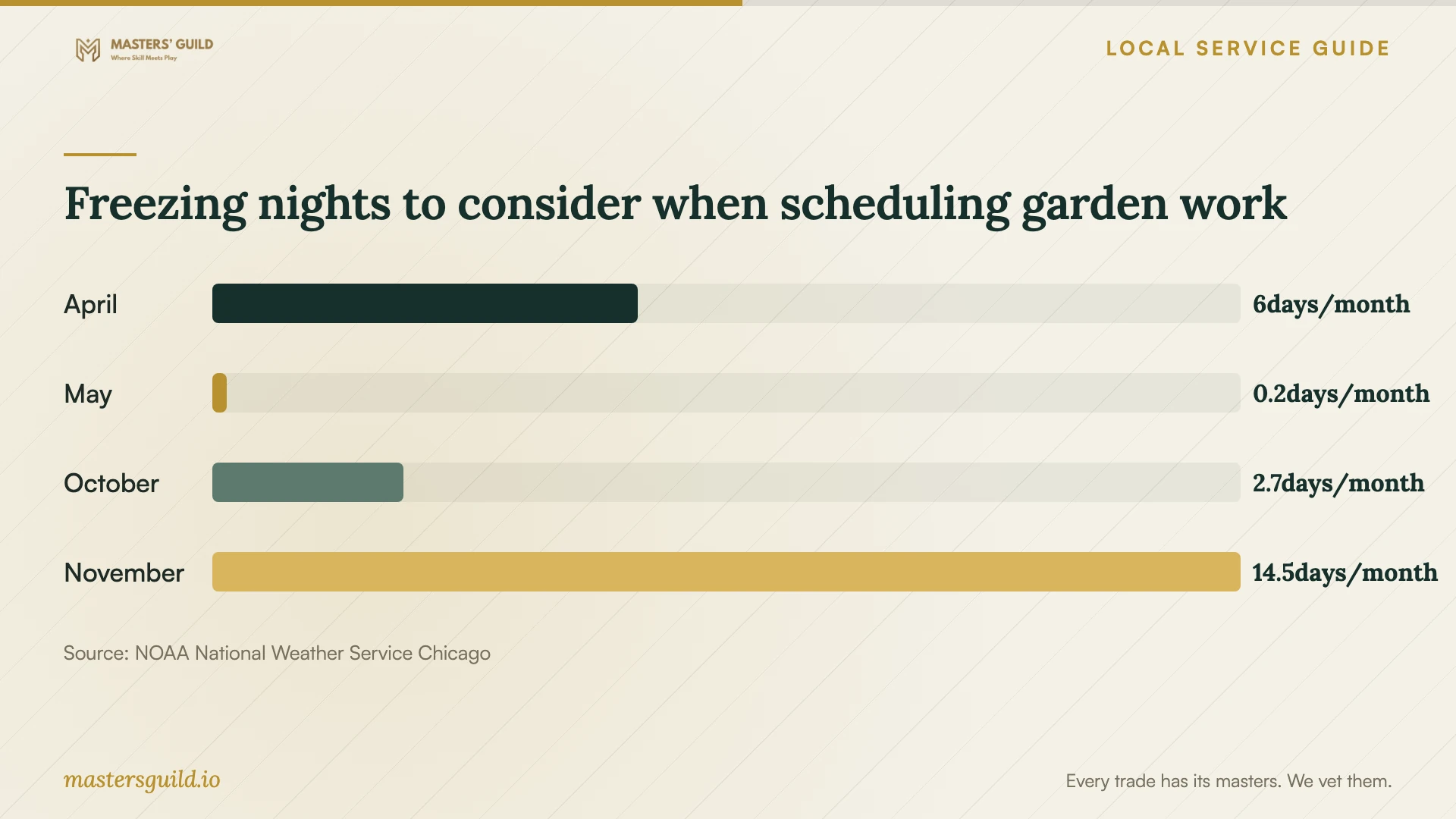
At O’Hare, the 1991–2020 normals show an average of 6.0 April days and 2.7 October days with lows at or below 32°F. Ask the gardener to explain how the selected plants and current forecast affect the work date. Agree on a weather rescheduling policy and who will protect or care for plants awaiting installation. [3]
Freezing nights to consider when scheduling garden work
Local details that affect your job
Include registry preparation in the installation scope
For an eligible parkway or managed community garden, ask who will prepare the dimensioned plan, photos, plant list, and three-year maintenance plan required by Chicago’s registry application. The form also requests a property-owner acknowledgement. Resolve owner participation before commissioning the application package. [1]
Check the border height before buying edging
Chicago’s registry form asks whether a garden fence or border will exceed 10 inches. For a yes answer, it requests a Public Way Use Permit upload and directs applicants to their alderperson or Business Affairs for applications. Discuss the proposed border height before approving materials. [1]
Check Illinois credentials for outdoor treatments
For paid herbicide or other pesticide application, request the responsible applicator’s license details and the credentials of the person doing the work. Illinois requires commercial applicator or operator licensing for general-use and restricted-use pesticides applied for hire. Ask the Department of Agriculture about any uncertainty over the applicable category. [2]
Match the gardener’s scope to your project
| Your project | Request in the quote | Resolve before work |
|---|---|---|
| Overgrown private bed | Defined removal tasks, retained plants, and debris handling | Identify uncertain plants and approve removals |
| Recurring garden care | Task list, visit schedule, and extra-work approval | Assign watering between visits |
| Parkway pollinator garden registration | Photos, dimensioned planting plan, plant list, and three-year care plan | Confirm eligibility and owner acknowledgement |
| Registry application with a border over 10 inches | Border dimensions and responsibility for permit paperwork | The registry form requests a Public Way Use Permit upload |
| Pesticide treatment | Treatment area, proposed product, and applicator details | Verify Illinois licensing and the applicable treatment category |
Your hiring checklist
- Send photos and approximate dimensions of each work area.
- Mark plants to retain and agree on how to handle unidentified plants.
- Request separate labor, material, delivery, and disposal amounts.
- Confirm gate access, water access, staging space, and cleanup.
- Assign watering and follow-up responsibilities after planting.
- Include application preparation in the scope when seeking parkway registration.
- Approve treatment methods and check credentials before pesticide work.
- Agree on weather delays and a spending limit for extra work.
Frequently Asked Questions
How should I compare gardening prices?
Ask bidders to price the same task list and work areas. Clarify crew size, hourly minimums or fixed-price inclusions, material quantities, delivery, and disposal. Set an approval limit for extra work so you can compare the expected total.
Can I register a private backyard pollinator garden through this city registry?
Chicago’s registry application limits this registry to parkway gardens and managed community gardens. It does not describe private backyard gardens as eligible. [1]
Does a gardener need a license to spray store-bought weed killer?
Illinois requires licensing for general-use as well as restricted-use pesticides applied for hire. The exemption for a person applying a general-use pesticide on their own property does not cover a hired gardener’s application. [2]
Does April weather guarantee safe planting?
No. O’Hare’s 1991–2020 normals include an average of 6.0 April days with lows at or below 32°F. Ask about the specific plants and check the forecast before confirming installation. [3]
Sources and scope
This guide combines the sources below with practical planning guidance. Figures apply to the stated geography and period; request a written quote for your property.