
Local service guide
Furniture delivery in Chicago: Plan Pickup and Access
Arrange furniture delivery in Chicago by agreeing on the pickup, final placement and access route before you book. Send item dimensions and photos, disclose stairs, and confirm your building’s delivery arrangements. For a hired household-goods mover operating within Illinois, check ICC licensing and request its filed service-and-price tariff. Assign curb-access responsibility before delivery day. [1]
Choose the delivery scope before comparing quotes
Tell each provider where you want the furniture left: outside the entrance, inside the doorway or in a particular room. Ask what the provider means by threshold, room-of-choice or white-glove service. Have the provider write down the tasks you expect rather than relying on the service label.
For a sofa or dining table, specify whether the crew should remove legs, reattach them, assemble components and take away packaging. Ask about old-furniture removal as a separate task. If you want placement upstairs, include the floor, stair flights and any narrow landing in your request.
Check the carrier and the price basis
For an Illinois household-goods move, start with the regulator’s requirements. The ICC says businesses or individuals transporting household property for hire must hold a Household Goods License, publish and file a tariff, and maintain valid insurance on file. Its household-goods page provides access to licensed-mover information and the Motor Carrier Information System entity search. [1]
Ask for the business’s legal name and license information, then use the ICC’s search access to check its status. Request the tariff provisions relevant to your job and a written quote that identifies the agreed work. For a retailer’s new-furniture delivery, ask who will transport the order and which delivery and damage terms apply; do not assume its service follows the same arrangements as a household move. [1]
These sources do not establish a typical furniture-delivery price for the city. Compare quotes using the same item list, addresses and access details. Ask each provider to identify charges for waiting, stairs, extra carrying distance, assembly, a failed fit and a return trip. Record the cancellation terms and payment schedule before booking.
Confirm the route from truck to room
Measure the item in its transport configuration and ask whether the seller’s measurements include packaging. Measure doorway clearance with the door open, hallway turns, stair landings and elevator openings. Send photographs of tight points to the provider and ask it to confirm the proposed handling method.
Ask your building manager about delivery hours, elevator reservations, loading entrances, protective padding and insurance-document requirements. Reserve access before accepting the carrier’s arrival window. Give the crew the correct entrance and a contact who can unlock it. Ask how the provider handles a late arrival that misses your reserved slot.
Treat curb space as a separate planning task. Ask the provider where its vehicle can stop, whether it needs reserved space and who will arrange any required permission. For a brief retail delivery, confirm the applicable curb arrangements rather than assuming that residential moving-sign procedures cover the stop.
Coordinate pickup and inspect the handover
For a secondhand purchase, agree with the seller on the pickup window, item condition and disassembly. Send the carrier the seller’s contact details with permission. Confirm who will release the furniture and whether anyone at pickup needs to help. Photograph existing scratches, seams and loose parts before loading.
Before paying, ask the provider about damage responsibility, coverage limits, exclusions and its claim process. Ask whom you should contact if the seller releases the wrong item or the crew discovers damage at pickup. Keep the item description, photographs and written scope together.
At delivery, inspect the furniture and carrying route with the crew before signing an acceptance statement. Check corners, upholstery, glass and assembled joints. Record any problem on the delivery paperwork, take photographs and retain a copy. Follow the provider’s stated reporting procedure and deadline.
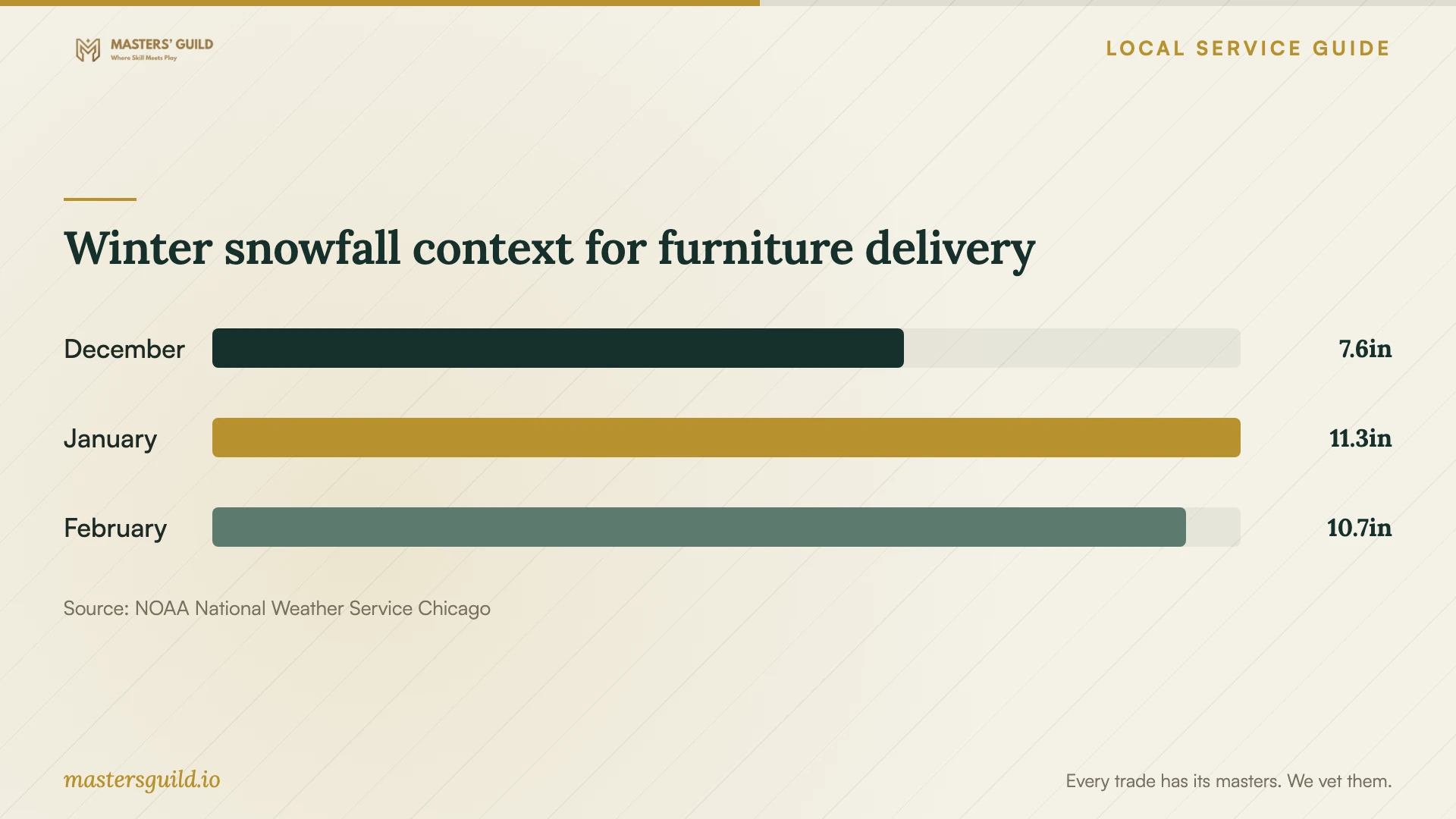
Winter snowfall context for furniture delivery
Local details that affect your job
Illinois licensing applies to hired household-goods transport
For an existing-furniture move within Illinois, use the ICC household-goods page to reach its licensed-mover resources and entity search. The regulator requires a Household Goods License and a filed tariff for for-hire household-property transport. Ask the provider to identify its authority and the tariff terms it will use for your pickup before you agree to the job. [1]
49th Ward moving signs require a choice before booking
The 49th Ward office offers complimentary signs for residents moving themselves, but those signs do not support ticketing or towing. The office asks self-movers to post them 48 hours ahead. For a contracted residential move, its guidance directs the moving company to obtain enforceable signs and lists a $25 permit fee charged to the resident. Agree with the mover on who will arrange signs. Confirm procedures with your own ward or CDOT for an address outside the 49th Ward. [2]
Prepare winter access before the truck arrives
O’Hare’s 1991–2020 normals report 7.6 inches of December snowfall, 11.3 in January and 10.7 in February. Use this seasonal context to plan a cleared unloading path and covered furniture handling, then check the forecast for your delivery date. The 49th Ward guidance also states that property owners and occupants must keep sidewalks clear of snow and ice. [2] [3]
Match the booking to the work you need
| Your situation | Request | Resolve before booking |
|---|---|---|
| You can carry the item from the entrance | A quote with an exact entrance drop-off point | Who unloads and who carries it inside |
| You need placement upstairs | A quote that includes the final room and stair route | Crew handling plan and any stair charges |
| You need setup as well as transport | An itemized assembly and packaging-removal scope | Which components the crew will assemble |
| You are hiring an Illinois household-goods mover | ICC license information and relevant filed tariff | License status and the service-and-price terms |
| Your residential move needs curb space in the 49th Ward | A moving-sign plan agreed with the hired mover | Enforceable signs and responsibility for the published $25 permit fee |
Your hiring checklist
- Send the item list, dimensions, photographs and both addresses.
- Specify the final room and any assembly or packaging removal.
- Measure doorways, turns, stair landings and elevator openings.
- Confirm building access, delivery hours and any elevator reservation.
- Assign responsibility for legal curb access and any moving signs.
- Get the price basis, extra-charge conditions and failed-delivery terms in writing.
- Confirm damage coverage and reporting instructions; photograph condition at pickup and arrival.
Frequently Asked Questions
Does a single furniture pickup need a licensed mover?
The ICC describes its requirement in terms of transporting household property for hire, rather than a minimum number of items. For an existing-furniture pickup within Illinois, ask the provider for its Household Goods License information and verify its status. Ask the ICC about applicability if the provider describes a different type of service. [1]
Can I reserve curb space with free moving signs?
In the 49th Ward, the office’s complimentary signs serve residents moving themselves and do not support ticketing or towing. Its residential-move guidance directs hired moving companies to obtain enforceable signs. Confirm the process for your address and type of delivery before relying on signs. [2]
What should I ask if the furniture may not fit?
Send measurements and route photographs before booking. Ask the provider to assess the route and explain permitted disassembly. Agree on what happens if the crew cannot complete delivery, including return transport, storage and charges. Avoid authorizing a handling method you have not reviewed.
How do I compare quotes without a reliable local price range?
Give each provider the same scope and access information. Compare the full charge, included tasks, waiting terms and return-trip conditions. For an Illinois household-goods mover, request the relevant filed tariff as well as the quote. Ask about any difference before paying a deposit. [1]
Sources and scope
This guide combines the sources below with practical planning guidance. Figures apply to the stated geography and period; request a written quote for your property.