
Local service guide
Concrete work in Chicago: Hiring and Permit Planning
Arrange Concrete work in Chicago by asking for a site visit, a written scope, and a clear assignment of permit responsibilities before signing. Separate your private patio, steps, or driveway slab from work involving the curb cut, apron, or public sidewalk. Consult CDOT’s residential driveway application instructions for driveway work, and check the City’s general contractor directory for the proposed business’s license and insurance expiration information. [1] [3]
Define the work before requesting bids
Give each contractor photographs, approximate dimensions, and a description of the problem. Identify uneven panels, crumbling edges, damaged steps, or water collecting near the building. Describe how you use the area and whether you want to preserve its current layout. Ask the contractor to explain the proposed remedy after inspecting the site.
For repair or leveling proposals, ask which defect the work addresses and which defects will remain. For replacement, request the removal boundaries and proposed finished elevations. If steps connect to a porch or building, ask who will assess that connection and any related structural concerns before agreeing to a cosmetic repair.
Mark the private slab, public sidewalk, curb, and apron on a sketch. CDOT’s residential driveway instructions call for photographs showing the curb cut, apron, and sidewalk area. Use those same views when discussing scope so you and the contractor agree on the project boundaries. [1]
Assign driveway application responsibilities
Use CDOT’s residential driveway application instructions to prepare questions about your project. The City lists five copies of a plat of survey for proposed driveways, or two copies of a survey or drawing for existing driveways, showing the exact location. It also requests a photograph for proposed and existing driveways. [1]
CDOT specifies homeowner liability insurance of $250,000 and requires the City of Chicago, its officers, employees, or agents as an additional insured. Ask your insurer about the required certificate before accepting a start date. Keep this homeowner application requirement separate from your request for the contractor’s own insurance documentation. [1]
The instructions require five elevation copies for new construction applications when a driveway enters or exits a building, and a surveyor’s engineers report for driveways with a slope. They also list Zoning Department sign-off for proposed driveways and a $10 application fee. Ask CDOT to confirm the requirements and submission method for your specific scope before demolition; the page states that it does not accept applications by mail. [1]
Check the business and compare the full scope
The City’s general contractor directory covers active and inactive contractors and includes fields for license number, license expiration, insurance expiration, and inactive status. Ask for the contracting business’s exact name and license number, then compare them with the directory. Use it to check the business rather than to infer workmanship quality. [3]
Request an itemized proposal covering area, slab thickness, excavation, base preparation, reinforcement if proposed, joints, finish, demolition, and debris removal. Ask the contractor to describe the intended drainage direction and transitions at doors, garages, and neighboring surfaces. Have each bidder identify exclusions and the process for pricing unexpected conditions.
Discuss equipment access during the site visit. Show the contractor gates, alley access, parking constraints, and anything you want protected. Ask whether the quote includes pumping or other placement equipment, landscape restoration, and cleanup. Compare the total scope before deciding that a lower price offers better value.
Agree on payment milestones, written approval for changes, and the warranty’s coverage and exclusions. Request separate dates for demolition, placement, cleanup, and return to use. Ask for written instructions for walking, parking, maintenance, and reporting a problem after completion.
Plan around weather and loss of access
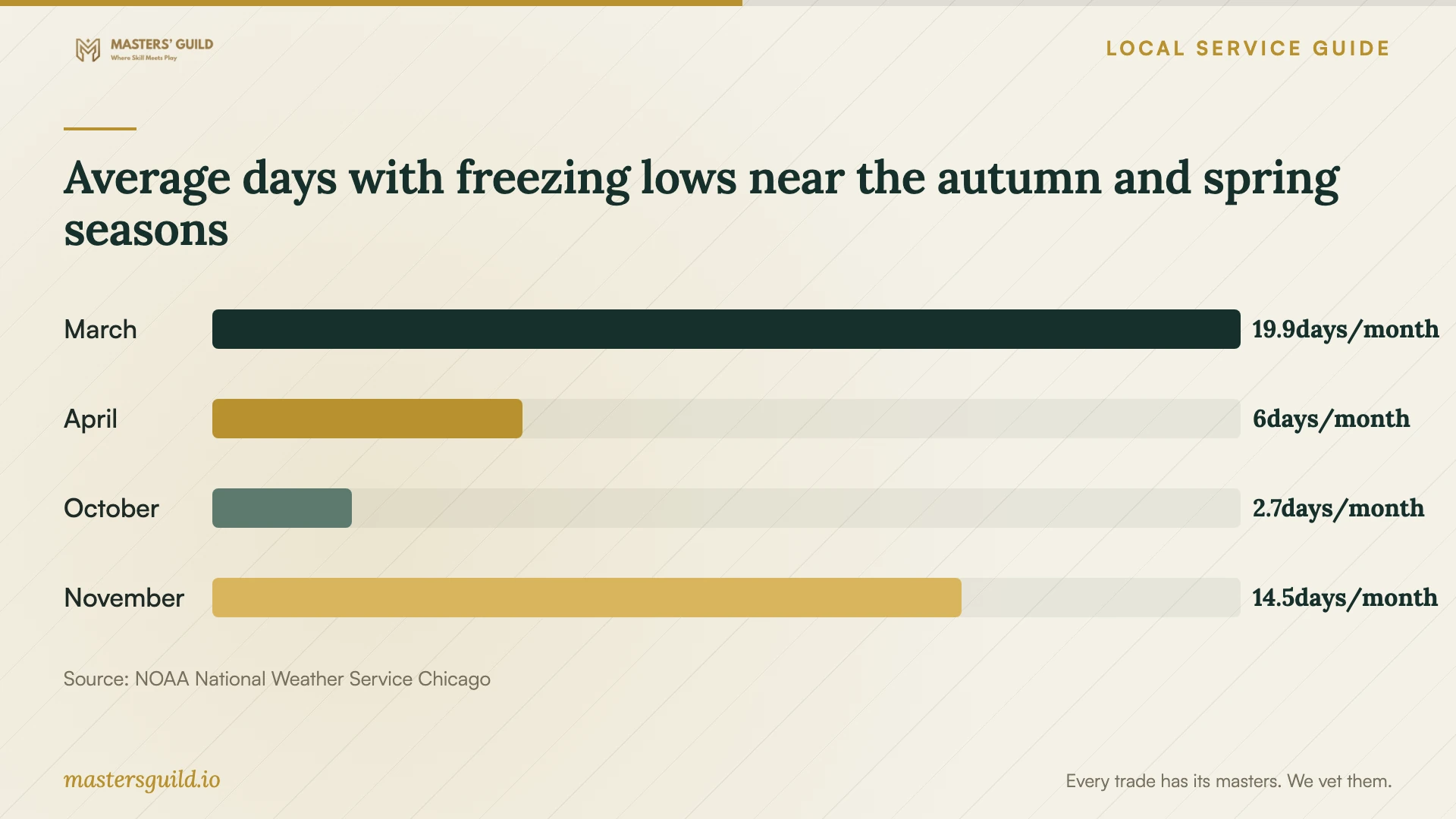
NWS reports an average of 2.7 October days and 14.5 November days with lows at or below freezing at O’Hare during 1991–2020. For an autumn project, ask the contractor to explain weather postponement criteria, protection during curing, and any associated charges. Use the current forecast when confirming the pour date. [4]
Ask who will protect the work if rain or cold arrives and who will decide whether to postpone. Arrange another entrance or parking location before removal begins. For a shared property, obtain the relevant owner or association agreement on scope, access, and payment before booking the crew.
Average days with freezing lows near the autumn and spring seasons
Local details that affect your job
A sidewalk program may change your purchasing decision
CDOT offers a voluntary Shared Cost Sidewalk Program in which property owners share repair costs with the City. Senior citizens and persons with disabilities may qualify for a further discount. The published 2026 application window was January 12, from 6 am to 10 pm, so that window has passed as of October 13, 2026. Ask CDOT about the next announced intake before choosing whether to wait or arrange private work. The City describes first-come applications, funding limits, and applications through 311, its service request website, or CHI311. [2]
A sloped driveway needs a documentation discussion
CDOT’s instructions require a surveyor’s engineers report for driveways with a slope. If your project has a slope, assign responsibility for that report before accepting the bid. For new construction involving a driveway entering or exiting a building, also discuss the required elevation copies. Ask whether the contractor’s price includes obtaining these documents or only performing the concrete work. [1]
Separate homeowner and contractor insurance checks
The residential driveway application calls for homeowner liability coverage of $250,000 with the City added as an additional insured. The contractor directory separately includes the contractor’s insurance expiration field. Discuss the application certificate with your insurer and request current coverage documentation from the contracting business. [1] [3]
Choose the next step for your concrete project
| Project situation | Next step | Resolve before signing |
|---|---|---|
| Private patio or walk | Request a site assessment and written scope. | Repair versus replacement, finished elevations, drainage, and access. |
| Residential driveway | Consult CDOT’s driveway application instructions. | Survey or drawing, photograph, homeowner insurance, and who prepares the application. |
| Sloped driveway | Discuss the surveyor’s engineers report listed by CDOT. | Who obtains the report and whether the bid includes its cost. |
| Public sidewalk repair | Ask about the next Shared Cost Sidewalk Program intake. | Whether to wait for an announced opportunity or arrange private work. |
| Autumn pour | Request a weather protection and postponement plan. | Protection charges, revised dates, and alternate access. |
Your hiring checklist
- Photograph the slab, curb cut, apron, sidewalk, and nearby drainage concerns.
- Give bidders the same project boundaries and intended use.
- Assign application preparation, surveys, insurance certificates, and submission responsibilities.
- Match the contracting business name and license number to the City directory.
- Request a written scope for removal, base preparation, concrete specifications, finish, and cleanup.
- Agree on weather delays, protection costs, access arrangements, and return-to-use instructions.
- Record payment milestones, change approval procedures, and warranty terms.
Frequently Asked Questions
Does the driveway application fee cover the whole project?
CDOT lists a $10 application fee. Treat that as the listed application charge when reviewing a quote. Ask the contractor to identify concrete work, surveying, document preparation, and any other charges as separate items. [1]
Can I apply for the listed 2026 sidewalk program now?
The City’s page announced applications for January 12, 2026, from 6 am to 10 pm. That window has passed. Ask CDOT about the next announced intake rather than assuming the program accepts applications throughout the year. [2]
How can I check a proposed general contractor?
Ask for the business’s exact name and license number. Compare them with the City’s active and inactive general contractor directory, including license expiration, insurance expiration, and inactive status. Request current insurance documents and project references as additional hiring checks. [3]
How long should I keep cars off a new driveway?
Ask the contractor to give written return-to-use instructions for the concrete mix, placement conditions, and intended loads. Agree on a parking alternative before work begins, and request confirmation before driving onto the new surface.
Sources and scope
This guide combines the sources below with practical planning guidance. Figures apply to the stated geography and period; request a written quote for your property.