
Local service guide
Cheyenne pest control: Hiring and Planning
Arrange pest control in Cheyenne by identifying the pest, checking the proposed applicator’s Wyoming credentials and agreeing on a written scope before booking. Separate treatment from entry-point repairs and contamination cleanup. The Wyoming Department of Agriculture provides a private and commercial applicator search; use it to check the person who will apply pesticides and discuss their relevant categories. [1]
Identify what needs treatment
Start with identification before selecting a treatment package. University of Wyoming Extension Entomology identifies insects and related arthropods from homes and yards and provides pest-specific integrated pest management recommendations when control is warranted. Its staff say good photographs and details about the specimen’s location and activity can speed identification. [5]
Give the contractor photographs, an affected-room list and a history of earlier treatments. Have them explain what evidence supports their identification and which areas they need to inspect. If they cannot identify the pest from your description, agree on an inspection step before authorizing treatment.
Verify the applicator’s Wyoming credentials
Get the name of the person who will apply pesticides and check their entry in the Wyoming Department of Agriculture’s license search. The department requires new commercial applicants to complete a general examination and supporting examinations for each pesticide category. Have the applicator explain how their categories relate to your proposed work. [1]
For a contractor coming from Colorado, verify their Wyoming credential. Wyoming lists Colorado among states eligible for reciprocal commercial licensing, but applicants must complete Wyoming’s process and meet its requirements. Do not treat eligibility for reciprocity as proof that an applicant has received a Wyoming license. [1]
Keep proof of liability insurance with the proposal. Before setting the appointment, review product names, application locations, preparation steps and instructions for people and pets returning to treated areas. Resolve any instructions you cannot carry out before committing to the work.
Compare the work behind the price
Request property-specific written quotes to build your budget. Give bidders the same description of the problem and access to affected rooms, sheds, garages or crawlspaces. Have each bidder identify work they cannot price until inspection.
Separate inspection, initial treatment, return visits and any recurring service. For rodents, include entry-point repairs, trap checks, carcass removal and contamination cleanup as distinct tasks. Name the person responsible for each task so you can arrange any work the pest-control company excludes.
For a continuing plan, compare visit frequency, minimum term, cancellation charges and total payment obligation. Agree on how the contractor will assess progress and what happens if activity continues. Keep any return-visit conditions with the signed proposal.
Arrange rodent cleanup before moving belongings
Cheyenne Laramie County Public Health warns about rodent contamination when residents open sheds, garages and cabins closed through winter. Its undated advisory describes the danger of breathing contaminated dust and tells residents to avoid sweeping or vacuuming. Ask Environmental Health for current precautions before planning your own cleanup. [4]
Pause the cleanout if you find droppings or nesting material. Tell the contractor where you found them and arrange a cleanup assessment before disturbing stored belongings. Define which surfaces, belongings and disposal tasks the cleanup crew will handle.
Choose mosquito work around the water source
Inspect water-holding areas before buying yard treatment. Local public health guidance recommends draining standing water, clearing gutters and changing bird-bath or wading-pool water at least once a week. It notes that larvae can develop into adult mosquitoes in as little as 7 to 10 days in warm weather. [3]
Have the contractor distinguish water you can remove from water that needs another approach. The local program describes Bti as a larval-control option when breeding areas cannot be eliminated and lists the health department and local farm and ranch suppliers as purchase sources. Confirm current availability and suitability before buying a product. [3]
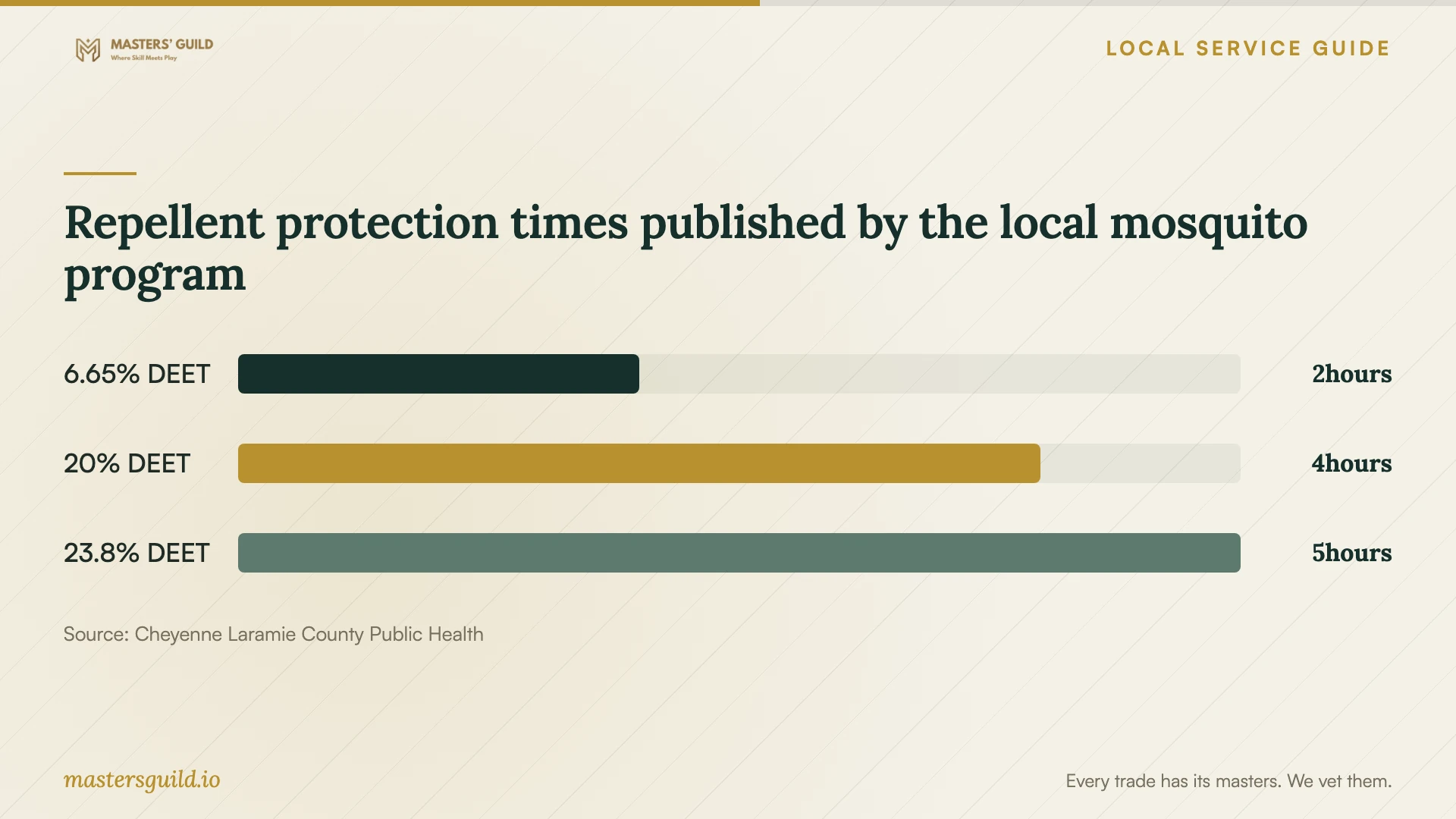
Use the repellent chart as a published planning reference for time outdoors while you address breeding areas. Read the label on the product you choose for its protection period, permitted uses and reapplication instructions. [3]
Repellent protection times published by the local mosquito program
Local details that affect your job
Public-area mosquito concerns have a local route
Cheyenne Laramie County Public Health lists mosquito control in public areas, education and surveillance under its West Nile Virus Program. Environmental Health lists 307-633-4090, and Cheyenne Weed and Pest lists 307-637-6475. Describe the location and confirm which agency handles it before paying for work involving a nearby public area. [3]
Wyoming identification help can precede a purchase
University of Wyoming Extension Entomology offers household and yard arthropod identification across Wyoming. Use this regional resource for an uncertain specimen before approving treatment. Send clear photographs plus the discovery location and feeding or activity details; the university lists 307-766-2508 for its department contact. [5]
Discuss contamination before emptying a closed shed
The local health authority flags winter-closed outbuildings as places requiring hantavirus precautions. If your job involves one of these structures, include contamination cleanup in the planning discussion before emptying it. Environmental Health lists 307-633-4090 for further guidance. [4]
Choose the next step for your situation
| Situation | Next step | Resolve before booking |
|---|---|---|
| Unidentified insect | Use the university’s identification service. | Does the identified pest warrant control? |
| Rodent waste in a closed shed | Leave waste undisturbed and arrange a cleanup assessment. | Who handles contamination and disposal? |
| Mosquitoes around a public area | Contact the local mosquito program. | Which agency handles that location? |
| Applicator coming from Colorado | Verify Wyoming credentials. | Has the person obtained Wyoming authorization? |
Your hiring checklist
- Photograph insects and affected areas without handling specimens or disturbing waste.
- Record discovery locations, affected rooms and earlier treatments.
- Verify the proposed applicator’s Wyoming credentials and discuss relevant categories.
- Compare itemized proposals and proof of liability insurance.
- Review preparation, access and return-to-area instructions.
- Assign responsibility for repairs, cleanup and disposal.
- Keep the service record, invoice and return-visit terms together.
Frequently Asked Questions
Do I need a recurring pest-control plan?
Have the contractor explain the purpose of each scheduled visit and how they will decide whether treatment should continue. Compare that proposal with an initial service and a defined reassessment. Choose an agreement whose scope and payment terms you understand.
Can I vacuum mouse droppings before the appointment?
Avoid sweeping or vacuuming rodent waste. Local public health guidance warns about contaminated dust. Leave the material undisturbed and arrange cleanup before preparing the area; consult Environmental Health for current precautions if you plan to handle it yourself. [4]
Does the mosquito program cover my private yard?
The published program lists mosquito control in public areas. Confirm coverage for your location with Environmental Health or Cheyenne Weed and Pest before assuming it includes private-yard treatment. [3]
How should I prepare for the inspection?
Provide photographs and a description of affected areas, then follow the contractor’s access instructions. Mention pets and any preparation limits when scheduling. For rodent contamination, agree on cleanup arrangements before moving belongings.
Sources and scope
This guide combines the sources below with practical planning guidance. Figures apply to the stated geography and period; request a written quote for your property.