
Local service guide
Tax Preparation and Accounting in Charlotte, NC
Arrange Tax Preparation and Accounting in Charlotte, NC by asking for a written scope that names your business and personal returns, any other-state filings, bookkeeping cleanup, and payroll duties. Interview the person who will handle the work, compare their experience with your needs, and verify any CPA credentials. The North Carolina CPA Board recommends a written engagement letter identifying the work, staff, and cost before work begins. [2]
Choose the work you need before comparing providers
Write a short description of your business, its ownership, the tax year you need help with, and the records you have. List any personal return work alongside the business work. Ask each provider to identify the returns and accounting tasks they propose to handle, then request separate prices for initial cleanup and ongoing service.
For ongoing bookkeeping, agree on who reconciles accounts, resolves missing transactions, and reviews the reports with you. For return preparation, name the person who will answer questions and explain the completed return. Ask the provider to describe what you must deliver before they can commit to a completion date.
The NC CPA Board recommends asking prospective CPAs what accounting work they perform and comparing that experience with your needs. It also recommends asking about year-round availability. Use those questions to assess whether the provider can support you after filing, particularly if you want help with a notice or a change in your business. [2]
Verify credentials and put the agreement in writing
If a provider uses the North Carolina CPA title, check their license status in the Board’s database and confirm that it is current and active. Check applicable firm registration and any public enforcement documents. North Carolina also permits qualifying CPAs licensed in other US jurisdictions to serve clients under practice privileges, so ask an out-of-state CPA which jurisdiction licenses them. [2]
Before a CPA starts work, obtain an engagement letter. The Board says it should identify the services, the employees who will perform them, and the cost. If the firm outsources work, ask how it protects your private information. Add your own questions about document transfer, access to records, and who approves additional work. [2]
Keep copies of the agreement and your communications about changes to scope or fees. The Board investigates potential violations of CPA statutes and rules, but it does not adjudicate private fee disputes or award damages. A written agreement gives you a record of what you and the provider accepted. [2]
Make other-state income and relocation part of the intake
Tell the preparer where you lived and where you earned income during the year. NCDOR’s 2025 filing guidance distinguishes residents, part-year residents, and nonresidents. It directs qualifying part-year residents and nonresidents with North Carolina-source income to use Schedule PN to determine the share subject to North Carolina tax. Ask the preparer to use guidance for the year you are filing. [3]
For a North Carolina resident with qualifying income taxed by another state, NCDOR allows a credit subject to eligibility and calculation limits. The department instructs taxpayers to complete the other-state return before the North Carolina return. Give the preparer the other-state return and proof of tax payment; ask them to account for any refund received or expected when calculating the credit. [1]
For work spanning North Carolina and South Carolina, ask the provider to explain which filings they will assess and include in the quote. Bring a dated record of moves and work locations rather than asking the provider to infer them from an employer’s mailing address.
Assign payroll duties and compare complete quotes
NCDOR requires a business planning to employ staff to register for a North Carolina withholding identification number through Form NC-BR. A federal employer identification number does not replace that state number. The department assigns withholding filing frequency based on the amount withheld and requires withholding taxpayers to file the annual NC-3 reconciliation. [4]
Ask who will register the account, monitor department correspondence, submit returns, and initiate payments. Request a written calendar and a named backup contact. NCDOR says employers remain liable for tax they fail to withhold or pay, so review the provider’s confirmation of each assigned filing and payment. [4]
Use written provider quotes to plan your budget, and compare them using the same list of deliverables. Ask whether the fee covers state returns, cleanup, payroll reconciliation, meetings, and responses to notices. Have the provider state the charge for added work and the point at which they must seek your approval.
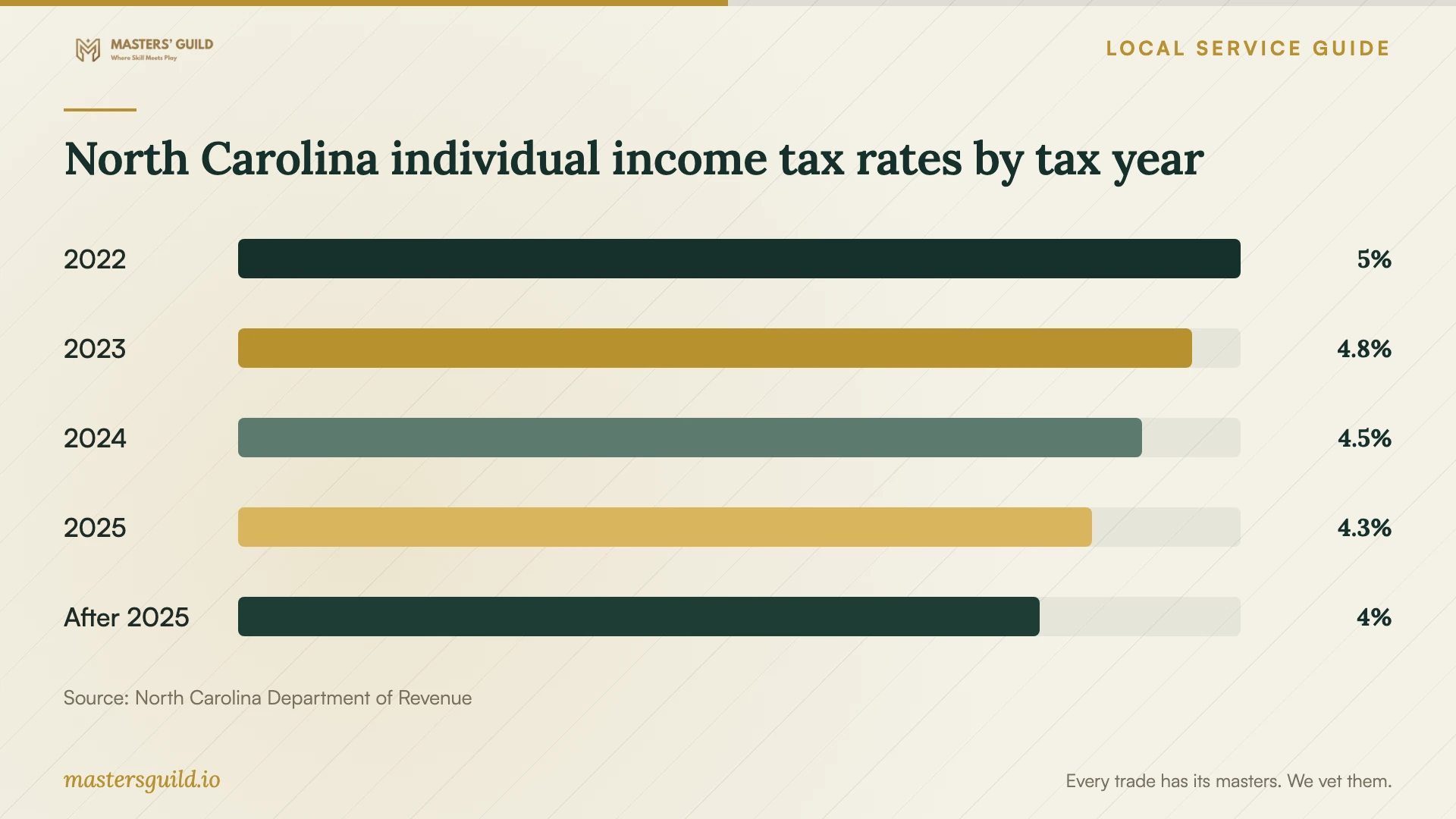
North Carolina individual income tax rates by tax year
Local details that affect your job
North Carolina residents with South Carolina income
If you live in Charlotte and have qualifying South Carolina-source income that both states tax, ask your preparer to assess North Carolina’s other-state income tax credit. NCDOR limits the credit and requires the other-state return plus proof of payment. Include that calculation and documentation in the agreed scope; withholding alone does not establish the credit amount. [1]
A move into or out of North Carolina changes the intake
For a 2025 return, NCDOR treats someone who became or ceased being a North Carolina resident during the year as a part-year resident. Its guidance calls for Schedule PN for part-year residents with North Carolina-source income. Give the preparer your move dates and income records, and ask them to assess filing requirements before quoting a single-state return. [3]
North Carolina payroll needs a separate state account
A Charlotte business hiring employees must obtain a North Carolina withholding identification number through Form NC-BR. NCDOR charges no fee for that number and does not accept the federal employer identification number in its place. Ask whether your accounting engagement includes registration and who will handle the assigned filing frequency. [4]
Match your situation to the engagement
| Your situation | Work to discuss | Question before hiring |
|---|---|---|
| Annual returns with organized records | Named business and personal returns | Which returns, review meetings, and follow-up questions does the fee cover? |
| Unreconciled business accounts | Bookkeeping cleanup before return preparation | How will you assess cleanup and obtain approval for added charges? |
| North Carolina residence with other-state income | Other-state return and potential NC credit | Will you calculate the credit and collect proof of tax payment? |
| Move into or out of North Carolina | Tax-year-specific residency assessment and Schedule PN where required | Which dates and income records do you need to establish filing scope? |
| Employees on payroll | NC withholding account, recurring filings, and NC-3 reconciliation | Who files, pays, and monitors changes to filing frequency? |
Your hiring checklist
- Describe your business, ownership, requested tax year, and personal return needs.
- List residence changes, work locations, and income from other states.
- Gather prior returns, income statements, account records, payroll reports, and tax notices.
- Ask the provider which missing records you must supply before work starts.
- Verify any CPA credentials and review applicable firm and disciplinary records.
- Obtain a written scope, price, completion plan, and process for approving added work.
- Assign responsibility for payroll filings, payments, correspondence, and record access.
Frequently Asked Questions
How can I check a CPA before hiring?
Use the NC CPA Board’s consumer guidance to check current active license status, applicable firm registration, and public enforcement documents. For an out-of-state CPA, ask about their licensing jurisdiction and eligibility to practice in North Carolina. [2]
Does another state’s withholding determine my North Carolina credit?
NCDOR says to calculate the credit using tax paid to the other state less any refund received or expected, subject to the credit limits. Give your preparer the other-state return and proof of payment rather than relying on the withholding figure. [1]
Can my accountant use my federal EIN for NC withholding?
NCDOR requires a separate North Carolina withholding identification number obtained through Form NC-BR. Ask your accountant to confirm registration and identify who will handle the recurring returns and annual reconciliation. [4]
What should I ask about the preparation fee?
Ask for the price of each agreed service, the assumptions about your records, and the charge for additional work. Have the provider identify whether cleanup, other-state returns, payroll work, and notice responses belong in the engagement.
Sources and scope
This guide combines the sources below with practical planning guidance. Figures apply to the stated geography and period; request a written quote for your property.