
Local service guide
Snow Removal in Charlotte, NC: Hiring and Planning
Arrange Snow Removal in Charlotte, NC with a written quote covering your driveway, entrance, steps, and walking route, plus treatment, materials, minimum charges, and return visits. Choose a per-event or seasonal agreement according to the access commitment you need. Check who maintains the road outside your home: NCDOT excludes sidewalks, driveways, and driveway entrances from its snow-clearing service, so include those areas in your private arrangement if your property fronts a state-maintained road. [1]
Choose a plan around the access you need
Start with the route you need to use, from your door to a parked car, mailbox, or pickup point. Tell the provider about your departure deadline and ask what response they will commit to. Include a contact method for delays and decide who you will call if the crew cannot reach your home.
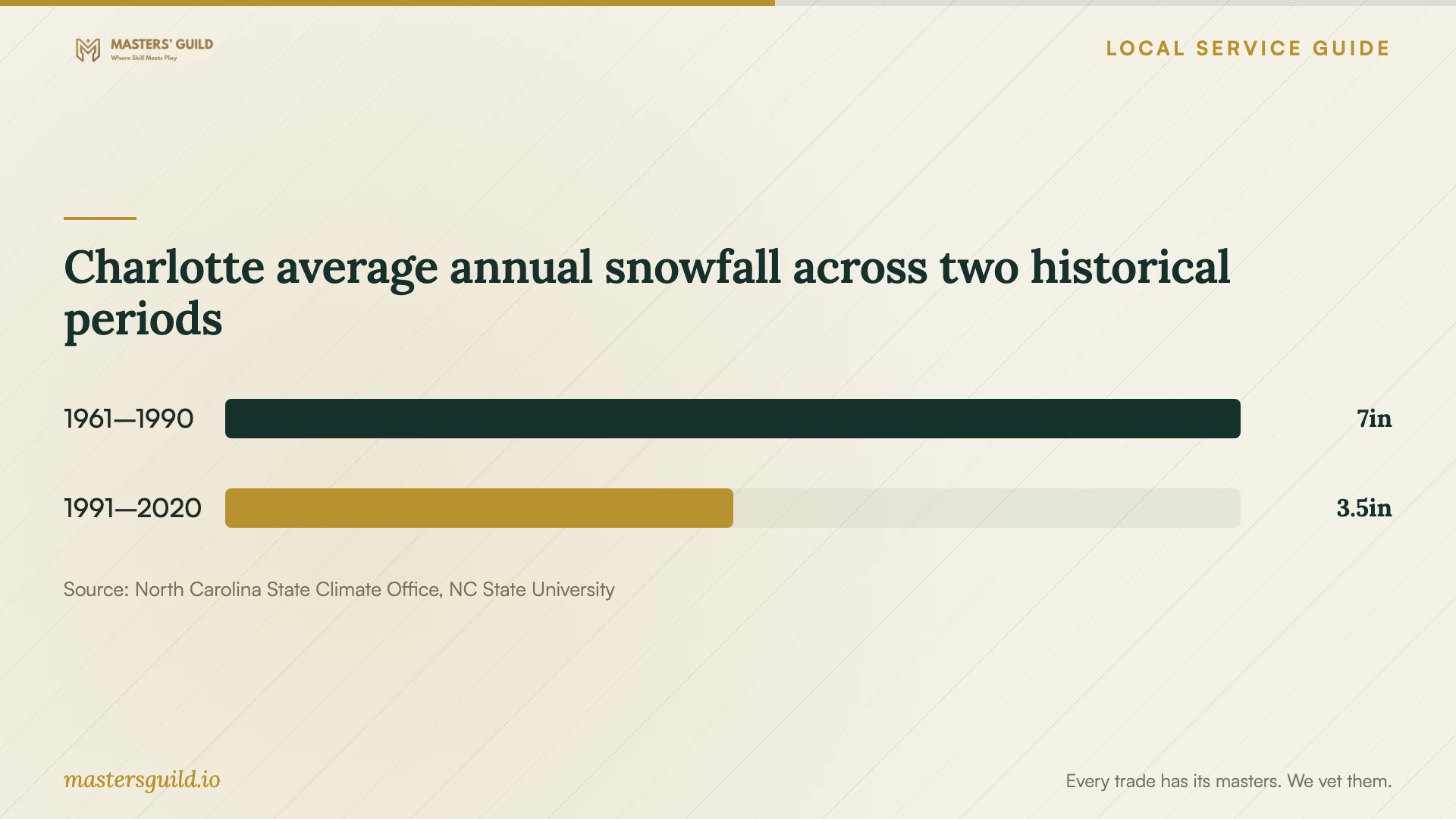
The North Carolina State Climate Office reports Charlotte’s average annual snowfall as 7.0 inches for 1961–1990 and 3.5 inches for 1991–2020. These historical averages describe snowfall across each period. They do not establish next winter’s storm depths, ice conditions, or the number of visits your property will require. [2]
Request per-event and seasonal terms if the provider offers both. Ask whether an event price includes repeated clearing during the same storm. For a seasonal agreement, settle visit limits, excluded conditions, cancellation terms, and extra charges. Compare the access commitment and total scope rather than choosing from the plan name alone.
Identify the road authority and its limits
Charlotte’s official street-maintenance GIS layer distinguishes city and state maintenance. It includes a full street-name field and beginning and ending descriptions for segments. Match the segment outside your property before applying NCDOT’s snow-clearing policy; a street name alone may leave the relevant section unresolved. [3]
To arrange a responsibility check, give Charlotte transportation staff your property address, full street name, and the nearest cross streets on each side. Ask them to confirm whether the segment has CITY or STATE maintenance responsibility and to identify its beginning and ending boundaries. Use that confirmation to choose which authority to ask about road-clearing plans. [3]
For state-maintained roads, NCDOT gives first priority to its Bare Pavement System, which generally includes interstates, four-lane divided primary routes, and other essential routes. Other U.S. and N.C. routes follow, then other paved secondary routes, then unpaved secondary routes. Crews follow designated routes; a passing truck does not establish that your street will receive treatment next. [1]
NCDOT does not clear sidewalks, driveways, or driveway entrances. If your home fronts a state-maintained road, include those work areas in your private quote. Ask about a return to clear the entrance after road crews pass, including the charge and the response window. [1]
Define clearing and ice treatment
Send each provider matching photos and a description of the work areas. Mark driveway edges, steps, gates, narrow paths, and your proposed snow-storage location. Have the provider explain which equipment they would use and how they would handle areas that equipment cannot reach.
Ask the provider to name the accumulation that triggers attendance and explain how they measure it. Set separate terms for an ice-only event, treatment after clearing, and a later treatment application. Request the product name, intended surfaces, material charge, and any precautions you should follow around pets or planted areas.
Describe the completion standard in terms you can inspect: the walking route, steps, vehicle space, and entrance you want cleared. Ask what may remain after the visit. Agree on how you will report an unfinished area and whether the provider charges for a corrective visit.
Compare written quotes and prepare the property
Request a written quote for your property, including treatment, materials, minimum charges, and return visits. Give providers the same scope so you can compare totals. Have each provider state whether a second clearing during one storm counts as another billable visit and whether entrance clearing carries a separate charge.
Ask for proof of insurance and identify the business responsible for the work. Confirm who will attend, including any subcontractor. Discuss contact between equipment and paving, edging, or steps, and agree on how the business will document and resolve damage.
Before the visit, move vehicles as agreed, remove loose items, and point out obstacles that snow could conceal. Share gate instructions and a contact number. Photograph the work areas before service and inspect those same areas afterward against your written scope.
Charlotte average annual snowfall across two historical periods
Local details that affect your job
Resolve responsibility for the segment outside your home
Charlotte’s municipal GIS layer records CITY and STATE maintenance categories alongside street names and beginning and ending segment descriptions. For a usable responsibility check, provide transportation staff with your address and nearby cross streets, then request the maintenance category and segment boundaries. If they cannot match the address, ask them to identify the segment using the intersections before you rely on state snow-clearing policy. [3]
Include private access on a state-maintained road
NCDOT excludes driveway entrances, driveways, and sidewalks from its snow and ice service. Name each needed area in the contractor’s quote rather than assuming road crews will clear it. Set a separate return-visit agreement for the entrance and ask the contractor how they will communicate delays while public-road crews follow their designated routes. [1]
Match the agreement to your access needs
| Your situation | Arrangement to compare | Question to settle |
|---|---|---|
| You want help when you request it | Per-event service | What arrival window will the provider commit to after accepting your request? |
| You need a response throughout winter | Seasonal agreement | What triggers attendance, and which visits or weather conditions fall outside the price? |
| Your home fronts a state-maintained road | Service that names the driveway entrance | NCDOT excludes entrance clearing; what will the contractor charge for a return? |
| You need help during an ice-only event | Explicit ice-treatment coverage | Which surfaces, products, materials, and repeat applications will the provider include? |
Your hiring checklist
- Request a street-responsibility check using your address, full street name, and nearby cross streets.
- Send the same property photos and work-area description to each provider.
- Specify your walking route, driveway entrance, and departure deadline.
- Confirm the snow trigger, measurement method, and ice-only coverage.
- Request written clearing, treatment, material, minimum, and return-visit charges.
- Confirm insurance, crew responsibility, and damage-reporting terms.
- Agree on vehicle placement, gate access, obstacles, and snow storage.
Frequently Asked Questions
Will NCDOT clear my driveway entrance?
No. NCDOT does not clear driveways or driveway entrances and does not remove snow and ice from sidewalks. For a property on a state-maintained road, include entrance clearing in your private service scope and settle the terms for a later return. [1]
How do I find out who maintains my street segment?
Give Charlotte transportation staff your address, full street name, and nearest cross streets. Ask for the CITY or STATE maintenance category and the segment’s beginning and ending boundaries. Charlotte’s official GIS layer includes those categories and fields; ask staff to resolve an uncertain match before applying NCDOT policy. [3]
Should I choose a seasonal agreement?
Compare its attendance commitment, included work, and exclusions with a per-event quote. The State Climate Office reports a Charlotte average of 3.5 inches of annual snowfall for 1991–2020. That historical figure does not determine next winter’s visit count or whether an offer meets your access needs. [2]
What should the quote say about another visit?
Have the provider distinguish repeated clearing during a storm, entrance clearing after road crews pass, and another treatment application. Ask for the trigger, charge, and response window for each. Keep those terms with the original scope so you can compare offers and inspect the completed work.
Sources and scope
This guide combines the sources below with practical planning guidance. Figures apply to the stated geography and period; request a written quote for your property.