
Local service guide
Lawn Mowing in Charlotte, NC: Plan Your Service
Arrange Lawn Mowing in Charlotte by asking providers to identify your grass, propose a cutting height, and explain how they adjust visits as growth changes. Request a written scope covering mowing, trimming, edging, cleanup, and clipping handling. NC State Extension recommends growth-based scheduling that limits removal to about one-third of the grass blade; a fixed biweekly plan can leave too much growth between cuts. [3]
Specify the work before comparing quotes
Give each provider the same description of the yard. Include the mowable area, current grass height, slopes, narrow passages, gate clearance, and obstacles. Send photographs of the front and back lawns, access points, and any overgrown areas. Ask the provider to confirm the scope after inspecting the property.
List mowing, string trimming, edging, and clearing clippings from hard surfaces as separate scope items. Identify beds or trees where you want the crew to avoid trimming. Ask whether leaf removal, fallen branches, bagging, and hauling require separate approval and charges.
Request a recurring visit price and a separate first-cut price if the lawn needs catch-up work. For a seasonal agreement, ask how the provider bills skipped visits, extra cuts, rain delays, and periods with little growth. Keep fertilizer, weed control, aeration, and seeding separate unless you intend to purchase them.
Match the schedule to your grass
Ask the provider to explain the proposed interval using your grass and target height. NC State says cool-season grasses grow most strongly in spring and fall, while warm-season grasses grow best in summer and go dormant after the first heavy frost. Use those differences when discussing seasonal visits. [3]
For a fescue lawn, ask whether the provider can shorten the interval during spring growth. NC State's fescue calendar recommends removing no more than one-third of the height and notes that mowing may be necessary every five to seven days in late spring. In summer, it recommends a 3.5-inch cut before the grass exceeds 5 inches. [1]
Consider biweekly visits only while growth allows the crew to maintain the agreed height without excessive removal. Ask how you can authorize an extra visit and how much it costs. Avoid agreeing to one interval for the whole season without a way to adjust it. [3]
Check equipment and cutting height
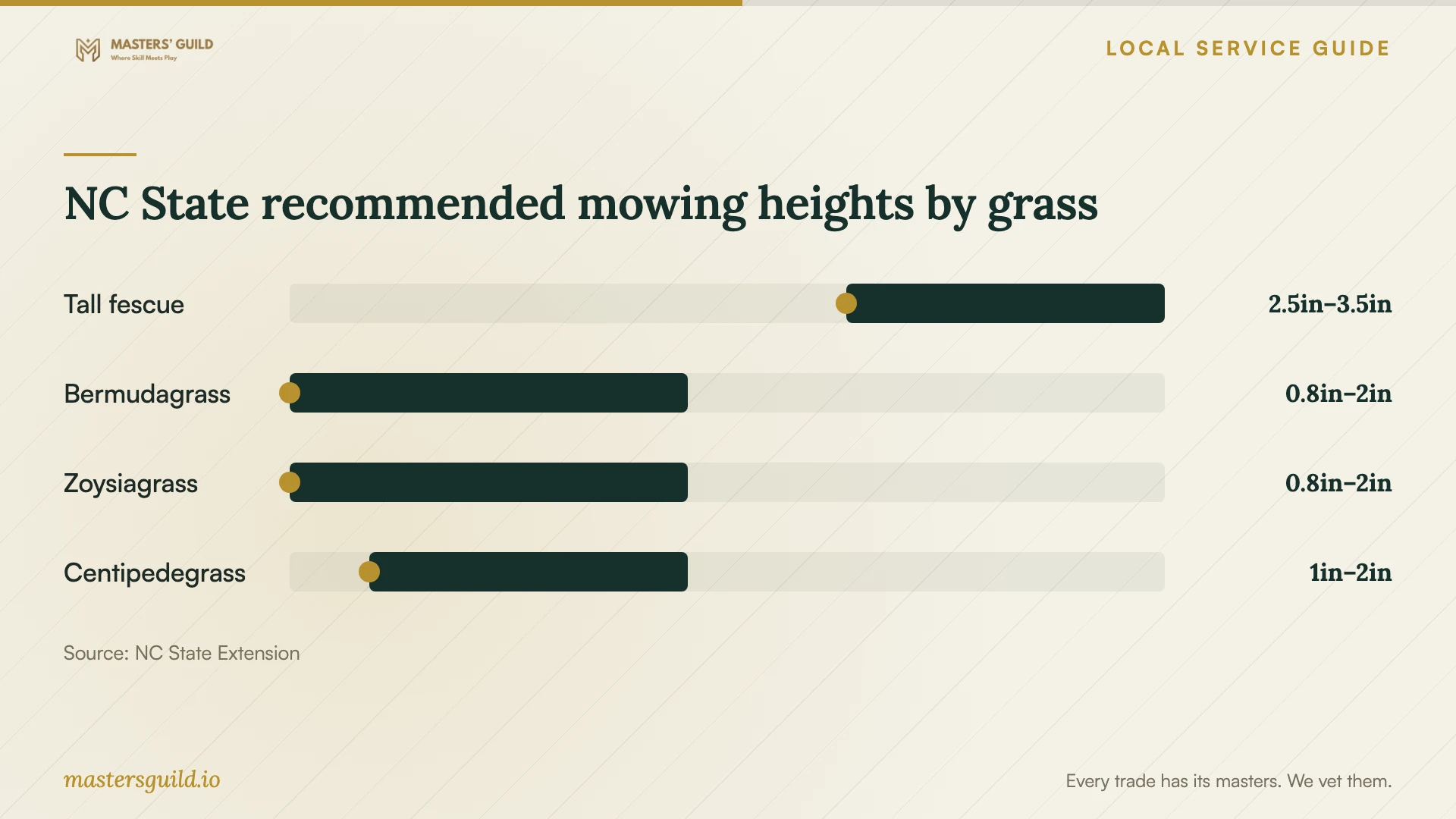
Ask for the intended finished height in inches. NC State's statewide guide lists tall fescue at 2.5 to 3.5 inches and bermudagrass and zoysiagrass at 0.75 to 2 inches. These broad ranges help you question a proposal; the provider should still account for cultivar, season, terrain, and lawn condition. [1] [2] [3]
For a low-cut bermudagrass lawn, ask about mower choice. NC State recommends a reel mower for cuts below 1 inch and a 1-to-2-inch height when using a rotary mower on bermudagrass. It also warns that uneven ground makes mowing below 1 inch difficult. Ask the provider to inspect bumps before promising a low finish. [3]
Ask how the crew maintains sharp blades and handles wet ground. NC State explains that dull blades tear grass and recommends mowing when soil and plants are dry to reduce turf injury and disease spread. Agree on who sends a delay notice and how the crew schedules the replacement visit. [3]
Agree on clippings and overgrown areas
Leave ordinary clippings on the lawn unless there is a reason to collect them. NC State recommends returning clippings to the turf, but advises removing heavy accumulations that shade or hold down the grass. Ask the crew to explain any proposed routine bagging charge. [2] [3]
For an overgrown lawn, request a recovery approach before the crew starts. NC State describes raising the mower for an initial cut and returning a day or two later to reach the proper height. Ask whether the quote includes a return visit and collection of excessive clippings. [3]
Before reusing collected clippings as mulch or compost, disclose recent herbicide treatments and ask the provider to check product-label restrictions. NC State qualifies clipping reuse when herbicide residues could harm trees or shrubs. Specify where the crew may place collected material. [3]
NC State recommended mowing heights by grass
Local details that affect your job
Use North Carolina's seasonal fescue guidance
For a Charlotte property with tall fescue, use the statewide species calendar when setting autumn service expectations. NC State recommends a September-through-November mowing height of 2.5 to 3 inches and fall aeration for lawns subject to heavy traffic or grown on clay soils. If you want aeration, request a separate assessment rather than adding it to every mowing visit. These are regional recommendations, not findings about your property's soil. [1]
Check the Piedmont seeding window before adding renovation
NC State's Piedmont table lists September 1 through October 1 as the optimum tall-fescue planting period and warns that seeding beyond recommended dates increases the chance of failure. For an October 16 service request that includes seeding, ask the provider to explain the timing and risks before approving the addition. This is regional planting guidance, not a prohibition or a site-specific forecast. [3]
Choose a service arrangement
| Your situation | Arrangement to discuss | Reason |
|---|---|---|
| Fescue growing fast in late spring | Weekly service with flexibility for a shorter interval | NC State notes mowing may be needed every five to seven days. |
| Slow growth between visits | A longer interval with an agreed height trigger | NC State bases frequency on growth and cutting height. |
| Low-cut bermudagrass | Confirm mower type and terrain suitability | NC State prefers reel mowing below 1 inch. |
| Overgrown grass with heavy clippings | A recovery quote covering follow-up cutting and collection | NC State describes staged cutting and removal of excessive clippings. |
Your hiring checklist
- Send photographs and describe the mowable area, current height, slopes, and obstacles.
- Measure gate clearance and identify the crew's access route.
- Ask the provider to identify the grass and write down the target cutting height.
- Confirm mowing, trimming, edging, and hard-surface cleanup in the quote.
- Agree on extra visits, rain delays, skipped cuts, and billing.
- Separate first-cut work, clipping removal, and optional treatments.
- Remove toys and pet waste; mark irrigation heads and vulnerable plants.
- Disclose recent herbicide treatments before approving clipping reuse.
Frequently Asked Questions
How much should I budget for mowing?
Obtain property-specific written quotes for matching scope and frequency. Ask providers to separate recurring visits, the initial overgrown cut, clipping removal, and optional treatments. Compare the billing terms as well as the visit price.
Can I choose biweekly mowing?
Yes, if growth allows the provider to maintain the target height without removing too much grass. NC State recommends limiting removal to about one-third of the blade. Ask for a way to add visits during faster growth. [3]
Should the crew bag the grass?
NC State recommends leaving ordinary clippings on the lawn and collecting excessive clippings that could shade or smother turf. Before composting or reusing collected material, check recent herbicide treatments and label restrictions. [3]
Should mowing continue through winter?
Base visits on grass type and growth. NC State says warm-season grasses go dormant after the first heavy frost, while cool-season grasses remain green through much of winter. Its fescue calendar includes winter mowing at 3 inches and removal of leaves and debris. [1] [3]
Sources and scope
This guide combines the sources below with practical planning guidance. Figures apply to the stated geography and period; request a written quote for your property.